The Travelling Symphony refuses the prophet and flees St. Deborah
Station ElevenThe Travelling Symphony refuses the prophet and flees St. Deborah is the moment when a performance becomes a test of power: The Prophet publicly casts the Georgia Flu as divine purpose, then privately presses The Conductor to surrender Alexandra. The Conductor's unequivocal refusal ends the troupe's brief stay. The departure is not simply a change of itinerary; it reveals the danger beneath the town's orderly applause and turns the Symphony's encounter with its audience into an immediate escape.
The Sermon and Its Audience
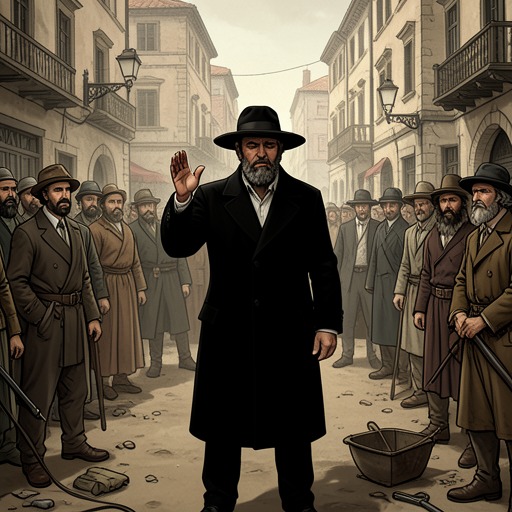
The confrontation begins after the Travelling Symphony has performed. The Prophet steps among the actors and musicians, calls the spectacle a beautiful respite, and leads the audience in thanking them. The applause comes again on cue, quieter than before, and stops when he raises his hands. The crowd's readiness to follow his gestures gives his address the character of a managed gathering rather than an open exchange. The Conductor stands very still beside the string section while he speaks.
The Prophet frames survival as evidence of a design. He asks why those present were spared and asserts that everything that has happened on earth has happened for a reason. He then applies this claim to the pandemic itself, asking his listeners to consider the virus's perfection. Recalling earlier outbreaks, he presents the 1918 influenza as divine punishment for the waste and slaughter of the First World War, contrasts it with later seasonal flus that mainly killed the very old, the very young, and the very sick, and describes the Georgia Flu as a radically different force. The speech transforms the catastrophe from a disaster to be endured into a message to be interpreted according to The Prophet's authority.
That rhetoric also changes the meaning of death. When The Conductor speaks of physical deaths she has witnessed, The Prophet answers that he means the death of the soul as well as the body. He says he saw his mother die twice, then explains that people who leave without permission are treated as dead by the community: the town holds funerals for them and marks their graves. His definition makes departure more than movement across a boundary. In his system, leaving without consent is a severance from the living community, one that the remaining people formally enact as death.
The Demand and Refusal
After describing those who leave as dead, The Prophet glances toward Alexandra, who is collecting flowers from the stage, and speaks privately into The Conductor's ear. The precise words are not heard in that exchange, but the subsequent conversation supplies their substance: he has suggested that the Symphony leave Alexandra behind as a guarantee of future good relations between the troupe and the town. He is looking for another bride. The apparent hospitality of his public thanks thus gives way to a demand that treats Alexandra as a bargaining instrument and potential wife.
The Conductor steps back and refuses absolutely. Her response is immediate, with no negotiation or attempt to trade another concession. The Prophet stares at her, turns away, murmurs to the archer who had guarded the gas station that morning, and walks off with him. Luli follows. The audience disperses; within minutes, the Symphony is alone in the parking lot. For the first time the troupe can remember, no one stays after a performance to speak with its members. The change is telling: the public welcome has not become open violence in the scene, but its disappearance leaves the performers isolated as soon as The Prophet's favor is withdrawn.
The Flight
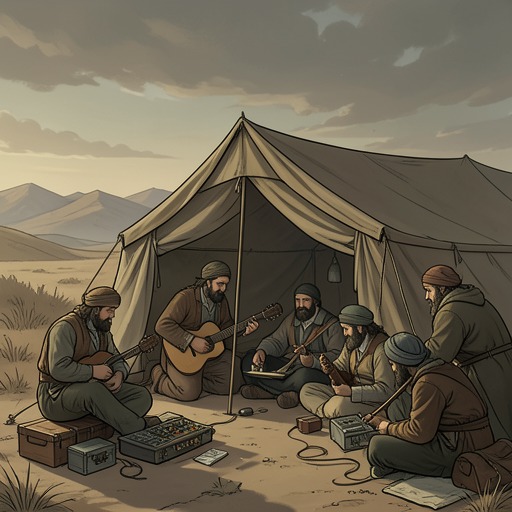
The Conductor responds to that isolation with an order to harness the horses. Alexandra, expecting the Symphony to remain for several days, objects to the sudden departure. The clarinet, while unclipping the backdrop for A Midsummer Night's Dream, identifies the gathering as a doomsday cult and points out that the warning signs were present in The Prophet's speech. The contrast between the dismantled theatrical set and the practical preparations to flee makes the break plain: the performance is over, and the troupe's next task is to get out.
Kirsten later tells August that The Prophet wanted Alexandra left behind and was looking for a bride. Alexandra is walking beside the third caravan, looking up at the stars and unaware of the proposal at the moment Kirsten sees her. The information gives the departure a personal stake beyond the Symphony's broader distrust of the town: refusal has protected Alexandra from being handed over, but it has also made continued hospitality impossible. Kirsten throws her Titania gown into a caravan and changes into the patched cotton dress she wears in hot weather, with the weight of knives at her belt. The theatrical role is put away; the knives remain part of the practical world of the road.
The Route and the Consequence
After midnight, the Symphony stops to rest. Jackson and the second oboe ride back along the road for a mile and return with the report that no one appears to be following. The troupe is not shown in a battle or a pursuit; its escape consists of urgent preparation, cautious checking, and choosing a way forward while uncertainty remains. The absence of pursuers does not undo the reason for leaving, since the demand and The Conductor's refusal have already made a return to ordinary relations unlikely.
The Conductor studies a map with several older members of the Symphony. Their flight has taken them south along the eastern shore of Lake Michigan, in an awkward direction. The most direct routes toward their usual territory would require them either to pass through St. Deborah by the Water again, go near a town known to shoot outsiders on sight, or head inland through a wilderness designated a national forest before the collapse. The episode therefore closes not with the troupe safely back on its familiar route, but with a new logistical problem created by its refusal. The Symphony preserves its freedom to leave and refuses to sacrifice Alexandra, while the map makes clear that escape has narrowed its choices.