The Travelling Symphony sets out
Station ElevenThe Travelling Symphony sets out as both a departure into uncertainty and the beginning of a durable cultural community. Formed five years after the Collapse, it emerged from the first years of mass movement, when survivors had not yet accepted that there was nowhere they could walk to in order to find life unchanged. Its journey began as a response to a world in which settled life and familiar infrastructure had been shattered; over time, it became a means of bringing music and theatre between the communities that took shape afterward.
Origins in a Changed World
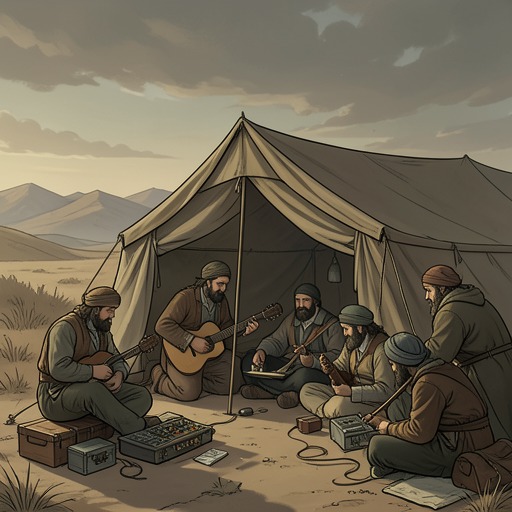
The Georgia Flu swept across the earth with catastrophic speed, and the shock of the Collapse followed. At first, people travelled in search of somewhere life might continue as before. They eventually settled in clusters, often in truck stops, former restaurants, and old motels, gathering near others for safety. The Symphony’s formation belongs to the unsettled interval between flight and resettlement: the Conductor gathered friends from her military orchestra, left the air base where they had been living, and set out into unknown territory.
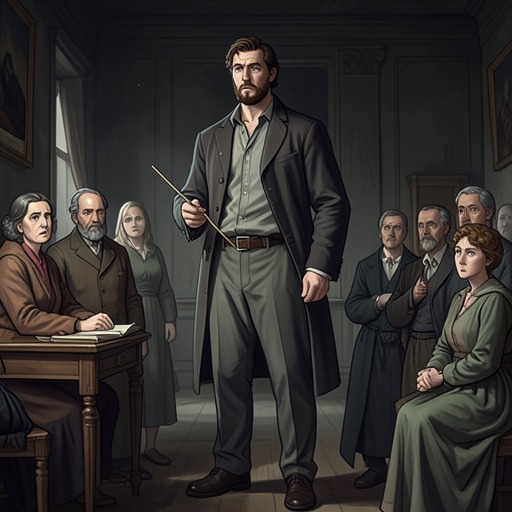
The first journey did not remain a purely military-orchestral venture. After six months of moving from place to place, the musicians encountered a company of Shakespearean actors who had escaped from Chicago together. The actors had worked on a farm for several years and had been travelling for three months. The two groups combined their operations, joining musical and theatrical work in a single travelling company. The partnership grew out of distinct histories of escape and survival, but gave both groups a shared purpose on the road.
Routes and a Changing Pattern of Movement
The Symphony’s mobility was shaped by the practical limits of the new world. By Year Three, gasoline had gone stale, and people could not keep walking indefinitely. Most survivors had therefore settled somewhere by the time the troupe began establishing a regular circuit. Its movement was neither endless flight nor a return to pre-Collapse travel: it connected small settlements, some consisting of only four or five families living together in a former truck stop.
Twenty years after the Collapse, the Symphony was still in motion, travelling along the shores of Lake Huron and Lake Michigan. Its route reached west to Traverse City, east and north beyond the 49th parallel to Kincardine, and south along the St. Clair River to the fishing towns of Marine City and Algonac before turning back. The territory was mostly tranquil, and other travellers were rare, usually peddlers carrying miscellaneous goods between towns. The long circuit shows how the original departure became a recurring practice: the troupe moved through a world that had largely settled, linking communities without abandoning its own itinerant life.
Performance as the Purpose of the Journey
The Travelling Symphony carried music and theatre together. Its repertoire included classical and jazz music, orchestral arrangements of pre-Collapse pop songs, and Shakespeare. The troupe sometimes performed more modern plays in its early years, but audiences proved especially receptive to Shakespeare. In the changed landscape, an old play could speak with renewed force: during a performance of A Midsummer Night’s Dream in a parking lot at St. Deborah by the Water, Kirsten Raymonde played Titania beneath candlelight, with Lake Michigan a half mile away. The scene made performance part of the community’s present rather than a mere recollection of the lost world.
The caravans made the troupe’s purpose visible as it travelled. All three bore the name The Travelling Symphony in white lettering, while the lead caravan carried the additional motto, “Because survival is insufficient.” The words frame the journey as more than a means of reaching the next settlement. Movement carried performances to audiences, and those gatherings offered something beyond subsistence in a society rebuilt from scattered survivors.
Continuing the Departure
The Symphony’s departure remained a repeated condition rather than a single founding moment. After staying five weeks at Severn City Airport, where the troupe rested, repaired its caravans, and performed Shakespeare and music on alternate evenings, it left on a bright September morning. The performances left traces in the people who stayed behind: one person hummed a Brandenburg concerto while working in the gardens, another whispered Shakespeare while sweeping the concourse, and children practised swordplay with sticks. The troupe carried its art and weapons onward, while the community retained fragments of its visit.
That later departure echoes the Conductor’s first decision to leave the air base, but its circumstances had changed. The Symphony was no longer setting out from the earliest years of upheaval; it was travelling from a settled community toward unfamiliar territory, with traders’ reports offering some reassurance about the route. Across those departures, the troupe’s defining action is not simply leaving one place for another. It is continuing to make a life in motion, carrying a repertoire that can be performed anew wherever people gather.