The clarinet’s escape and warning
Station ElevenThe clarinetist’s escape and warning turn a captivity into a change of course for the Travelling Symphony. After she and Sayid are seized by the Prophet’s followers, she slips away despite illness and the restraints placed on her, then reaches the troupe’s rear scouts with news that the road ahead is unsafe. The warning arrives as a storm complicates the search for Kirsten Raymonde and August, and The Conductor responds by redirecting the whole company inland toward Severn City Airport.
Capture and the Threat to the Symphony
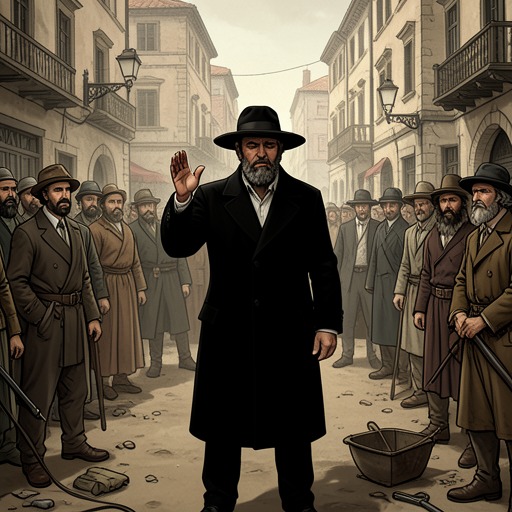
The episode begins with the clarinetist and Sayid held by the Prophet’s followers. The captors describe their method as a practiced one: they move silently, attack from behind, and have used that training to disarm ten towns and take two of their leader’s wives. The threat is not confined to the two prisoners. The attackers tell Sayid that they can kill members of the Symphony one by one from the forest unless the company exchanges the captives. Their advantage lies in surprise and familiarity with the terrain, not in numbers alone.
The clarinetist is bound and weakened by whatever the captors used to incapacitate her. Sayid is tied nearby, and he keeps the attackers’ attention by questioning their account of being the light. The exchange gives the clarinetist time to work at the knot around her ankles. The episode’s narrow opening depends on both prisoners’ actions: Sayid holds the conversation, while she uses the opportunity to free herself. Her escape is therefore not a simple flight from captivity but a coordinated response to a threat that extends beyond the clearing to the rest of the troupe.
Escape and the Warning
The clarinetist’s ability to disappear into the trees has a history behind it. She is one of the Symphony’s best hunters and survived alone in the forest for three years after the collapse. Even sick and with her wrists still bound, she can move away from the clearing with little sound. The escape draws on a skill that has kept her alive before; illness makes the journey harder but does not erase that competence.
She reaches the road and continues through the night into morning, alternating between running, walking, and stumbling as her condition worsens. She is also hallucinating and dreaming of water. Eventually she falls into the arms of the Symphony’s rear scouts. Her message is brief and practical: the group must change its route. It is not a general warning about the Prophet’s beliefs but information that requires immediate action. Once the scouts carry her back, the road ahead has only just been cleared of a tree, making the decision to abandon it consequential rather than hypothetical.
A Route Changed Under Pressure
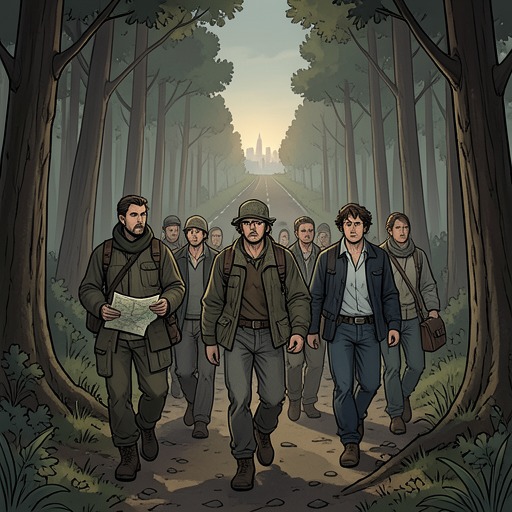
The Conductor orders an immediate change of course after hearing the warning. Scouts are sent to find Kirsten Raymonde and August, who are fishing somewhere along the road ahead, but the storm prevents the search party from locating them. The Symphony therefore has to choose between delaying its movement to regroup and responding to the danger the clarinetist has reported. It veers inland, taking a circuitous combination of back roads that will eventually lead to Severn City Airport. The account establishes the intended destination, but not that the separated Kirsten Raymonde and August are found at this moment.
The clarinetist travels in the first caravan, slipping in and out of consciousness while Alexandra holds a bottle of water to her lips. The change of route thus carries a direct personal consequence: the person whose warning has altered the company’s plans is brought with it, still recovering, rather than left behind at the site of her escape. Meanwhile, the clearing of the blocked road is rendered moot. A practical obstacle has been removed, but the greater danger makes that newly passable way unusable.
Movement After the Collapse
The rerouting takes place in a world where movement no longer depends on the systems that once made long-distance travel routine. Airplanes remain in places, but they stand dormant on runways and in hangars; abandoned aircraft are repurposed for food storage, and rust marks their exposure. Before the collapse, Clark Thompson could board one of the last flights to leave John F. Kennedy International Airport and reach Severn City Airport by a diversion. The Symphony’s journey, by contrast, depends on roads, scouts, horses, and the ability to judge whether a route is safe.
Its caravans were converted from pickup trucks after gasoline became unusable. Their engines and fuel systems were removed, and teams of horses pull the vehicles on steel and wooden wheels. A bench sits atop each cab for the drivers; the cabs retain doors and difficult-to-break glass, offering children a relatively safe place when the troupe crosses dangerous territory. The three tarpaulin-covered structures bear the Travelling Symphony’s name. These details make the route change more than a line on a map: travel is slow, exposed to weather, and dependent on the people who scout ahead and carry information back. The clarinetist’s warning becomes a form of infrastructure in its own right, allowing a moving community to alter course before the danger on the road catches it.