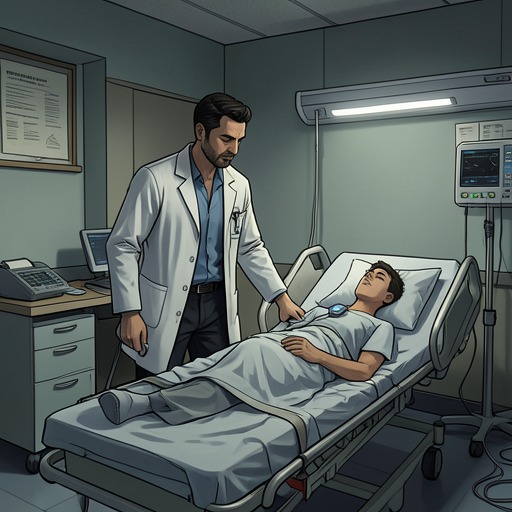
Toronto General Hospital
Station ElevenToronto General Hospital is the first clearly identified Toronto site of the Georgia Flu outbreak and a focal point in the novel’s transition from uncertain news to immediate crisis. The hospital’s rapidly mounting cases, deaths, and isolation order turn a distant health story into evidence of a disaster already advancing through the city.
First Cases
The outbreak comes into view through Hua, a physician at Toronto General Hospital who contacts his friend Jeevan Chaudhary. Hua describes a sixteen-year-old girl who had flown from Moscow the previous night, arrived at the emergency room with flu symptoms that morning, and was in critical condition. By midmorning, twelve more patients had presented with the same symptoms. They had no family or social connection to the first patient; their common link was that they had all boarded the same flight from Moscow. The hospital is thus introduced not through its architecture or routine work, but through a pattern of cases that suggests illness has travelled with passengers into Toronto.
An Overwhelmed Hospital
The scale of the crisis increases sharply. Hua tells Jeevan that more than two hundred flu patients have been admitted since morning, including 160 in the preceding three hours, and that fifteen have died. The emergency room is full, with beds placed in the hallways, while Health Canada prepares to make an announcement. The details make the hospital’s pressure legible as both a medical emergency and a public warning: the pace of admissions is accelerating faster than the hospital’s ordinary capacity can contain.
Hua’s alarm also changes the meaning of his call. Jeevan knows him as a person given to understatement, and understands that a warning from him cannot be dismissed as ordinary concern. Hua tells Jeevan to leave if possible, or otherwise to obtain food and remain in his apartment. Toronto General Hospital is the source of that warning, but its implications immediately extend beyond its walls: if the disease is spreading there, the city itself may already be exposed.
Isolation and Public Warning
A television report later shows a broadcaster outside Toronto General Hospital in the snow. The report says that the hospital and two other local hospitals have been placed under isolation and that Health Canada is confirming an outbreak of the Georgia Flu. Officials withhold current numbers while acknowledging fatalities; the broadcast also reports suggestions that Georgian and Russian officials had not been transparent about the crisis’s severity. The request that viewers remain calm sits uneasily beside the news of hospital isolation and deaths.
The hospital’s appearance on the broadcast gives the emergency a public, visible location, while the circumstances leave its boundaries uncertain. Jeevan, already acting on Hua’s warning, becomes acutely aware of the other passengers around him and wonders whether they have come from the airport. The narrative connects the hospital’s cases to a wider vulnerability without claiming that those nearby are infected: the crisis has made ordinary proximity feel newly consequential.
Narrative Significance
Toronto General Hospital is a brief but decisive threshold in the account of the pandemic. The initial patient and the cluster from one flight establish a route by which the illness has reached the city; the crowded emergency room and deaths reveal the speed at which the situation is escalating; and the isolation order confirms that the outbreak has moved beyond a matter of scattered reports. Later, Jeevan reflects on the human labor that sustains modern systems and on how their interruption brings fuel delivery, transportation, food supply, and electricity to a halt. That broader collapse is not presented as an event at the hospital, but it deepens the significance of the early scenes there: Toronto General is where the story first gives the spreading crisis a specific civic address.