Traverse City
Station ElevenTraverse City is a town on the western side of the Travelling Symphony’s circuit around Lakes Huron and Michigan. The company had recently left it when Kirsten Raymonde and Alexandra discussed a local inventor’s effort to generate electricity and search for the Internet. The episode gives the town a particular place in the novel’s post-collapse landscape: not a restored gateway to the old world, but a setting where a modest machine briefly makes its lost networks imaginable again.
Setting and the Symphony’s Route
Twenty years after the collapse, the Travelling Symphony remained in motion between settlements around the Great Lakes, ranging west as far as Traverse City, east and north to Kincardine, and south along the St. Clair River. The territory was mostly tranquil, and the troupe encountered few other travellers. Traverse City was one stop in this recurring circuit, a town the company had recently departed as it continued onward through a world where gasoline had gone stale and long-distance travel had become difficult.
The Symphony’s movement depended on a transformation of old vehicles into horse-drawn caravans. Their former pickup trucks had been stripped of engines and fuel systems and refitted with wooden and steel wheels; tarpaulins covered the main structures, and the cabs retained doors and sturdy windows as relatively safe places for children during travel. The caravans carried the company between settlements such as Traverse City, while their performances joined classical, jazz, orchestral arrangements of pre-collapse pop songs, and Shakespeare. The town therefore belongs both to a practical route and to the cultural network the travelling performers sustain.
The Attic Experiment
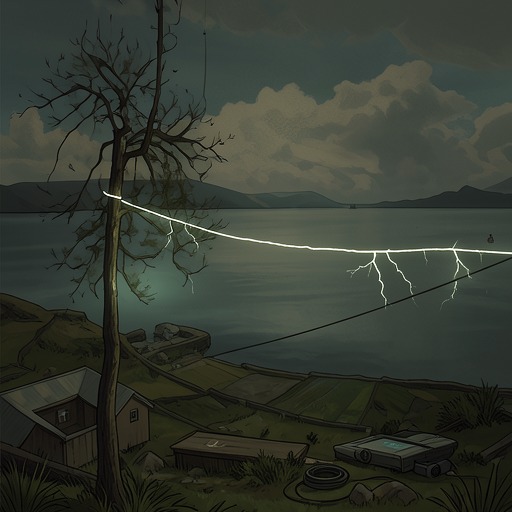
In Traverse City, an unnamed inventor had rigged a small electrical system in an attic. A stationary bicycle, pedalled vigorously, powered a laptop. The setup was limited, but the inventor’s larger ambition was to find the Internet; the search, rather than the electricity itself, was the project’s point. His effort depended on sustained human exertion to keep the screen lit, making the scene an especially small-scale version of the labour and infrastructure once hidden behind effortless access to information.
The attempt did not recover the network. Kirsten Raymonde stared at a message indicating that the webpage was unavailable, while the inventor continued pedalling and explained something about satellites. She did not seriously expect him to find the Internet, but the experiment held her attention because she remained fascinated by electricity. Her response was less about a particular website than about the lost possibility of electric light: she imagined a shaded lamp, a half-moon nightlight, a dining-room chandelier, and a brilliant stage. The screen’s failure thus coexists with a vivid sense of what electricity could still make possible.
The Screen and Its Witnesses
The same laptop carried different meanings for the younger members of the Symphony. Several felt a thrill at the prospect that Wi-Fi and the Cloud might still exist somewhere, invisible and beyond immediate reach. They knew these things through stories, not ordinary experience. For Alexandra, who was enraptured by the illuminated screen, it had the force of a magical object without personal memories attached to it.
Kirsten, who had been eight when the old world ended, admitted that she could not really remember what computer screens looked like. Her uncertainty marks a generational break: the technologies that had once been familiar parts of daily life have become difficult for her even to picture. The novel places that limited memory beside the younger group’s excitement about a network they have never used, showing how the same failed connection can signify both a hazy recollection and an almost mythical possibility.
August looked at the screen with a lost expression. His response is connected to a childhood spent watching television in interchangeable U.S. Army base houses, where familiar programs made distant postings feel alike. After the collapse, he searched abandoned homes for old issues of TV Guide and recalled television shows in detail; at Traverse City, the laptop and its absent network stand against those memories of a once-routine electronic world. The town’s experiment does not restore that world, but briefly concentrates its remnants—electricity, a screen, satellites, and remembered forms of connection—into one fragile scene.