Tyler Leander
Station ElevenTyler Leander is Arthur Leander’s only son and, in adulthood, the figure known as the Prophet. The novel first places him in the fragile orbit of his parents’ separation, then shows him stranded with Elizabeth at an airport after the Georgia Flu pandemic begins. There, beside a plane whose dead passengers cannot answer him, he reads scripture about plague and judgment. Years later, Clark Thompson’s recollections connect that child to the violent religious leader encountered by the Travelling Symphony—a transformation the novel makes legible through images and memory, while leaving much of Tyler’s intervening life unknown.
Identity and Family Background
At the Elgin Theatre, after Arthur’s collapse, members of the company try to establish who should be told of his death. A makeup artist identifies Tyler as Arthur’s one son and says he lives with his mother in Jerusalem. The estimate of Tyler’s age is given uncertainly in the conversation, but later evidence clarifies that he was seven when a celebrity magazine photographed his father picking him up at LAX. His mother, Elizabeth Colton, is identified in that caption as a model and actress.
Arthur’s family life is already fractured before the pandemic. When he speaks with Clark in a restaurant, Arthur says he is going to Paris to visit Tyler, who is vacationing there with Elizabeth. He describes the year as difficult; Clark knows that Arthur’s third wife has recently served him divorce papers and that Elizabeth has taken Tyler to Jerusalem. Arthur’s distressed question about why they went to Israel makes the separation tangible: his son is not simply distant, but living in a place Arthur cannot understand as a destination.
A Childhood Preserved in Fragments
Years after the collapse, Kirsten Raymonde finds a magazine clipping showing Arthur carrying Tyler at LAX. The boy beams up at his father while Arthur smiles toward the camera. The caption identifies Tyler as seven and says he lives in Jerusalem with Elizabeth. The photograph dates from a year before the Georgia Flu, turning an ordinary celebrity image into evidence of a family life and world already lost.
Kirsten searches discarded magazines for more traces of Arthur. She collects photographs of him alone, with his first wife Miranda, with Elizabeth, with Tyler, and later with a third wife. The clippings accumulate in a ziplock bag in her backpack, an improvised archive of the past. They do not match the brief memory Kirsten retains of Arthur as a kind man with grey hair who gave her comics, but they allow her to follow his life beyond that remembered encounter. Charlie calls her like an archaeologist, a description that also captures how Tyler’s childhood survives: not as a continuous story, but as scattered images recovered from the ruins.
The Airport and the Air Gradia Jet
After the pandemic strands them at Severn City Airport, Tyler spends his days curled in an armchair in the Skymiles Lounge, reading his comic books again and again. Elizabeth sits nearby with her eyes closed, her lips moving in rapid, repeated prayer. Around them, the airport’s televisions show silent test patterns. The repeated reading and prayer offer two different responses to a world abruptly emptied of ordinary life, though the evidence does not specify what Tyler makes of his comics at this stage.
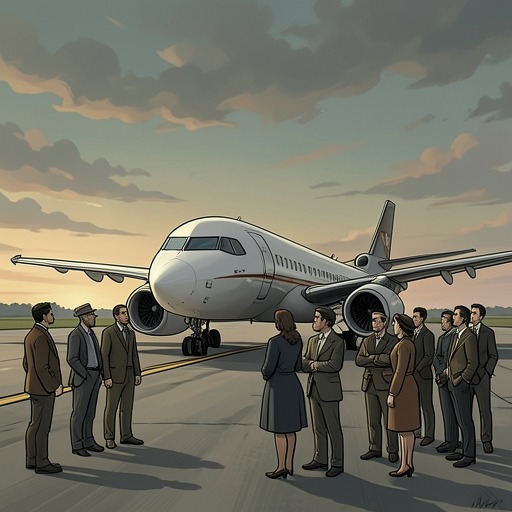
Months before Elizabeth and Tyler leave the airport in Year Two, Clark sees what appears to be a child near the Air Gradia jet. The plane is strictly off-limits, and children tell ghost stories about it. Clark discovers Tyler standing by its nose, reading aloud from a paperback. The passage is from the Book of Revelation: it describes plagues, death, mourning, famine, and a city consumed by fire under divine judgment. Clark recognizes the text from a former boyfriend’s Bible. The scene gives the forbidden aircraft a second meaning. It is not only a remnant of the catastrophe, but the silent audience for Tyler’s apocalyptic reading.
When Clark objects that the people aboard the plane were simply in the wrong place at the wrong time, Tyler accepts the response, then resumes reading more softly. Later, Clark finds Elizabeth and Tyler living in the First-Class cabin of an Air France jet. He approaches Elizabeth, who is knitting on the rolling staircase in the sunlight, and tells her he is worried about her son. The evidence presents Clark’s concern without disclosing the full conversation that follows; it does, however, show how Tyler’s reading has unsettled him.
Departure and the Prophet
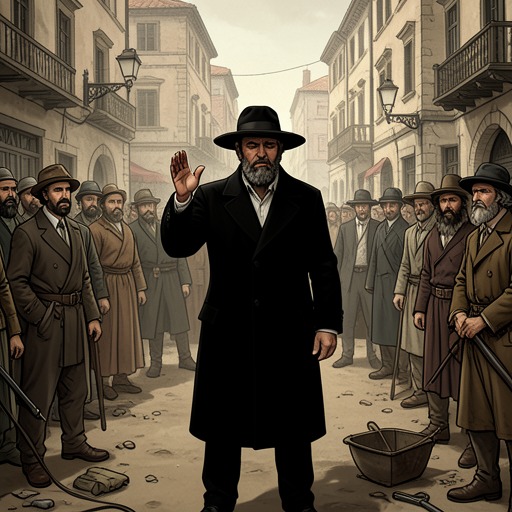
Elizabeth and Tyler leave the airport in the summer of Year Two. The night before they go, Elizabeth gives Clark their passports, open to the picture pages. Years later he remains unsettled by them. The passports preserve the faces of two people whose fate he cannot verify, and his uncertainty becomes acute when he hears Charlie and Jeremy describe a blond-haired Prophet who ruled St. Deborah by the Water through charisma, violence, and selected verses from the Book of Revelation.
Clark is certain he would remember a prophet from the airport, yet Jeremy’s account prompts him to think of Elizabeth and Tyler on the road. He remembers the boy at the Air Gradia jet, Arthur Leander’s beloved only son, reading verses about plagues to the dead. The novel joins these memories rather than supplying a continuous account of Tyler’s journey or explaining how he acquired power. Jeremy says that people may not know the Prophet’s name; Clark’s recollection nevertheless makes the identification between the boy and the later leader compelling. The same scripture that Tyler read beside the sealed plane is associated with the authority he later exercises over the town.
Death and Narrative Significance
When Kirsten encounters the Prophet dead on the road, she kneels beside his body and wonders who he was and how he came to possess a page from Station Eleven. He offers no answers. Kirsten understands him, however, as someone who was once a boy adrift on the road, perhaps burdened by memories she herself cannot recover. She closes his eyes and places the folded page in his hand. The gesture does not resolve his story; it acknowledges the child and the unknowable history contained within the dead man.
Tyler’s role is therefore shaped by the distance between the boy preserved in photographs and the Prophet remembered by survivors. The novel supplies telling connections—his separation from Arthur, the airport years with Elizabeth, the reading of Revelation, and Clark’s later recognition—without filling in every step between them. His story becomes one of the book’s starkest transformations: a child who reads catastrophe aloud to a plane of the dead returns in memory as a leader whose rule is built from apocalyptic language.