Year Fifteen
Station ElevenYear Fifteen is a measure of time counted from the catastrophe, rather than from a restored sense of normal history. By then, survivors have lived long enough for the first emergency to become the past, but the losses and altered habits of that emergency still shape daily life. The year brings together two views of that passage: Kirsten Raymonde looking back in an interview, and Clark Thompson living among the people and objects preserved at Severn City Airport.
A calendar counted from catastrophe
At first, the people stranded at Severn City Airport counted in days, expecting that the interruption would soon end. They imagined the National Guard arriving with food and blankets, airport crews returning, and flights resuming. Day One became Day Two, then Day Forty-eight and Day Ninety; as expectations of a return to normal faded, the count expanded into years. The calendar was not simply resumed: catastrophe had become its new point of reference.
The airport community eventually retained familiar months and days while numbering its years from the disaster. Dates could therefore be recorded as January 1, Year Three, or March 17, Year Four. Clark Thompson recognized in Year Four that the count would continue in this form. The practical calendar endured, but its year-numbering made the rupture permanent: each new year measured how long the survivors had been living after the old world ended.
That measure gives Year Fifteen a double character. It is an ordinary designation within the survivors’ adopted calendar, yet it also records fifteen years of separation from the life that preceded the catastrophe. The text makes that duration tangible through changed routines and remembered last occasions: the last orange, the last moving bus, or the last time an airplane took off rather than serving as living quarters.
From outbreak to a new measure of time
The scale of the break is established before the later year count takes hold. At the hospital, Hua tells Jeevan Chaudhary that more than two hundred flu patients have been admitted since morning, including 160 in three hours, and that fifteen have died. The emergency room is full and beds have been placed in hallways. The numbers make the crisis immediate; Hua’s fear persuades Jeevan that this is not an ordinary warning.
Hua advises Jeevan to leave if possible, or otherwise to stock food and stay inside. Jeevan understands the illness as the dividing line between a before and an after. At a grocery store, a television reports that Toronto General Hospital and two other local hospitals have been isolated and that Health Canada is confirming an outbreak of the Georgia Flu. Officials have not yet released figures, but fatalities are confirmed. The movement from an hourly count of admissions to the later count of years links the first shock to the long aftermath.
Jeevan reaches Frank’s apartment with shopping carts of supplies. He and Frank watch the news, cover air ducts with plastic, hang towels over windows, and push a dresser in front of the door. When people knock, they stay silent; twice, someone tries to force the lock, but the deadbolt holds. As days pass, news coverage continues until its horrors seem abstract, even as broadcasters sometimes weep. These measures show the first emergency being lived minute by minute, in contrast to the durable annual reckoning that Year Fifteen represents.
Life organized around the fifteenth year
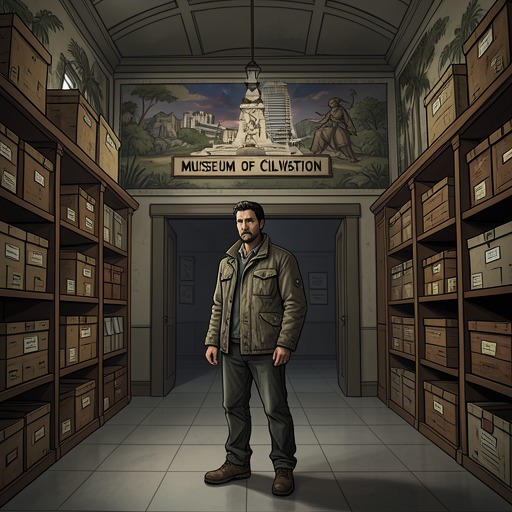
By the end of Year Fifteen, three hundred people live at Severn City Airport, and the Museum of Civilization fills the Skymiles Lounge. Clark, who had once spent his days gathering firewood, hauling water to keep the toilets operational, salvaging supplies in Severn City, planting crops beside the runways, and skinning deer, now spends much of his time caring for the museum. The community has grown, Clark has aged, and the work of preserving objects has become part of the airport’s established life.
The museum keeps things that have little practical use but remain worth saving to its inhabitants: cell phones, iPads, Tyler Leander’s Nintendo console, laptops, high heels, car engines, and a chrome motorcycle. Traders bring Clark magazines, newspapers, stamps, and coins. He also records passports, driver’s licences, and credit cards belonging to people who lived at the airport and died there. His careful records turn the museum into more than a collection of obsolete technology: it is also an account of lives that passed through the community.
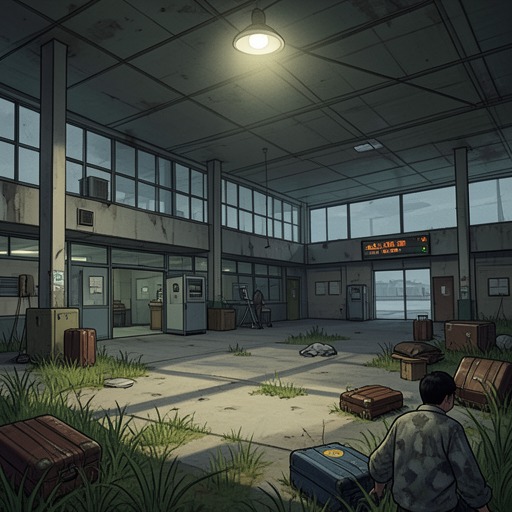
The fifteenth year is thus not presented as a return to the former world. The objects are preserved, but their old uses have vanished; aircraft that once carried passengers now form part of the setting in which survivors live. The airport’s changed purpose makes the passage of time visible in its surroundings as well as in the calendar.
Looking back in Year Fifteen
A continuing interview with Kirsten Raymonde places personal recollection inside the fifteenth-year frame. Asked about the world’s transformation during her lifetime, Kirsten says she was eight when the Georgia Flu came and the collapse occurred. Her answer establishes childhood as the point from which she measures the change, while the interviewer, François Diallo, approaches the experience as both a historical rupture and a subject he wants to understand through survivors’ memories.
The interview format contrasts with the airport chronology. Clark’s recognition in Year Four shows a community discovering that its emergency calendar will last; the Year Fifteen conversation shows what it means to speak from within that lasting change. Kirsten’s childhood recollection and Clark’s mature stewardship of the museum are different forms of witness: one names the age at which the old world disappeared, while the other preserves material traces of the life that preceded it.
For Clark, remembering the former world includes its space shuttles, electrical grid, amplified guitars, handheld computers, and high-speed trains. He thinks of having lived among those things for fifty-one years before the disaster, and the memory brings sadness together with exhilaration. Year Fifteen therefore measures more than elapsed time. It holds the survivors between a world they can still remember and a present whose routines, community, and records have been made in its absence.