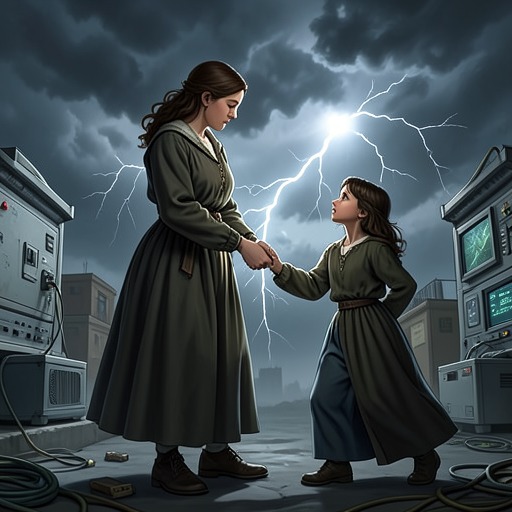
Carrie's Confrontation with Margaret White after the Shower Incident
Stephen King Three Classic Novels Box Set: Carrie, 'Salem's Lot, the ShiningCarrie's Confrontation with Margaret White after the Shower Incident is the first sustained revolt against the religious and physical authority of Margaret White. What begins as punishment for Carrie White's menstruation becomes a compressed struggle over who may define her body, her guilt, and her future. Carrie enters the confrontation as an abused daughter being forced back into the role of sinner; she leaves it having discovered that terror can be answered, however briefly, with defiance and supernatural threat.
Identity and Immediate Context
The confrontation follows the shower-room incident in which Carrie was mocked and attacked by her classmates during her first menstrual period. The violence at school is not treated as an isolated humiliation: a later account records that Christine Hargensen and about ten other girls threw sanitary napkins at Carrie while she believed she was bleeding to death, called her a “dumb pudding,” told her to “plug it up,” and subjected her to obscene gestures. Margaret White therefore receives Carrie not as a frightened child needing protection but as a supposed sexual and religious offender. Her response extends the school’s humiliation into the home, where maternal authority, doctrine, and bodily punishment become indistinguishable.
The scene’s first reversal occurs when Margaret White enters and she and Carrie stare at one another across the front hall. Margaret White tells Carrie, “You're a woman,” making menstruation a sentence rather than a biological fact. Carrie responds by crying that she had been frightened, that the girls had laughed and thrown things, and that Margaret White had failed to tell her what was happening. The accusation is simple but fundamental: Carrie does not merely object to punishment; she identifies abandonment at the moment when she needed explanation and care.
The Religious Punishment
Margaret White answers Carrie’s appeal with a backhand blow delivered by a hard, laundry-callused hand. Carrie falls in the doorway, and Margaret White invokes the biblical creation of Eve while ordering her to rise and pray. She then kicks Carrie and recites a private theology in which Eve’s weakness releases Sin into the world, intercourse becomes the first sin, and menstruation is the “Curse of Blood.” Childbearing is described as a second curse, associated with Eve bringing forth Cain in sweat and blood. Margaret White thus converts the physical processes of womanhood into evidence of inherited corruption.
The setting makes that doctrine material. Margaret White drives Carrie toward an altar bearing a cross, white candles, and painted images of Jesus and his apostles. Beside it stands the open prayer closet, lit by a permanently burning blue bulb. Inside is a terrifying representation of Jonathan Edwards’s “Sinners in the Hands of an Angry God,” with Yahweh casting humans into fire while the Black Man sits on a flame-colored throne. The closet is not presented as a refuge or neutral place of prayer. It is the domestic instrument through which Margaret White extinguishes Carrie’s resistance to both God’s will and her own.
Margaret White orders Carrie to enter the closet, pray in secret, and ask forgiveness for her sin. Carrie refuses the assigned identity, telling her mother, “I didn't sin, Momma. You sinned. You didn't tell me and they laughed.” This statement changes the moral direction of the scene. Carrie identifies Margaret White’s concealment and neglect as the original wrongdoing, while the mother’s doctrine attempts to return all blame to the daughter’s body. Margaret White’s eyes briefly reveal what Carrie reads as fear before Margaret White forces her toward the blue glare.
The Threat of the Stones
The confrontation reaches its turning point when Carrie threatens, “I'll make the stones come again, Momma.” The warning recalls the earlier Rain of Stones on the White House, transforming an apparently inexplicable supernatural incident into a resource Carrie can consciously invoke during conflict. The threat is also a speech act: Carrie does not yet move the stones in the scene, but speaking the possibility interrupts Margaret White’s physical advance and makes her halt. For a moment, the persecuted daughter controls the terms of the encounter by placing the mother inside the range of a power she cannot explain or safely dismiss.
The pause is brief. Margaret White’s breath seems to stop, then her hand tightens around Carrie’s neck until Carrie sees red dots and feels her mind become distant. The threat therefore produces recognition without producing safety. Margaret White understands enough to react, but not enough to surrender authority. Her grip turns the scene from attempted religious correction into an open contest between bodily force and telekinetic potential.
Carrie’s language then becomes violently obscene. She screams, “You SUCK!” and “You FUCK!” Margaret White answers with the cry of “Sin!” and beats Carrie across the back, neck, and head. The exchange strips away the ritual vocabulary that had governed the confrontation. Margaret White names every form of resistance as sin; Carrie answers with words that reject the sacred language imposed upon her. Neither side achieves reconciliation, but the old arrangement has been damaged: Carrie is no longer silently receiving Margaret White’s definitions.
Confinement and Escalation
Margaret White finally drives Carrie headfirst into the closet. Carrie strikes the far wall, falls into a semiconscious state, and hears the door slam and the key turn. She is left alone with Margaret White’s angry God, beneath the blue light and the image of damnation. The punishment restores Margaret White’s immediate physical control, yet it also seals Carrie inside the very symbolic world that has produced her rebellion. The closet becomes both prison and pressure chamber, concentrating shame, fear, rage, and the supernatural force that emerges under extreme personal stress.
The later documentary account of Carrie’s telekinesis gives this domestic scene a wider significance. David R. Congress argues that the failure to identify earlier incidents should be understood through the conclusion that telekinesis comes forward only in moments of extreme personal stress. The ability to move objects by will alone can remain submerged, with only the tip of its capacity visible. In that framework, the confrontation is not merely an episode of parental abuse. It is one of the moments in which repeated humiliation and immediate terror bring an immense “TK” potential toward conscious expression.
Consequences and Narrative Significance
The confrontation establishes the central pattern of Carrie’s relationship with Margaret White: Margaret White interprets Carrie’s bodily existence as sin, Carrie seeks recognition and protection, and every attempt at explanation is answered by punishment. Yet the scene also records a crucial change. Carrie names her mother’s failure, resists the command to pray, and threatens to repeat the stones. The threat does not free her from the closet, but it proves that Margaret White’s authority is no longer absolute even within the house.
Its consequences extend beyond the family. The school’s cruelty, Margaret White’s religious fanaticism, and Carrie’s latent telekinesis form a single chain rather than separate causes. The later destruction of Chamberlain is reported through public disaster language, and commentary on the event asks whether Thomas Everett Ross served as a trigger knowingly or unknowingly. The national AP report confirms that a disaster of major proportions has struck Chamberlain, while the later account declares that the Carrie White affair is over and turns uneasily toward the future of the TK gene. Against that retrospective knowledge, the closet confrontation reads as an early, intimate version of the larger catastrophe: a frightened girl is told that her body is cursed, answers with a promise that matter may obey her, and is met with violence that drives the emerging power deeper into confinement before its eventual release.