Carrie's prom dress
Stephen King Three Classic Novels Box Set: Carrie, 'Salem's Lot, the ShiningCarrie's prom dress is the handmade red gown that carries Carrie White from the private discipline of the White family home into the public ritual of the Spring Ball. It begins as an awkwardly made garment that Carrie hates, becomes the material form of her defiance and desire to participate, and ends as a torn, blood-streaked remnant on the body of a wounded girl. Its movement through the story makes the dress more than clothing: it is the object through which domestic religious shame, feminine self-presentation, school ceremony, public cruelty, and supernatural retaliation become visibly joined.
Origin and Making
The dress is completed after Carrie has resisted Margaret White in a way she has never done before. Carrie remembers that Margaret has previously confined her in the prayer closet for offenses such as stealing a forty-nine-cent ring and keeping a picture of Flash Bobby Pickett beneath her pillow; on one occasion, Carrie fainted from hunger and the smell of her own waste. After Carrie speaks back, even using the forbidden Eff Word, Margaret releases her almost immediately. Carrie understands that this leniency has a purpose: Margaret wants the dress made because she expects Carrie to attend the dance, and Carrie recognizes the bargain while sitting at the sewing machine.
When the work is finished, Carrie holds the garment up and sees a dress that is long and ugly. She hates it, but that hatred does not cancel its importance. The dress is an object produced within punishment and obligation, yet it also gives Carrie a project through which she can imagine a different self. The garment therefore begins in contradiction: it is made under Margaret's authority, but it will be worn in an act of departure from Margaret's authority.
Carrie has bought the material at John's in Westover. The heavy, crumpled velvet frightens her because of its price and because the store itself is strange and socially distant from the Chamberlain Woolworth's where she normally buys cloth. She feels intimidated by the fashionable women examining bolts of fabric, but she is not stopped. Her imagination briefly gives the material an expansive power: mannequins could topple, light fixtures could fall, and bolts of cloth could shoot through the air. The fantasy connects the dress's physical substance with the telekinetic power Carrie has begun to sense, making the garment both a vulnerable handmade thing and a possible instrument of transformation.
Wearing the Dress
Carrie first puts the dress on in her room on the morning of May 27. She has bought a special brassiere to wear with it, one that lifts her breasts while leaving their upper halves uncovered. The experience is half shame and half defiant excitement. The dress is nearly floor length, with a loose skirt and a snug waist; its rich, unfamiliar material contrasts with the cotton and wool that normally touch her skin. Its fit seems right, or nearly right, pending the addition of new shoes. The details matter because Carrie is not merely disguised by the dress: she is learning, awkwardly and intensely, how a young woman might arrange her body for public attention.
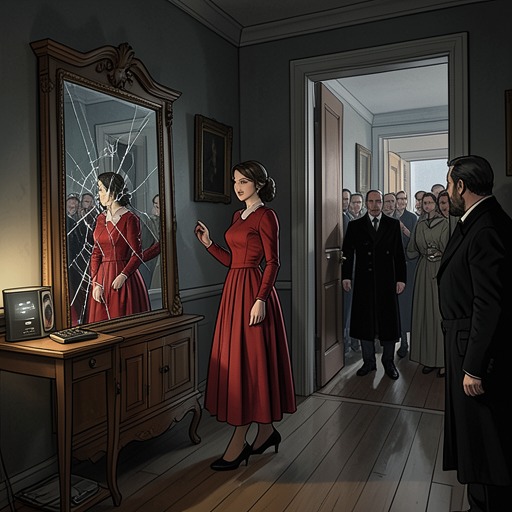
Margaret immediately interprets the garment through the language of sexual danger and religious pollution. She sees that it is red and objects that Carrie's breasts will be visible. Her command is that Carrie remove the dress so that it can be burned in the incinerator, followed by prayer and penance. Margaret proposes staying home from work and keeping Carrie home from school while they ask for a Sign and the Pentecostal Fire. The dress thus becomes the immediate cause of another confrontation between them, with Margaret treating ordinary female development and public appearance as evidence of sin.
Carrie refuses. Margaret responds by clawing her own cheek and striking herself in the mouth until she draws blood, then daubing that blood on the cover of the Bible while whispering about being washed in the Blood of the Lamb. Carrie tells her to stop hurting herself and makes clear that the self-punishment will not make her remove the dress. This exchange places the gown beside the household's other charged objects and practices: the Bible, the blood Margaret produces herself, the cross, and the prayer closet. Margaret's religious vocabulary turns the dress into a test of faith, while Carrie's refusal makes it a small but decisive assertion that her body cannot remain entirely governed by Margaret's interpretation.
Margaret locks herself in the chapel and prays hysterically for two hours while Carrie prepares to leave. Carrie pins the corsage Tommy Ross has brought to her shoulder by herself because there is no Margaret to place it correctly. The missing maternal gesture is significant: the dress is supposed to introduce Carrie into a formal social ritual, but she must complete its preparation without the mother who has controlled every other aspect of her appearance. Her private thought that she is sorry to Margaret but cannot be sorry records the emotional cost of the choice without undoing it.
Entrance into the Spring Ball
The dress carries Carrie into a world that initially appears almost unreal. Tommy Ross meets her, and the atmosphere of the Spring Ball overwhelms her with what she perceives as Glamor: chiffon, lace, silk, satin, flowers, low-backed dresses, scooped bodices, long skirts, pumps, white dinner jackets, cummerbunds, and polished black shoes. She wants to see her classmates as beautiful strangers rather than as the people who have bullied or ignored her. Tommy's hand remains firm on her elbow as he guides her through the room, giving the dress and its wearer a temporary place within a social landscape that has normally excluded her.
The garment also accompanies a modest, concrete hope rather than an extravagant ambition. The day before the prom, Carrie agrees to Tommy's suggestion that they stop at the Kelly Fruit Company afterward for a hamburger and a dime root beer. Because she must be home by eleven-thirty or her mother will worry, she is pleased by the possibility of a simple evening that will not violate Margaret's rules. The dress is therefore tied not only to spectacle but to Carrie's wish for ordinary companionship and a manageable happiness.
As the evening proceeds, the gown becomes part of the dance's ceremonial scenery. Stagehands slide the King and Queen thrones into position; they are white, decorated with real flowers and large crepe banners, and Carrie finds them beautiful. Tommy tells her that she is beautiful, and the compliment briefly persuades her that nothing bad can happen that night. The dress helps create this fragile interval in which Carrie can imagine herself not as an object of ridicule but as a participant in the pageant of adolescence.
When the votes are counted, Tommy and Carrie win by one vote. The result first produces applause with satiric overtones, but the response grows honest and deep as they are led toward the thrones. A robe with a dog-fur collar is placed over Carrie's shoulders, and she is seated beside Tommy while the audience applauds. Vic Mooney announces them as the King and Queen of the 1979 Spring Ball. Carrie is trembling, woozy, and still troubled by the sense that her breasts are exposed, yet the dress has carried her into the exact public recognition that seemed impossible at the beginning of the evening. Its apparent triumph is precarious because the ceremony has been organized by the same community capable of turning recognition into spectacle and spectacle into punishment.
From Celebration to Exposure
The dress's meaning changes at the moment Carrie realizes that she has been drenched in blood before everyone. She sees herself as red and dripping, smells the wet coppery odor, and relives the earlier shower-room humiliation in which menstrual blood ran down her leg while the girls laughed and urged her to plug it up. The pig blood does not merely stain a costume; it forces the private substance that Margaret calls the Curse of Blood into the center of a public rite. The red dress and the red liquid become indistinguishable signs of a body that the school has first excluded, then displayed, and finally violated.
The contrast between the dress's intended function and its ruined appearance gives the prank its particular cruelty. The gown had allowed Carrie to approach the Spring Ball as a threshold into social life, with its new shoes, corsage, formal cut, and ceremonial setting. The blood converts that threshold into a reenactment of the shower-room scene. What seemed like a passage from shame toward belonging becomes a ritual of exposure, and the school community's laughter supplies the audience for the reversal.
After the disaster, Carrie returns home carrying the physical evidence of that reversal. Her body has become twisted and crone-like; the prom dress hangs in tatters and flaps, while pig blood has begun to clot and streak across it. Grease marks her forehead, her knees are scraped raw, and much of the blood later visible on her belongs to her own wounds. The gown has ceased to be a carefully constructed promise of beauty, but it remains unmistakable as the object that accompanied her into the hall, absorbed the violence done there, and now travels with her through the destruction that follows.
The dress also remains present when Carrie’s retaliation reaches beyond the Spring Ball. After leaving the hall, she turns toward home while power transformers bloom into purple light, high-tension wires fall into the streets, and people in nightclothes burn or collapse amid the electrical chaos. The gown is no longer a social costume separated from the town’s infrastructure; it moves through a landscape in which the violence directed at Carrie has become violence imposed on Chamberlain itself. Its red surface links the school’s prank to the wider spread of destruction, while the dress’s visibility keeps the catastrophe attached to the body that was publicly humiliated.
Material Ruin and Bodily Transformation
The garment’s final physical condition records several stages of Carrie’s passage. It begins as velvet selected with fear and determination, is shaped into a nearly floor-length gown with a loose skirt and snug waist, and is completed despite Carrie’s dislike of its appearance. On the morning of the dance, its unfamiliar richness against her skin produces a mixture of shame and excitement; at the ceremony, it is covered by the robe placed over her shoulders as she is seated on the white throne. After the blood falls, the formal surface becomes a damaged material record of the night: torn fabric, clotted stains, dirt, grease, and traces of injury.
This deterioration is not merely decorative. The dress makes the transformation of Carrie’s social identity legible as a change in matter. The girl who enters the dance is carefully dressed for recognition, standing upright in the sunlight while Margaret condemns the color red. The girl who leaves is physically altered by terror and violence, and the gown hangs from a body that resembles a wounded, exhausted figure rather than the hesitant prom queen of a few minutes earlier. The dress exposes the failure of every category imposed on Carrie: respectable daughter, sinful woman, schoolgirl, queen, monster, and avenger.
Blood, Religion, and Public Ritual
The red gown gathers together the story’s competing meanings of blood. Carrie’s first menstrual bleeding is discovered in the shower, where the girls form a circle around her and mock her ignorance while Susan Snell reacts with disgust. Margaret later explains menstruation through a private theology in which Eve’s intercourse and childbearing bring the Curse of Blood into the world. When Margaret wounds herself and marks Daddy Ralph’s Bible with her blood, religious language turns bodily substance into proof of sin and submission. At the Spring Ball, the pig blood placed on Carrie repeats this vocabulary in a deliberately theatrical form.
The dress is the surface on which these meanings are forced to meet. To Margaret, its red color already suggests sexual danger and religious transgression; to Carrie, it is part of an attempt to appear beautiful and enter ordinary adolescent life. To the students who engineer the prank, it becomes the ideal background for a spectacle of contamination. The blood makes the gown resemble the very curse Margaret has taught Carrie to fear, but it also reveals that the supposedly moral community has manufactured the scene of pollution itself. The disaster therefore exposes not an inherent monstrosity in Carrie’s body but the destructive power of a culture that repeatedly classifies female development as shameful and then turns that shame into entertainment.
The evening’s ceremony intensifies this contradiction. Voting, enthronement, applause, the white thrones, flowers, banners, robe, and formal announcement temporarily elevate Carrie within the school’s hierarchy. Yet the one-vote victory and the applause that begins with satiric overtones show how unstable the elevation is. The crown-like recognition does not protect her from being displayed; it gives the school a more visible stage on which to violate her. The dress consequently marks both coronation and sacrifice, an object carried through a failed rite of incorporation rather than a successful entrance into communal life.
An Object That Changes Meaning
At first the dress is an object Carrie must make under pressure. Its materials, cost, and unfamiliar texture make the act of sewing a confrontation with class distance and social aspiration. The cloth bought at John's in Westover belongs to a world of fashionable women and elegant spring clothing that seems remote from Carrie’s customary purchases at Chamberlain Woolworth's. Even before it is worn, the material has acquired imaginative force: Carrie pictures bolts of cloth unwinding through the air and fixtures falling, as though the dress were already connected to the latent capacity that will later destroy the town.
Once worn, however, the gown becomes an object others interpret for Carrie. Margaret reads its cut and color as evidence of sin; Tommy Ross sees the girl inside it and tells her she is beautiful; the assembled students see a prom queen whose public elevation can be converted into a spectacle of humiliation. The garment itself does not possess a stable meaning apart from these encounters. Its significance is produced through competing acts of looking, naming, dressing, covering, staining, and exposing.
Its damaged state makes that process visible. The gown can no longer function transparently as formalwear: its torn edges and blood-streaked surface insist on its material presence. It becomes an obstructive, conspicuous thing that cannot be reduced to the social role it was meant to perform. Every later sight of Carrie in the dress carries the absent ceremony with it—the corsage pinned without Margaret’s help, the white thrones, Tommy’s hand, the announcement, the laughter, and the violence. The object retains these incompatible histories in its fibers and stains.
Narrative Significance
Carrie’s prom dress gives the story a concrete form for its central reversal. It is made so Carrie can participate in a conventional adolescent ritual, and it appears, briefly, to succeed: she enters the Spring Ball, sees beauty where she expects hostility, receives Tommy’s companionship, and is named Queen. Yet the same garment becomes the visual center of the prank that repeats the shower-room humiliation and precipitates Carrie’s retaliation. The dress turns an apparently ordinary coming-of-age costume into the emblem of a community’s failed responsibility toward one of its children.
Its trajectory also links private and public spaces. The dress is conceived in the White family home, made at the sewing machine, defended against Margaret in the bedroom, prepared while Margaret prays in the chapel, displayed in the school hall, drenched before the crowd, and carried through the ruined streets back toward the house. Each movement enlarges the conflict. What begins as a dispute over whether Carrie may wear a red gown becomes a struggle over who may define her body, her adulthood, and her place among other people.
By the time Carrie appears in the high beams at the Cavalier, the prom dress is covered with dirt and grass stains, and the butcher knife still protrudes from her shoulder. Much of the blood on the gown is now her own. The image completes the object’s transformation from handmade aspiration to evidence of accumulated injury. It remains the same dress, but its relation to Carrie has changed irreversibly: it no longer promises entry into a social world, because that world has answered her desire for belonging with exposure and violence. Its final significance lies in that irreversible contradiction. The dress preserves the brief possibility that Carrie might have been welcomed, while its ruined fabric testifies to the consequences of making that possibility a public spectacle.