Chamberlain Mills and Weaving
Stephen King Three Classic Novels Box Set: Carrie, 'Salem's Lot, the ShiningChamberlain Mills and Weaving is Chamberlain’s principal industrial landmark and one of the clearest measures of the town’s post-disaster condition. Unlike much of the surrounding community, the mill remains standing after the fire that consumes large portions of Chamberlain during the Spring Ball disaster. Its survival does not represent recovery: the plant becomes an intact shell of local economic life, operating with too few workers and facing further contraction as families leave the town.
Industrial Anchor of Chamberlain
Chamberlain Mills and Weaving is identified as the town’s major industry. Its importance is economic as well as social, since the mill depends on a substantial local workforce and helps organize the town’s ordinary life around employment. In the aftermath of the disaster, its continued existence gives Chamberlain one of the few visible signs of institutional continuity amid blackened buildings, abandoned homes, funerals, and residents preparing to leave.
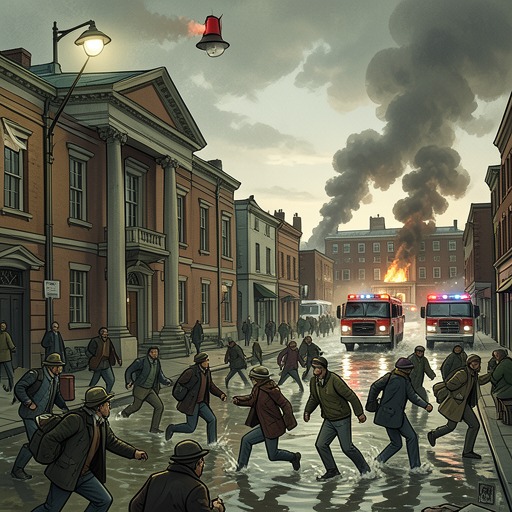
The contrast is deliberately stark. The mill stands untouched by the fire that raged over much of Chamberlain during the two days in May, while nearby businesses and civic spaces are destroyed or emptied. The Kelly Fruit Company is leveled, the Congregational Church on Carlin Street is swept away, and many houses display for-sale signs or black wreaths. Against that landscape, the intact mill seems stable, but the narrative makes clear that structural survival cannot protect the community that made the institution viable.
Operation After the Disaster
Chamberlain Mills and Weaving has been running only one shift since June 4. The reduced schedule reflects the disappearance of workers rather than a shortage of orders. William A. Chamblis, the mill president, explains that the company still has work available but cannot operate without people to punch the time clock. The crisis therefore moves from physical destruction to labor depletion: the mill survives, yet the town no longer supplies the workforce required to keep it fully active.
Chamblis reports receiving notice from thirty-four men since August 15. The likely response is to close the dye house and outsource its work, with further layoffs a strong possibility. The proposed closure shows how disaster travels through an industrial system even when flames do not reach the factory itself. A business can remain materially intact and still be weakened by depopulation, grief, fear, and the loss of ordinary local routines.
Workers and Population Loss
The mill’s future is tied to the decisions of individual employees and their families. Roger Fearon, who has spent eighteen years with the mill and risen from a third-floor bagger earning seventy-three cents an hour to dye-house foreman, faces the possible loss of a substantial wage. Yet the prospect of unemployment is not the only issue governing his decision. Fearon and his wife are considering selling their house because they no longer want to live in Chamberlain.
Fearon’s response makes the mill’s predicament inseparable from collective trauma. Even a good job and an established home cannot restore a sense of safety or belonging after the Spring Ball disaster. The mill’s management sees a financial survival problem; Fearon sees a town that has gone bad. Those perspectives describe the same collapse from opposite sides of the time clock: one measures labor and production, while the other measures whether the place remains inhabitable as a community.
Place in the Chamberlain Aftermath
The mill appears within a wider record of infrastructural and social breakdown. The fire at Ewen Consolidated High School is reported as raging out of control while the area’s fire hydrants have been vandalized and water pressure has failed. Later, a gas-main explosion destroys nearly half a block, including the offices of the Chamberlain Clarion, and the telephone exchange becomes jammed with calls. These failures leave Chamberlain increasingly cut off from the outside world, while the mill’s intact buildings offer only limited protection against the cascading consequences of the disaster.
By the fall, Chamberlain has been declared a disaster area, but rebuilding remains painfully slow. Four hundred and forty people are known dead, eighteen are unaccounted for, and sixty-seven of the dead are Ewen High School seniors. The dead are buried in three mass ceremonies on June 1 and 2, followed by a town-square memorial service on June 3. The town’s main business becomes funerals, not commerce, and the mill’s single-shift operation is consequently less a sign of normality than evidence of how thoroughly normality has been interrupted.
Narrative Significance
Chamberlain Mills and Weaving embodies the difference between survival and restoration. Its machinery, buildings, and orders remain, but its workers are departing, its dye house may close, and its economic future depends on a population unwilling or unable to remain. The mill thus widens the meaning of the Chamberlain disaster beyond the school and the immediate deaths. The catastrophe damages a whole civic organism: workplaces, churches, shops, communications, transportation, households, and the willingness of survivors to imagine a future in the same town.
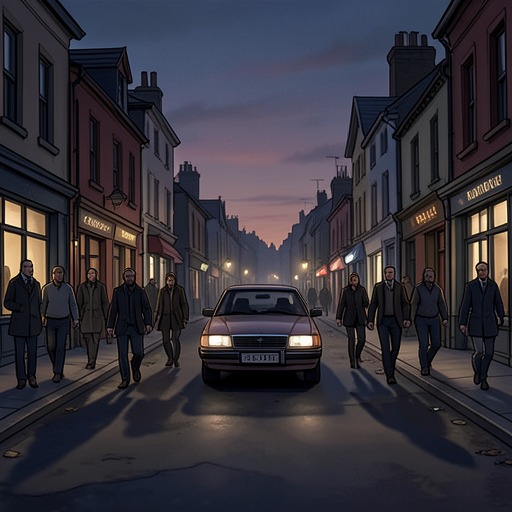
Its untouched condition also sharpens the book’s imagery of a community living beside its own ruins. The town’s houses still stand in some neighborhoods, and the mill still stands at the center of its industrial life, yet the surviving structures are surrounded by absence. Chamberlain Mills and Weaving remains available for production, but the people who would make that production possible are leaving, grieving, or dead. In that sense, the mill is not a symbol of uncomplicated resilience. It is a durable monument to a local economy whose human foundation has been shattered.