Henty farm
Stephen King Three Classic Novels Box Set: Carrie, 'Salem's Lot, the ShiningHenty farm is the North Chamberlain agricultural property that supplies the pig blood for the prank against Carrie White, making it a crucial physical link between Christine Hargensen’s revenge scheme and the catastrophe at the Spring Ball. The farm first appears as a remote, dangerous place whose animals, tools, roads, and darkness convert adolescent malice into a concrete operation.
Setting and Reputation
Henty farm is identified with Irwin Henty, one of the few successful independent farmers in the Chamberlain area. The property lies along the rutted Stack End Road in North Chamberlain, beyond No Trespassing signs, barbed wire, and newly turned fields. The route is rough enough to threaten life and limb: William Nolan drives a fender-dented, rusted-out 1961 Biscayne at sixty-five miles per hour, its damaged headlights flickering when the car strikes the washboard road.
The farm’s owner is not a benevolent rural figure. Irwin Henty is described as exceptionally mean, and his shotgun carries birdshot rather than harmless rock salt. He has prosecuted people for stealing from the property, including Freddy Overlook, who was caught in the henhouse, wounded with number-six birdshot, and later fined for larceny and trespass. That history gives the farm a specific local menace. The boys are not entering neutral countryside but a place associated with punishment, firearms, trespass, and resentment.
The approach briefly makes the farm seem almost pastoral. After William Nolan cuts the headlights and kills the ignition, the car rolls silently toward the driveway and passes the dark, empty house. Beyond it stand the barn, a cow pond glittering in moonlight, and an apple orchard. The pigpen contains two sows, while a cow lows softly in the barn. Yet the quiet landscape is not peaceful for long: its rural abundance becomes the setting for deliberate animal killing, and the farm’s ordinary agricultural life is converted into an instrument of revenge.
Role in the Prom-Prank Plan
The visit to Henty farm is part of the preparation for the Spring Ball prank. The narrative questions how carefully the ruination of Carrie White was planned, then presents Christine Hargensen as the likely brains of the affair, though her idea of how to target Carrie remains vague. The trip to Irwin Henty’s farm is attributed to her suggestion because the imagined result appealed to a warped sense of poetic justice.
This uncertainty about planning matters to the farm’s narrative function. The prank is neither a perfectly controlled conspiracy nor a wholly accidental outburst. Christine supplies the direction, William Nolan and the other boys supply the means, and Henty farm supplies the blood. The property therefore marks the point at which an idea becomes material. Before the buckets are filled, revenge exists as intention; after they leave, it has weight, smell, and a method.
William Nolan arrives with Jackie Talbot, Henry Blake, Steve Deighan, and the Garson brothers, Kenny and Lou. They travel in a drug-filled, reckless atmosphere, with three joints circulating through the car, but the mood changes as they near the farm. The car moves without headlights or engine noise, and the group proceeds on foot toward the hogpen. Excitement shortens their breathing. The stealth of the approach gives the episode the structure of a covert raid, while the farm’s warning signs and absent owner make trespass part of the boys’ chosen risk.
The Hogpen and the Harvest of Blood
The decisive action occurs at the hogpen. The two sows are tame, and the old boar lies asleep at the far end. Henry Blake tests a nine-pound sledge, but when the moment arrives he loses his nerve and hands it to William Nolan. Lou holds a broad butcher knife taken from the car’s glove compartment. The tools are specific and utilitarian, yet in the scene they also expose the violence concealed beneath the prank’s theatrical surface: the later spectacle at the Spring Ball depends on an actual killing carried out in darkness.
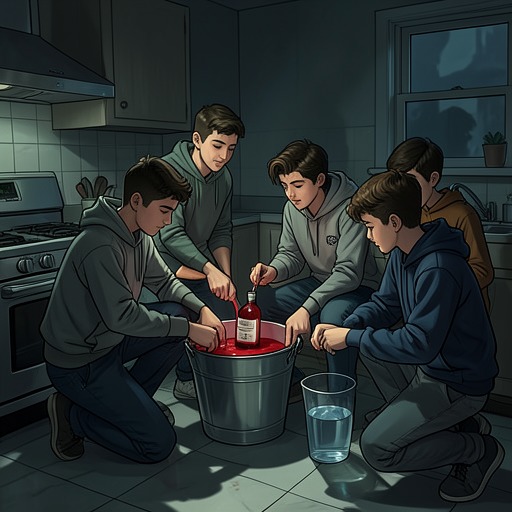
The first sow is slaughtered and a galvanized steel pail is filled. The second animal returns to the fence after Kenny Garson calls to it, and the sledge falls again. The remaining blood is allowed to run into the ground, while another bucket is filled. William Nolan becomes slimed with pig blood to the forearms, and the air takes on a rank, coppery smell. The blood is not an abstract prop. It coats the conspirators, stains the earth, and makes the coming humiliation physically present before Carrie ever encounters it.
The group carries the pails back to the car and nests them in crushed ice. William Nolan makes the symbolic connection that gives the operation its governing phrase: pig blood is appropriate because Carrie is being treated as a pig. His thought that the blood makes everything solidify reveals the transformation taking place at Henty farm. The prank has acquired a material form, and the phrase “Pig blood for a pig” condenses the contempt behind it. The farm thus becomes the site where livestock, blood, and social cruelty are joined into a single retaliatory instrument.
From Animal Blood to Human Shame
The blood taken from Henty farm acquires its full destructive meaning only when it is carried into the school. At the Spring Ball, Carrie White is not merely struck by a prank but drenched in the substance the conspirators have selected to define her. She opens her eyes to find herself red and dripping, covered in the secrecy of blood before the assembled crowd. Its wet, coppery smell recalls menstrual blood, the shower, and the voices that had once urged her to plug it up. The farm’s slaughter is therefore replayed symbolically on Carrie’s body: animal blood becomes a public sign of supposed bodily pollution, while the old insult that reduced her to a pig is converted into a ritual of humiliation.
The connection also reaches backward into the religious language that governs the White household. When Margaret White explains the supposed origin of menstruation, she describes intercourse and childbirth as curses transmitted through Eve, joining blood, sin, and female embodiment in a single doctrine. In the prayer closet, she injures herself and marks Daddy Ralph’s Bible with her own blood while whispering about being washed in the Blood of the Lamb. These scenes give the blood at Henty farm a wider symbolic field. The pranksters use it as cruel mockery, Margaret treats blood as evidence of sin and possible purification, and Carrie experiences it as the material of accumulated shame. The same substance moves between farm, school, family altar, and disaster, changing its meaning without losing its power to contaminate.
A Rural Space Inside the Chamberlain Disaster
Henty farm is not itself destroyed in the account of the disaster, but the violence enacted there becomes one of the physical preparations for Chamberlain’s destruction. The farm’s quiet signs of agricultural continuity—the cow pond, orchard, barn, sows, and sleeping boar—stand in stark contrast to the electrical fires and panic that later spread through town. Power transformers burst into purple light, high-tension wires fall into the streets, people touch the cables and collapse in jerking electrical dances, and clothing begins to smolder. The movement from the farm’s enclosed darkness to the town’s exposed devastation enlarges the prank from a local act of bullying into a chain of consequences that reaches public infrastructure and civilian life.
That contrast gives the farm a distinctive place in the narrative geography. It is remote enough for the boys to imagine that their conduct can remain hidden, yet close enough to Chamberlain to feed its central catastrophe. The warning signs, barbed wire, and absent owner create a temporary boundary against witnesses and law; the returned pails carry what happened beyond that boundary. Henty farm thus functions as a concealed workshop for violence, a space where the social order is suspended before the consequences return to the town in a much larger form.
Retrospective Meaning and Responsibility
The farm sequence is later framed by documentary and investigative voices that ask how much planning went into the ruination of Carrie White. The account favors an improvised rather than meticulously rehearsed plan, while still identifying Christine Hargensen as the likely brains behind it and William Nolan and his companions as the agents who made it possible. Henty farm clarifies the relation between those levels of responsibility. Christine’s suggestion becomes a destination; William Nolan drives, organizes the equipment, and performs the killing after Henry Blake recoils; Jackie Talbot, Steve Deighan, Kenny Garson, and Lou Garson accompany the operation and participate in its atmosphere of collective complicity.
The later testimony about Carrie White’s presence and responsibility is marked by certainty, denial, and institutional pressure. Mrs. Simard says she simply knew Carrie White was responsible, while Susan Snell rejects the idea that she had prior knowledge of Carrie White’s whereabouts and challenges the search for a scapegoat. Against that contested public record, Henty farm offers a concrete and less ambiguous chain of preparation: the boys entered private property, killed two sows, collected the blood in galvanized pails, packed it in ice, and transported it to the Spring Ball. The farm does not explain every later act, but it prevents the disaster from being treated as an inexplicable eruption. It preserves the material evidence of a human decision made before the town burned.
Narrative Significance
Henty farm’s decisive significance lies in the way it converts metaphor into matter. The boys’ contempt for Carrie White is expressed through an agricultural image, then made tangible through the slaughter of animals and the handling of their blood. The property’s rural stillness, dangerous reputation, and practical tools lend the prank a grim seriousness that its perpetrators themselves do not fully acknowledge. Their excitement, nervousness, drugged laughter, and moments of hesitation coexist with purposeful action; the scene records cruelty becoming organized even while the participants pretend to be merely playing.
The farm also establishes a pattern repeated throughout the novel: blood crosses a boundary and carries an earlier violence into a new setting. Menstrual blood first appears on the school tile as a private bodily crisis exposed to ridicule. Religious teaching recasts it as a curse. Pig blood is then harvested as a joke, brought into the public ritual of the Spring Ball, and transformed into the immediate trigger for Carrie White’s retaliation. Henty farm is the middle passage in that sequence, the place where blood is deliberately collected, chilled, transported, and prepared for spectacle. Its importance lies not in its duration but in its irreversible function: after the boys leave, the prank can no longer remain an idea, and the coming disaster has acquired a physical instrument.