Otis Doyle
Stephen King Three Classic Novels Box Set: Carrie, 'Salem's Lot, the ShiningOtis Doyle, identified in the record as Sheriff Otis Doyle or Sheriff Doyle, is the law-enforcement witness who anchors the aftermath of the Ewen High School Spring Ball disaster in verifiable time and place. His sworn testimony reconstructs how a report of trouble at the school became a wider catastrophe in Chamberlain, Maine, while his encounter with Susan Snell and Vic Mooney places him amid the frightened survivors rather than above the disaster as a detached observer.
Identity and Position
Doyle is the sheriff responsible for responding to the crisis, but he is not initially at Ewen High School. On the night of May twenty-seventh, he is on Route 179, the Old Bentown Road, investigating an automobile accident over the Chamberlain town line in Durham and assisting Mel Crager, the Durham constable. This detail gives his testimony a practical starting point: he enters the disaster from an unrelated public-safety duty, without prior knowledge of what has happened inside the school.
His position makes him especially important to the documentary structure surrounding the Chamberlain disaster. The account does not present him as the originator of the catastrophe or as an interpreter of Carrie White's motives. Instead, he records the sequence through radio traffic, arrival times, direct encounters, and the condition of the town. His authority is procedural, and that procedure becomes one of the few remaining forms of order after the Spring Ball has collapsed into fire, panic, and infrastructural failure.
Response to the School Emergency
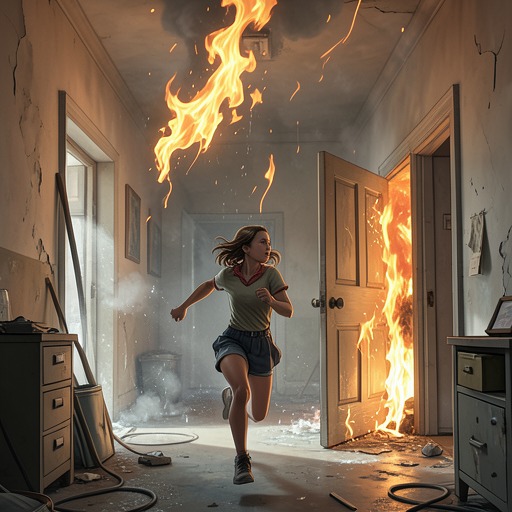
Doyle first learns that trouble has broken out at Ewen High School through a radio transmission from Officer Jacob Plessy at 10:21 P.M. Plessy reports that there is trouble at the school but does not know whether it is serious. He can hear considerable shouting and says that someone has pulled a couple of fire alarms; he is going to investigate the nature of the disturbance. The message therefore reaches Doyle as an uncertain disturbance rather than as a clearly identified massacre or supernatural attack.
The uncertainty is crucial to the chronology. The school is already in danger, yet the first official description available to Doyle is incomplete and cautious. The radio system carries alarm without explanation, and the gap between those two things mirrors the wider failure of the town to understand what has been set in motion. Doyle's subsequent testimony preserves that gap rather than pretending that the disaster was immediately legible.
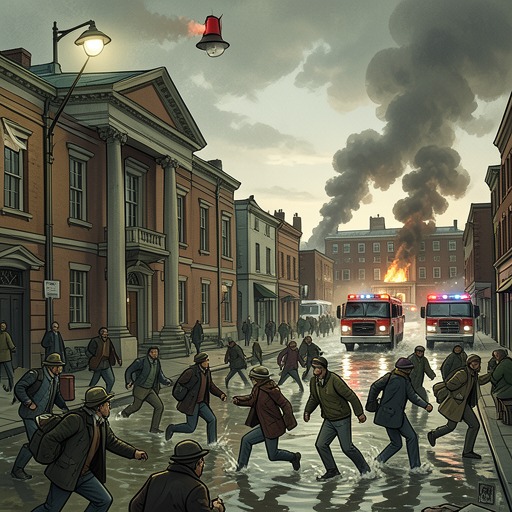
By the time Doyle reaches Chamberlain at 11:10 P.M., the emergency has expanded beyond the school grounds. The New England AP ticker has already reported that a fire is raging out of control at Ewen Consolidated High School, where a school prom was taking place, and that firefighting efforts have arrived to no avail. The failure is not simply a matter of insufficient response: hydrants in the area have been vandalized, and water pressure from the city mains between Spring Street and Grass Plaza has been compromised. Doyle therefore arrives in a town where the ordinary mechanisms of rescue have been deliberately or catastrophically disabled.
Encounters in a Disordered Town
Doyle meets Susan Snell after entering town because she flags him down. Her presence links his official investigation to the testimony of a surviving participant in the Spring Ball. The encounter also shows that the sheriff's work depends on frightened civilians who can identify what happened, even when the available information is fragmentary and emotionally difficult to communicate.
Doyle's surroundings are rendered through Vic Mooney, who emerges from the shadows near the Bankers Trust drive-in office. Mooney has blood across his forehead, one eye swollen purple and closed, and hair that has come loose from the careful styling required for his emcee duties. He staggers into Doyle's squad car, bounces back, and then clutches Doyle with both arms, squeezing him while wearing a huge, crazed grin. The scene converts the sheriff's vehicle, normally a controlled instrument of authority, into a temporary refuge for a badly injured and psychologically shattered survivor.
The contrast between Doyle's role and Mooney's condition is stark. Doyle is attempting to gather statements and establish facts; Mooney appears unable to offer a stable account, responding to the fire-lit streets in what the narrative describes as the maroon tones of dried blood. Doyle's contact with him does not restore order, but it records the human cost of the disorder in a bodily form: injury, disorientation, manic expression, and desperate physical attachment to the nearest authority figure.
Timeline of Escalation
The chronology preserved around Doyle shows that the school fire is only one stage in the destruction. Sheriff Doyle accepts an average time of 10:59 P.M. for the explosion at Teddy's Amoco, rather than treating the reported 11:00 time as exact. That small adjustment reveals the evidentiary character of his testimony: he distinguishes between an approximate reconstruction and a certain observation, even while the town's communications and records are breaking down.
After the school crisis, the national AP ticker reports a disaster of major proportions striking Chamberlain, but no further AP reports come from the town. At 12:06 A.M., a gas main on Jackson Avenue is opened. At 12:17, an ambulance attendant traveling toward Summer Street tosses out a cigarette butt, and the resulting explosion destroys nearly half a block, including the offices of the Chamberlain Clarion. By 12:18 A.M., Chamberlain is cut off from the outside country that continues to sleep in what the narrative calls reason.
The telephone exchange fails even before that gas-main explosion. At 12:10 A.M., every town telephone line still operating becomes jammed. Three girls remain at their posts, attempting to place calls while unable to cope with the volume and urgency of the demands. The sequence places Doyle within a disaster shaped not only by fire and explosions but also by delayed information, blocked communication, damaged rescue infrastructure, and the inability of institutions to coordinate.
Witness to the Aftermath
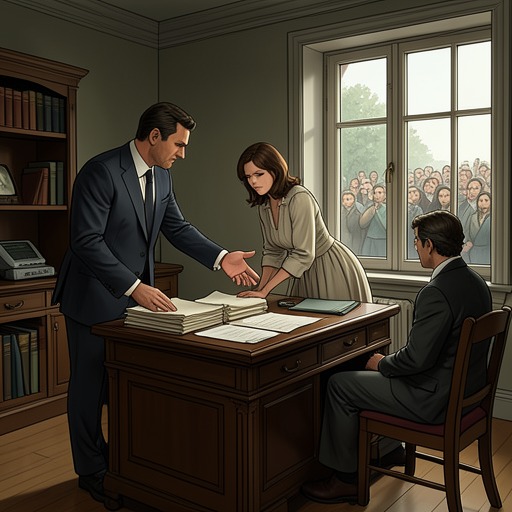
Doyle's testimony is one strand in a broader archive that tries to understand the Chamberlain disaster after the fact. The Shadow Exploded treats the destruction of Chamberlain as an event repeatedly reconstructed through official reports, press accounts, and retrospective argument. In that setting, Doyle's value lies in the limits of what he can certify. He can report where he was, when he received Plessy's transmission, when he reached town, and whom he encountered; he cannot reduce the entire catastrophe to a simple, complete explanation.
His evidence also participates in the book's movement from immediate panic toward public memory. Later reporting describes Prom Night as history and portrays Chamberlain's residential streets as still standing around a blackened and shattered center. Houses remain neat on streets such as Morin Street and Brickyard Hill, yet many carry FOR SALE signs, while occupied homes bear black wreaths. Doyle's arrival belongs to the transition between those two images: the first stage of official response and the beginning of a civic aftermath in which the town must live with damage, departure, and unresolved meaning.
Doyle consequently functions less as a heroic rescuer than as a stabilizing witness inside a system that is failing around him. His testimony supplies the clock, the route, the radio call, the arrival, and the survivor encounters by which the disaster can be reconstructed. In a narrative preoccupied with how Carrie White's telekinetic power, the Spring Ball humiliation, and the town's institutional failures became inseparable, Doyle represents the factual impulse to document the collapse even when documentation cannot undo it.