Qian Berlan Fire Department
Stephen King Three Classic Novels Box Set: Carrie, 'Salem's Lot, the ShiningThe Chamberlain Fire Department is the town’s emergency firefighting organization, presented during the Ewen High School disaster as both a necessary public institution and a force rendered nearly helpless by sabotage. Its central significance lies in the gap between the existence of an organized response and the destruction of the systems on which that response depends: when the school burns, the department arrives, but the hydrants have been stripped of their nozzles and cannot supply the water needed to control the fire. The disaster therefore becomes more than a school catastrophe. It exposes the vulnerability of Chamberlain’s civic infrastructure and allows Carrie White’s telekinetic retaliation to spread through the town.
Organization and Emergency Role
The department operates within Chamberlain’s local emergency network, alongside the police, municipal water authorities, volunteer responders, and neighboring communities’ fire services. During the prom disaster, its personnel are expected to protect the school and rescue those trapped inside, but the crisis quickly exceeds ordinary firefighting. A contemporary Associated Press report states that fire crews reached the gymnasium where the prom was taking place and were unable to make effective progress. The report emphasizes that the hydrants in the area had been vandalized and that the water pressure from the city mains was compromised between Spring Street and Grass Plaza.
The failure is not simply a matter of insufficient manpower. The hydrants have been stripped of their nozzles, leaving the arriving firefighters without usable connections to the water supply. The report describes them as spouting uncontrollably while the students inside were burning. Three bodies had been recovered at that stage, including Thomas B. Mears, a Chamberlain fireman, while the other two were apparently prom-goers. The department thus suffers losses among its own personnel even as it attempts to save the students, making the emergency response part of the casualty field rather than a force standing outside it.
Response to the Ewen High School Fire
The department’s response unfolds against rapidly changing reports. Sheriff Otis Doyle later testified that he received a radio transmission from Officer Jacob Plessy at 10:21 p.m. By 10:42, a State Police message relayed through the Motton Fire Department described a fire, an apparent riot, and a probable explosion at Ewen High School. No one yet understood the full situation; the sheriff stressed that the principal events had occurred within roughly forty minutes. The department was therefore responding under conditions of incomplete information, with the school fire already joined to panic, explosions, and the collapse of normal communication.
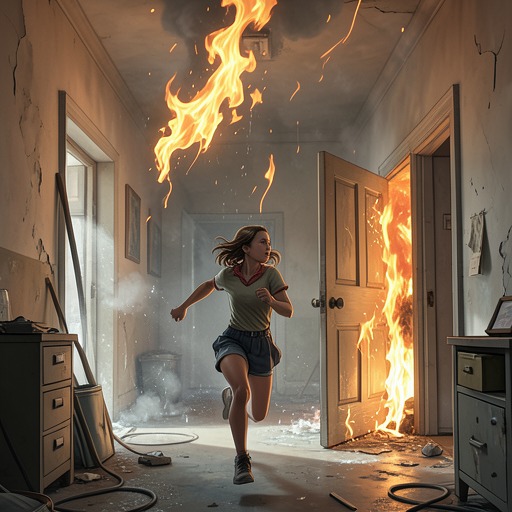
At the school, the sprinkler system initially creates the appearance of rescue. Water falls across the gymnasium, and the panic at the doors briefly stops as students look toward the ceiling. Yet the water does not restore order. The electrical equipment used by Josie Vreck and the Moonglows turns the flooded floor into a lethal hazard: Josie Vreck is unable to release a microphone stand, an electrical flash follows, smoke rises from his shirt, and an amplifier falls into the water. The resulting fire spreads from the band’s equipment to the stage mural and then through the backstage stores of uniforms, books, and papers. The department must confront a building in which the sprinkler system, electricity, fuel, and combustible scenery have become parts of one accelerating chain of failure.
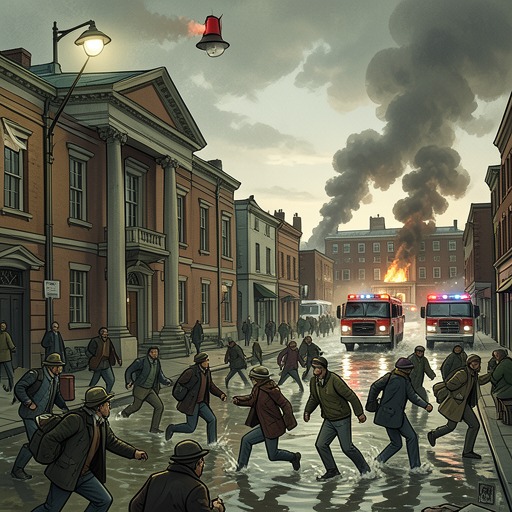
The fire crews’ practical options are further reduced by the ruined hydrants. At Grass Plaza, Thomas K. Quillan witnesses a hydrant’s large side nuts unscrewing themselves before the hydrant blows. He sees Carrie White nearby and recalls her seeming satisfaction that the destruction would give the town a shower. When the new pumper reaches the school, the firefighters begin working on the hydrants and discover that no water is available. Chief Burton is shouting as the school explodes. This testimony links the department’s operational failure directly to the supernatural manipulation of the town’s water system, while also preserving the uncertainty and shock of an eyewitness account that cannot explain what it has seen.
Cascading Municipal Failure
The department’s inability to obtain water allows the school fire to become a wider urban emergency. Sheriff Doyle later reports that the entire upper half of Chamberlain’s business section is burning. The Amoco station is gone, Woolworth’s is reduced to a blazing frame, and the fire spreads to Duffy’s Bar and Grille, the Kelly Fruit Company, and the billiard parlor. Sparks threaten the Maitland Real Estate Agency and Doug Brann’s Western Auto Store. The high school itself is isolated from nearby buildings, but the town’s commercial center is not; once fires begin there, the department’s damaged water network leaves surrounding structures exposed.
The two old volunteer fire department pumpers from Westover are able to do little beyond wetting the roofs of nearby buildings. Their presence shows that neighboring assistance is attempted, but it cannot compensate for the deliberate destruction of Chamberlain’s hydrant system. The Chamberlain Fire Department is consequently trapped between a disaster too large for local capacity and infrastructure too damaged for outside equipment to use effectively. Firefighting becomes defensive rather than restorative: crews can dampen some roofs, but they cannot reclaim the school or halt the main spread of fire.
The failure of water is accompanied by a failure of coordination. Motton and Westover ask whether ambulances should be sent, and Otis Doyle orders everything available, including hearses. Young people establish a hospital in the police station, where the floor is expected to become stained with blood. Meanwhile, the telephone exchange jams every town line still operating, and the staff cannot cope with the volume of calls. The fire department therefore works inside a broader breakdown in which warning, dispatch, rescue, medical treatment, and public communication all become unreliable at once.
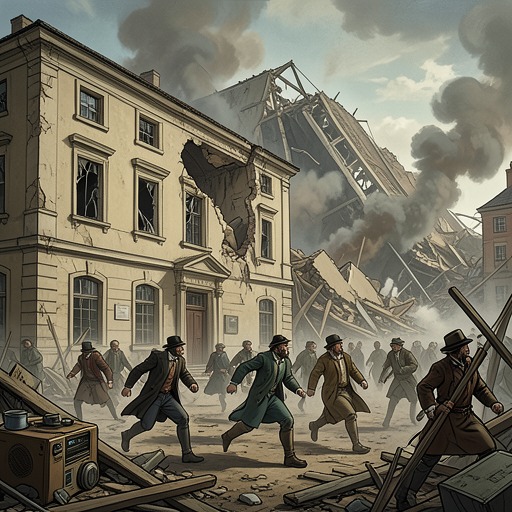
The disaster continues after the immediate firefighting effort. At 12:06 a.m., a gas main on Jackson Avenue is opened; at 12:17, an ambulance attendant discards a cigarette butt while the rescue vehicle is traveling toward Summer Street, causing an explosion that destroys nearly half a block, including the offices of the Chamberlain Clarion. By 12:18, Chamberlain is cut off from the outside world. The department’s failure to secure the fire and the town’s utilities permits the emergency to move from school grounds into streets, businesses, communications, and transportation routes.
Institutional Meaning and Aftermath
The Chamberlain Fire Department is not portrayed as the originator of the catastrophe. Its members arrive in response to a crisis produced by Carrie White’s retaliation and by the actions of those who have sabotaged the town’s systems. Yet the department’s experience demonstrates how responsibility in a disaster can become distributed across human violence, supernatural force, municipal design, and institutional weakness. The firefighters are required to act within a network whose essential components have been made unusable: hydrants cannot deliver water, telephones cannot carry instructions, and the school’s own safety equipment becomes entangled with electrical danger.
The death of Thomas B. Mears gives the organization a direct human cost. He is identified among the first recovered bodies while the fire remains out of control, a detail that prevents the department from appearing merely as a failed mechanism. Its personnel are also victims of the same civic collapse they are trying to contain. The neighboring volunteer pumpers from Westover, the requests for ambulances from Motton and Westover, and the improvised hospital in the police station together suggest a community attempting mutual aid after its formal systems have been broken.
In the post-disaster account, Chamberlain remains a town marked by what happened at the prom. A later newspaper description calls Prom Night history but presents the town as a blackened and shattered center surrounded by residential streets that are still standing. Houses carry black wreaths, and many have For Sale signs. The department’s response is therefore part of the town’s lasting memory: not a successful containment of an isolated school fire, but an encounter with a catastrophe whose infrastructure failures helped turn a single act of retaliation into the destruction of Chamberlain’s civic heart.