Teddy's Amoco
Stephen King Three Classic Novels Box Set: Carrie, 'Salem's Lot, the ShiningTeddy's Amoco is the gas station whose sabotaged pumps turn an ordinary Chamberlain roadside location into one of the central engines of the Chamberlain disaster. Its destruction is not merely another burst of fire after the Spring Ball massacre: the station exposes how damaged infrastructure, delayed information, and a single human act can convert a familiar civic landscape into an expanding field of death.
Setting and Ordinary Function
Teddy's Amoco stands at the corner of Main and Summer, a recognizable part of Chamberlain's commercial landscape. The station is associated with Teddy Duchamp, who had been dead since 1968, but its routines continued under his son. The pumps were locked every night with Yale padlocks, a small act of maintenance that made the station appear controlled and dependable. That ordinary security becomes crucial because the later disaster depends on its deliberate removal.
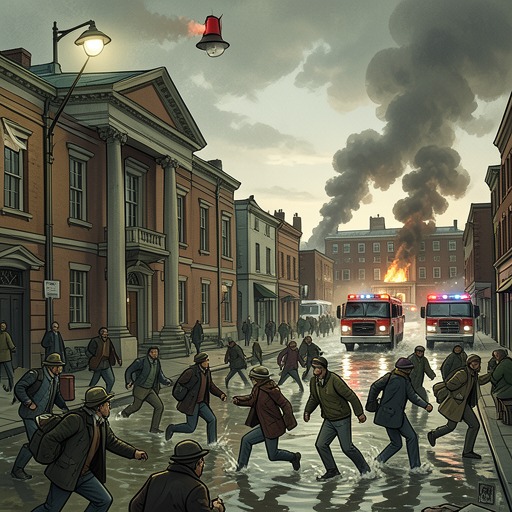
The station is also encountered as part of the town's immediate visual and practical world rather than as an isolated symbolic site. Wet streets, reflected light, traffic, sirens, and the movement of people toward the school place it within a connected urban system. Its fuel supply links it materially to the school fire, the police response, and the surrounding streets: once the pumps are forced open, the station can no longer remain only a place of commerce.
Sabotage and the Uncontrolled Fuel
After trouble begins at Ewen Consolidated High School, a witness looking toward Teddy's Amoco sees that all six gas pumps have been pulled from their mounts. Every Yale padlock is broken at its hasp, the nozzles lie on the tarmac, and the automatic feeds are switched on. Gas pours across the sidewalk and into the street. The details matter because they establish preparation rather than accidental malfunction. The station has been physically rearranged from a regulated machine into an open, spreading source of fuel.
The scene's danger is intensified by the mismatch between the station's former order and its new material behavior. The pumps had been locked as part of a nightly routine; now their mechanisms continue feeding gasoline while the safety system that contained them has been destroyed. The station becomes conspicuous as a thing out of place, its nozzles detached and its fuel escaping into public space. Human observers recognize the threat, but the infrastructure itself drives the crisis onward faster than ordinary intervention can contain it.
A man runs nearby with a lighted cigarette. The witness shouts a warning that the cigarette is dangerous because gasoline has flooded the sidewalk and street, but the man does not hear over the fire sirens, the town whistle, and the traffic. When the man is about to throw the cigarette, the witness ducks back inside. The moment compresses the disaster's central gap between knowledge and control: the danger is visible, the warning is attempted, and yet noise, panic, and physical distance prevent the warning from becoming protection.
Explosion and Death
Jacob Plessy is killed in the subsequent explosion of Teddy's Amoco. The sheriff first learns that trouble has broken out at Ewen High through a radio transmission from Officer Jacob Plessy at 10:21, but Plessy does not report back because the station explosion takes his life. Teddy's Amoco therefore marks a direct break in the town's emergency communications: an officer who is part of the response network disappears before he can provide further information.
The explosion is also witnessed as a violent transformation of the town's nighttime geography. At 11:15, Teddy's Amoco suddenly erupts with a great roar, producing a flash bright enough to make people stagger back against a police car and shield their eyes. An oily cloud of fire climbs over the elms in Courthouse Park, illuminating the duck pond and Little League diamond in scarlet, while glass, wood, and fragments of gas-station cinderblock fall back to earth. A secondary explosion follows, prolonging the shock rather than allowing the event to end with a single blast.
The station's destruction is part of a sequence rather than an isolated climax. It follows the fire at Ewen Consolidated High School, where the Spring Ball was taking place and whose area fire hydrants have been vandalized, leaving firefighters without usable water pressure. It is followed by the explosion at Tony's Citgo on Summer Street. Reports circulating afterward connect the school, Teddy's Amoco, and the second gas station into one chain of catastrophe, even as frightened witnesses struggle to understand what has happened.
Communication, Escape, and Aftermath
The explosion at Teddy's Amoco contributes to the collapse of Chamberlain's ability to respond as a community. At 12:06 a.m., a gas main on Jackson Avenue is opened, and at 12:17 an ambulance attendant from Motton throws out a cigarette butt as the rescue vehicle speeds toward Summer Street. The resulting explosion destroys nearly half a block, including the offices of the Chamberlain Clarion. Seven minutes earlier, at 12:10, the telephone exchange has suffered a softer but equally consequential explosion: every town phone line still operating becomes jammed, leaving the three girls on duty unable to cope with the calls.
This sequence makes Teddy's Amoco part of a broader infrastructure failure. Fire hydrants have been vandalized, fuel systems have been forced open, police communication has been interrupted by Plessy's death, telephone lines are overwhelmed, and later explosions damage the physical routes by which information and rescue might travel. The town is not simply burning; its systems of warning, movement, and coordination are being dismantled at the same time.
The station also becomes part of the population's fragmented memory of the night. Jackie Talbot recounts that Carrie and Tommy Ross were named King and Queen at the high school, that blood was dumped on them, that Carrie ran out, and that the school caught fire. He then lists Teddy's Amoco and the station on Summer Street among the explosions. His account does not establish a complete explanation, but it shows how the gas station enters the immediate search for a cause: every place where something happened is associated with Carrie, and the damaged location becomes evidence in a frightened attempt to turn scattered destruction into a single story.
Narrative and Thematic Significance
Teddy's Amoco embodies the disaster's movement from routine order to uncontrollable consequence. The station begins as a maintained commercial fixture, guarded by locks and nightly habit. Once those protections are broken, gasoline crosses the boundary between station and street, and a cigarette, unheard warning, or delayed response can become decisive. The location's material systems do not merely serve the human plot; their forced opening determines how far the violence can travel and how difficult it becomes to stop.
Its significance is therefore both practical and symbolic. The school fire reveals the failure of fire protection; Teddy's Amoco reveals the weaponization of fuel and the death of an emergency officer; the later gas-main and telephone failures reveal a town cut off from the wider world. Together, these moments turn Chamberlain's familiar places into agents of isolation. The station remains a concrete site in the disaster's chain, but it also stands for the fragility beneath ordinary civic reassurance: locks, pumps, roads, phones, and official channels all appear stable until one breach makes their hidden power visible.
In the later account of the disaster's legacy, Chamberlain is described as a town whose residential streets remain while its central hub is blackened and shattered, with houses marked by black wreaths and many placed for sale. Teddy's Amoco belongs to that shattered center. Its explosion helps convert Prom Night from a school tragedy into a town-wide catastrophe whose physical scars, deaths, disrupted communications, and enduring grief continue long after the flames have gone.