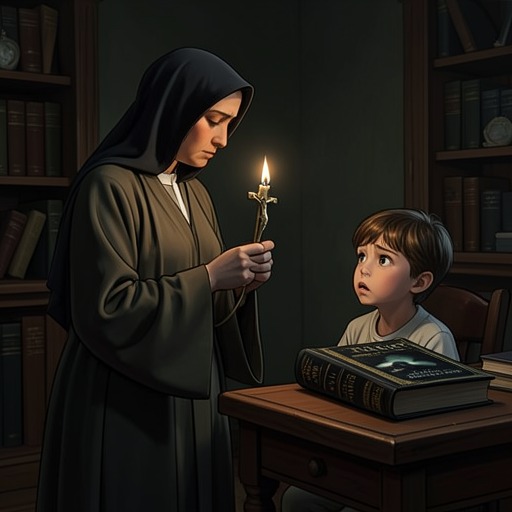
The Angel's Fiery Sword
Stephen King Three Classic Novels Box Set: Carrie, 'Salem's Lot, the ShiningThe Angel's Fiery Sword is the half-recovered religious image that surfaces in Carrie White's mind after the destruction of Chamberlain. It gives shape to an otherwise confused obligation: badly wounded, moving through the night, Carrie remembers an angelic weapon associated with judgment and destruction, but cannot fully recover what it means. The phrase therefore becomes less a stable doctrine than the final mental residue of Margaret White's religious world, carried into the catastrophe by the daughter who has both suffered under it and enacted its violence.
Religious Image and Inherited Meaning
The image appears through several overlapping forms: "the Angel with the Sword," "The Fiery Sword," and the recollection of something connected with "roadhouses parking lots." Carrie remembers it after leaving the White family home, but the memory arrives in fragments. She knows there is something she is supposed to do, something about the Angel with the Sword, yet the thought slips away with the words "Never mind. It would come to her." The broken recall matters. The image retains emotional force even when its narrative or theological explanation has become inaccessible.
The Angel's Fiery Sword belongs to the vocabulary of Margaret White's religious fanaticism, in which sexuality, punishment, sin, and divine judgment have been fused. Carrie has been taught to understand her body and her relationships through condemnation, while the community has treated her humiliation as entertainment and then as evidence of monstrosity. The image consequently carries two kinds of authority at once: it resembles a sacred command inherited from her mother, but it also expresses the coercive logic through which suffering is converted into a duty to punish.
The Sword in Carrie's Flight
After the White house has been attacked by fire and Carrie has been gravely injured, she forces herself out through the back door and across the lawn. She rests against a tree, dizzy and nauseated, tasting blood while smoke enters through the windows and the flames spread to the neighboring property. At 1:15 AM, she crosses back yards to Willow Street and crawls up the embankment toward Route 6. The remembered sword belongs to this interval of exhaustion, when physical survival and mental purpose are almost indistinguishable.
Carrie's progress is sustained by brute determination. She falls into a brook, drags herself out icy and shivering, and continues for three miles toward The Cavalier. Susan Snell's psychic awareness follows this movement without deliberate effort, making the sword-image part of a shared aftermath rather than a private symbol sealed inside Carrie's mind. Carrie is traveling for Momma; the remembered maternal command remains active even after Margaret White's death. The sword thus marks the persistence of an abusive religious bond: Carrie has escaped the house, but the house's imperative continues to direct her body.
From Sacred Weapon to Urban Destruction
The image also illuminates the larger course of the disaster. Carrie moves through Chamberlain as if carrying out a judgment, and her telekinetic power turns ordinary civic objects into instruments of catastrophe. At Main Street she reaches a fire hydrant and tries to twist its large painted lug nut. The metal resists her, heavy and tightly fastened, but the attempt shows how the language of sacred fire has been translated into an attack on the town's practical defenses.
Earlier, inside the Carlin Street Congregational Church, Carrie has prayed in her wet, torn, bloodstained gown, kneeling barefoot with feet cut by broken glass. Psychic force has thrown pews down, sent hymnals flying, and driven a silver Communion set across the nave into the far wall. She receives no answer. In the scene's decisive reversal, the church is no longer a place where judgment might be mediated by God; it becomes a damaged chamber in which Carrie concludes that God has turned away, even though the horror is as much His doing as hers. The Fiery Sword therefore moves from religious emblem to failed appeal: Carrie seeks an explanation in sacred space, finds silence, and leaves to complete the destruction herself.
Judgment, Witness, and Aftermath
The sword's meaning is inseparable from the public attempt to explain the Chamberlain disaster. Contemporary accounts describe the destruction as one of the twentieth century's defining catastrophes and debate whether Thomas Everett Ross functioned as a knowing or unknowing trigger. Other testimony insists that witnesses simply knew Carrie White was responsible, without being able to give a rational account of how they knew. Susan Snell's later questioning likewise exposes the strain between direct experience and the authorities' desire for a clean chain of responsibility.
That documentary framework makes the sword an emblem of interpretation as well as action. The disaster is repeatedly translated into religious, psychic, scientific, and legal vocabularies: Carrie is treated as a girl with an immense TK potential, as the product of abuse, as a possible supernatural threat, and as a convenient object of blame. The sword belongs to the religious vocabulary, but the surrounding testimony prevents it from becoming a complete explanation. It can describe the emotional grammar of Carrie's violence, not reduce the violence to a single supernatural cause.
The image finally remains unresolved. Carrie cannot fully remember what she was meant to do, yet she continues toward The Cavalier, still driven by the thought of Momma and by a command that has outlived its speaker. The published account declares that the Carrie White affair is over while warning that the future consequences of TK research and social response have only begun. In that context, The Angel's Fiery Sword is not merely a weapon from inherited scripture. It is a recurring sign of how private repression becomes public catastrophe, how moral panic seeks a scapegoat, and how a sacred symbol can survive as a broken command inside the person it was meant to control.