Thomas K. Quillan
Stephen King Three Classic Novels Box Set: Carrie, 'Salem's Lot, the ShiningThomas K. Quillan is a Chamberlain police officer whose testimony provides one of the clearest outside views of the Ewen High School Spring Ball disaster and its spread through the town. He does not witness the events inside the gymnasium from their beginning, but his account establishes the catastrophe’s public scale: a school fire, failed emergency response, Carrie White moving through the streets in the wreckage of her party dress, and Chamberlain entering a chain of fires, explosions, blocked communications, and mass flight. His later appearance beside Victor Mooney’s cruiser also gives the ruined town a living emblem of continuity: Quillan is shaken, disordered, and still physically intact, a fragment of ordinary Chamberlain amid its destruction.
Identity and Position
Thomas K. Quillan appears in the record through sworn testimony taken before the State Investigatory Board of Maine concerning the events of May 27–28 in Chamberlain. The testimony is presented in an abridged form from Black Prom: The White Commission Report, placing his observations within the retrospective, documentary structure used to reconstruct the disaster. He is identified as a resident of Chamberlain and as someone sufficiently connected with local police operations to be present at the station during the emergency, although the evidence does not supply a full biography or rank beyond that civic role.
His importance comes from the position he occupies between official response and personal shock. He is not one of the students at the Spring Ball, nor is he presented as a specialist capable of explaining Carrie White’s telekinesis. Instead, he is a local witness who sees the emergency from a police-station window, hears the fire whistle, and then moves into the streets. His testimony therefore records what the disaster looked like to a person suddenly pulled out of routine and forced to interpret events faster than reliable information could arrive.
Witness to the School Disaster
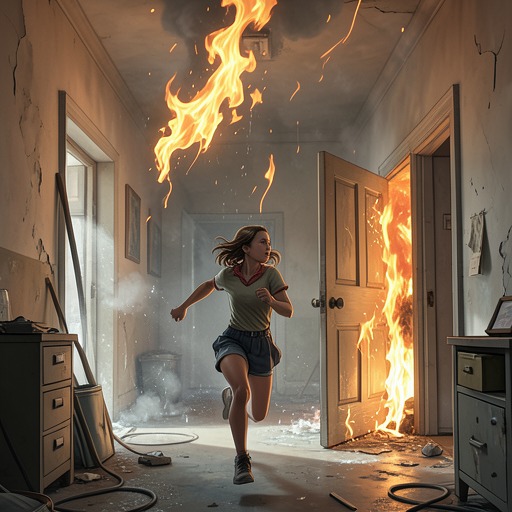
Quillan recalls being left alone in an open cell when the fire whistle sounded at night, a sound he had not heard since the Vietnam War ended. The alarm breaks the station’s expected order: there is no one in the office, and he immediately thinks that Jacob Plessy will be blamed because someone is supposed to remain available for incoming calls. The detail links the personal confusion of the witness to a concrete failure in emergency procedure. Even before Quillan sees the school, the system intended to receive and transmit danger is already unattended.
From the station window, Quillan can see Ewen Consolidated High School across the street, roughly a block and a half away. He sees people running and yelling, and then sees Carrie White, whom he says he had never seen before. That unfamiliarity matters: his account is not shaped by the years of school bullying that preceded the disaster, and he encounters Carrie only as a strange, terrifying figure emerging from the crisis. His testimony transforms her from an isolated student known to classmates into a public presence observed by the town.
Quillan places Carrie’s appearance at around twenty to eleven. She is wearing what remains of a party dress, is soaked by a hydrant, and is covered with blood. He compares her appearance to someone who has crawled out of a car accident, but the most unsettling feature for him is her grin, which he describes as resembling a death’s head. He sees her looking at and rubbing her hands against her dress, apparently trying to remove the blood. The image concentrates the disaster’s central blood motif: the blood is no longer confined to the humiliation at the dance, but has become something Carrie carries into the town and cannot simply wipe away.
The testimony becomes uncertain when Quillan reports what Carrie was thinking: that she would pour blood over the whole town and make it pay. When questioned about how he could know her thoughts, he admits that he cannot explain. This limitation is essential to his role. Quillan is a direct observer of Carrie’s physical condition and movement, but his account also contains an unresolvable leap from visible behavior to inferred intention. The record preserves that gap rather than supplying a rational explanation, allowing his testimony to show how witnesses confronted an event that exceeded ordinary categories of observation.
From Local Emergency to Civic Collapse
The school disaster unfolds through infrastructure that fails in succession. A fire originating in electrical equipment associated with Josie and the Moonglows spreads through the gymnasium and backstage areas, while the fire response is rendered ineffective because hydrants in the surrounding area have been vandalized. The failure is not merely a matter of flames inside a building: damaged access to water turns a school emergency into a wider municipal vulnerability. Quillan’s alarm and subsequent movement occur within this larger breakdown of systems that should have contained the fire.
The official record also places the police response inside a widening information crisis. Victor Mooney’s report records that Sheriff Henry Grayle received a radio transmission from Officer Jacob Plessy at 10:21, while later national reporting announces a disaster of major proportions without yet possessing a complete account. There are no further Associated Press reports from Chamberlain after the initial bulletin. At 12:06 a.m., a Jackson Avenue gas main is opened; at 12:17, an ambulance attendant from Motton throws a cigarette butt from a rescue vehicle, and the resulting explosion destroys nearly half a block, including the offices of the Chamberlain Clarion. By 12:18, Chamberlain is cut off from the outside world.
Quillan’s testimony thus belongs to a disaster in which knowledge travels unevenly and emergency systems become part of the catastrophe. The telephone exchange is overwhelmed by a complete jam of the town’s surviving lines, leaving the operators unable to place or manage calls. The damaged hydrants, absent personnel, failed communications, and later gas-main explosion form a chain in which the original violence at Ewen Consolidated High School is amplified by ordinary civic infrastructure. Quillan does not explain that chain, but his experience at the station makes its human meaning visible: people must act while the institutions meant to organize action are themselves failing.
Survival and Recognition in the Ruins
After leaving the police station, Quillan encounters Victor Mooney outside and runs down the sidewalk to his cruiser. His appearance is comic and distressed at once: his hair stands up, he wears dirty green work fatigues and an undershirt, and his loafers are on the wrong feet. Yet Victor Mooney is intensely relieved to see him. Quillan is described as being as much Chamberlain as anything, and as present and intact. The contrast is sharp. His disorder shows how thoroughly the night has broken ordinary composure, while his survival offers one of the few immediate signs that the town’s social body has not been entirely erased.
Quillan asks whether Victor Mooney saw what happened and is told that Carrie White is responsible. When asked how he knows, he says that the knowledge simply came to him and cannot explain it. This exchange repeats the epistemic uncertainty of Quillan’s own testimony. Neither man possesses a complete, verifiable account in the moment; both are trying to form a causal explanation from fragments, sensation, and rumor. Quillan therefore functions not as a detective who solves the disaster, but as a witness inside a community whose shared understanding is being assembled amid panic.
The later record places his experience against the town’s enduring damage. A report on the legacy of telekinesis describes Chamberlain’s residential streets, saltboxes, and ranch houses as still standing in places, but the town as a whole remains on the rim of a blackened and shattered center. Many houses bear FOR SALE signs, and occupied homes display black wreaths. Quillan’s survival cannot restore what has been lost. Its significance is narrower and more human: he is one of the recognizable local figures who carries the event from immediate terror into testimony, memory, and the unfinished effort to understand how a school dance became the Chamberlain disaster.
Civic Memory and the Limits of Testimony
Quillan’s testimony also exposes the difficulty of assigning responsibility after a catastrophe that contains several different kinds of causation. The school fire, the vandalized hydrants, the abandoned police office, the jammed telephone exchange, the opened gas main, and the cigarette butt that ignites another explosion do not form a simple chain that can be reduced to one witness or one institution. His account records immediate observations, but it also preserves uncertainty, hearsay, and unexplained knowledge. That mixture is characteristic of the documentary reconstruction of the Chamberlain disaster: official inquiries seek a coherent sequence, while survivors encounter only disconnected alarms, glimpsed figures, and information arriving too late to prevent the next failure.
The larger record repeatedly places Quillan near the boundary between ordinary explanation and the supernatural. The scientific discussion of Carrie White’s telekinetic potential argues that such ability may remain hidden until extreme personal stress brings it forward, while the public record treats the destruction of Chamberlain as an event that irrevocably set something else in motion. Quillan cannot verify the mechanism behind the disaster, and his statement about knowing that Carrie was responsible is explicitly presented as something that merely came to him. His value as a witness therefore lies not in mastering the mystery, but in showing how the mystery entered civic knowledge: through frightened inference, incomplete reports, and testimony that remains credible about what was seen even when it cannot explain what was understood.
Narrative Function
Quillan gives the catastrophe an external scale without displacing Carrie White from its center. The students experience the Spring Ball disaster from inside the gymnasium, but Quillan sees the alarm from a police station, the school from a distance, and Carrie as she begins her passage through Chamberlain. His perspective converts a private history of ostracism and humiliation into a public emergency. The girl whom classmates had tormented for years is suddenly visible to an observer who knows none of that history, and the town receives her not as a bullied student but as a blood-covered survivor of a burning school.
That separation produces a grim irony. Quillan’s lack of prior knowledge makes his description seem independent, yet it also leaves him unable to recognize the accumulated social violence behind Carrie’s appearance. The record of the shower-room incident shows that girls threw sanitary napkins at her while she believed she was bleeding to death, and that the abuse had been preceded by years of practical jokes, insults, and deliberate humiliation. Quillan sees only the aftermath. His testimony is consequently both clarifying and incomplete: it establishes the reality and reach of the disaster while revealing how easily the conditions that produced it disappear when public attention turns to the final explosion.
His meeting with Victor Mooney extends this function from observation to communal recognition. The two men do not exchange a fully reliable explanation; they exchange shock, partial knowledge, and the relief of finding another local person alive. Quillan’s disordered clothing and misplaced shoes make the civic emergency bodily and immediate, while the description of him as intact makes survival itself a form of testimony. He stands for the town not because he can speak for every victim, but because he carries ordinary Chamberlain into the moment when ordinary Chamberlain has been broken.
Significance
Thomas K. Quillan is important as a witness of transition: from school incident to municipal disaster, from direct perception to uncertain interpretation, and from living panic to historical record. His evidence helps establish the chronology of the emergency, including the nighttime fire alarm, the view of Ewen Consolidated High School from the station, Carrie White’s appearance at approximately twenty to eleven, and the later collapse of communication and infrastructure. It also preserves the human texture of the crisis: fear of blame at the empty station, running crowds, a grotesquely damaged party dress, and the sight of a familiar civic figure arriving in confused but intact condition.
The final significance of Quillan’s role is ethical rather than investigative. He cannot undo the violence that preceded the disaster, explain Carrie White’s telekinesis, or restore the town after its center is blackened and shattered. What he can do is testify to the moment when private cruelty became public ruin. In the retrospective architecture of the account, that testimony resists a clean legend of supernatural destruction by keeping the disaster attached to failed procedures, damaged infrastructure, confused witnesses, and a community that had long participated in making Carrie an outcast. Quillan survives as one of the record’s modest but necessary custodians of that complexity.