Carlin Street
Stephen King Three Classic Novels Box Set: Carrie, 'Salem's Lot, the ShiningCarlin Street is both the fixed address of the White family and the principal geographic thread connecting Carrie White’s childhood, Margaret White’s religious household, and the last movement of the Chamberlain disaster. It begins as a street of surveillance, stigma, and enclosed domestic life; it ends as a burning passage along Carrie White’s route home, where the destruction of the town converges with the destruction of the White household.
Setting and the White Home
Carlin Street is identified in a 1966 report as a street in Chamberlain where stones fell from a clear blue sky onto Margaret White’s home. The attack damaged the roof extensively, ruined two gutters and a downspout, and made the White property an early visible site of the town’s unexplained violence. Margaret White, described in the report as a widow living with her three-year-old daughter, Carietta, could not be reached for comment. The domestic address therefore enters the narrative through public testimony and damage to property before it is fully encountered through Carrie White’s memory.
The White residence stands on Carlin Street as a small white house with blue shutters, also described as a bungalow. Ivy climbs its western side. Carrie White experiences the building through a contradictory mixture of hate, love, and dread: the ivy can appear picturesque, but in moments of fear it resembles a grotesque, veined hand gripping the house. The street and house are consequently more than neutral background. They embody a home that promises protection while also enclosing Carrie White within Margaret White’s religious authority and the family’s separation from ordinary community life.
Childhood Memory and Social Stigma
Carlin Street marks the starting point of Carrie White’s movement into public life. Carrie White remembers leaving the controlled environment of the small house on Carlin Street to walk to Barker Street Grammar School with a Bible under her arm. Her first public act there was to kneel before lunch in the school cafeteria, an act that provoked laughter and began the social humiliation that continued for years. The memory establishes a direct contrast between the supposedly controlled safety of Carlin Street and the hostile public world beyond it, while also showing that the street’s domestic shelter is inseparable from the beliefs that make Carrie White appear strange to other children.
The same isolation is visible in recollections by Estelle Horan, whose family lived beside the White property. Estelle Horan recalls that Margaret White objected to her daughter’s presence in the neighboring backyard and repeatedly complained about Estelle Horan’s bathing and sunbathing as a scandal. The unfinished hedge between the yards did not prevent conflict; it made the boundary visible while leaving both households exposed to one another. Estelle Horan also remembers that the Whites’ home seemed unusually closed. Even when she expected Margaret White to hang laundry, nobody came outside, and Margaret White never hung underwear on the back line, including Carrie White’s clothing when Carrie White was three. Carlin Street thus functions as a neighborhood setting in which domestic privacy becomes conspicuous and religious severity turns ordinary proximity into suspicion.
The Stones and the Street’s Early Violence
The first supernatural assault associated with Carlin Street begins with ice falling on the White property. Estelle Horan remembers seeing something glitter in the sun before it struck the edge of the White roof and shattered. More pieces then fell across the roof, the front and back lawns, and the sheet-metal cellar bulkhead, whose first impact produced a noise like a church bell. Melting water ran down the slate shingles, leaving a bright mass of ice caught between the roof and chimney before the event stopped as abruptly as it had begun.
The later rain of stones is even more concentrated. Stones fall out of a blue sky, whistling and screaming like bombs, but they strike only the Whites’ property. One knocks a downspout onto the lawn; others punch through the roof into the attic, cracking the roof and sending puffs of dust upward. The stones that hit the ground make the earth vibrate underfoot. In narrative terms, Carlin Street becomes the first place where Carrie White’s family is surrounded by an inexplicable violence that appears to answer the household’s atmosphere of repression. The event is publicly reported as damage, but privately it remains a formative image in Carrie White’s childhood memory, resurfacing when she later approaches home after the Spring Ball disaster.
The Church and Carrie White’s Return
Carlin Street also contains the Carlin Street Congregational Church, where Carrie White stops during the final night of destruction. After opening a gas main, she enters the church for what seems to her like a long period of prayer, although only minutes pass. She kneels before the altar in a wet, torn, bloody gown, barefoot and injured, while psychic energy throws pews down, sends hymnals flying, and propels a silver Communion set across the nave into a wall. The church offers a traditional place of refuge and judgment, but it cannot provide the answer Carrie White seeks. She leaves convinced that God has turned away from her and continues toward the White home to complete the destruction.
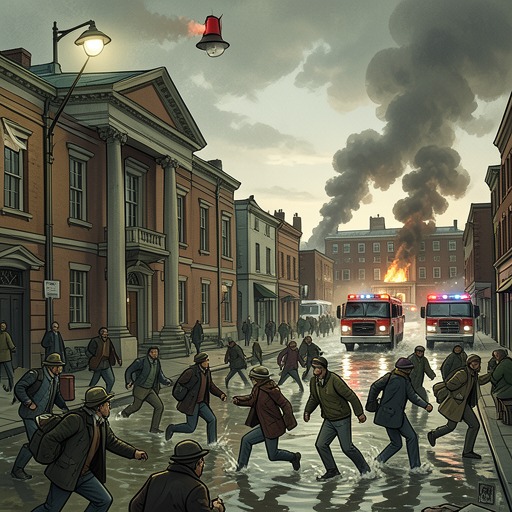
When Carrie White emerges from the church, Carlin Street is crowded with people moving toward the center of Chamberlain. She sees power transformers blooming with purple light, high-tension wires falling into the street, and people who touch the cables collapsing or burning. The street is no longer merely the location of the White family’s private history. It has become an active zone in the town-wide catastrophe, where electrical infrastructure, fire, panic, and psychic force converge. Carrie White turns back toward the church once, watches its heavy door swing shut, and then turns toward home.
The Chamberlain Disaster and Aftermath
The route through Carlin Street is part of a larger wandering path of destruction whose likely destination is the White house. Fires spread through the town as the school burns, hydrants are found vandalized, communications fail, and later a gas-main explosion destroys nearly half a block and cuts Chamberlain off from the outside world. On Carlin Street, an electrical fire caused by downed power lines eventually guts the entire north side, including the bungalow where Margaret White gave birth to Carrie White. The street therefore becomes the place where the town’s infrastructural collapse reaches backward into the family’s origin.
During the night, residents move along Carlin Street in large numbers, including people who come to see whether Chamberlain is burned and bleeding and others who come to die. Cora Simard later estimates that perhaps thirty people, or more, were walking there, although shock prevents her from knowing the number precisely. The crowd’s movement gives the street a collective dimension that contrasts with the solitary child once enclosed in the White home. Yet the crowd is not evidence of safety: Carlin Street is simultaneously an evacuation route, a viewing place, and a lethal corridor marked by live wires and fire.
By the following morning, the damage to Carlin Street has become part of Chamberlain’s permanent wound. The town’s later account describes the electrical fire as having consumed the north side, including the White bungalow, while the broader report presents the residential streets as standing around a blackened and shattered center. Carlin Street’s significance lies in this convergence. It holds the White family’s home, the neighborhood’s memories of religious conflict, the church where Carrie White’s last prayer fails, and the final fires that erase the house itself. The street is thus the novel’s clearest geographic expression of how private cruelty, public ostracism, supernatural retaliation, and civic collapse can become one continuous disaster.