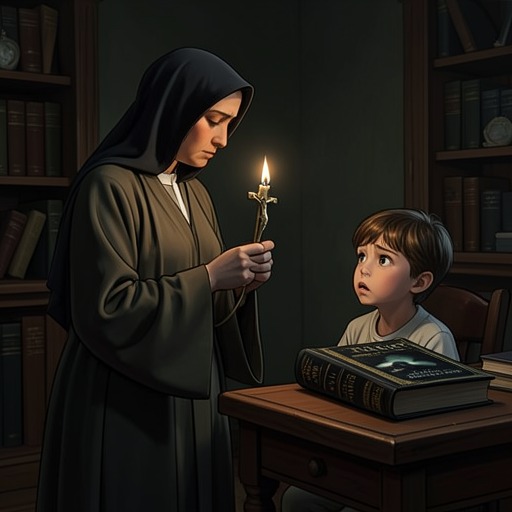
White family plaster crucifix
Stephen King Three Classic Novels Box Set: Carrie, 'Salem's Lot, the ShiningThe White family plaster crucifix is the central religious object in the White home and one of the clearest material expressions of Margaret White’s theology. Standing four feet high on the wall, it does not offer Carrie White consolation or protection: its bleeding, agonized Christ becomes an emblem of punishment, surveillance, and enforced submission. The crucifix gives the house a visual center in which religious belief, fear of the body, and family violence are made inseparable.
Appearance and Place in the White Home
The crucifix dominates a room otherwise furnished with a small deal table, a lamp, and a stack of religious tracts. It was specially mail-ordered from St. Louis, making it both a devotional object and a deliberately installed authority within the household. The Jesus fixed to it is represented in grotesque physical detail: his body strains in pain, his mouth is drawn into a groaning curve, and his crown of thorns sends scarlet streams down his temples and forehead. His eyes turn upward in an expression of medieval agony, while blood covers both hands and the feet nailed to a small plaster platform.
Its scale and placement matter. The object is not a discreet religious token but an overwhelming presence that governs the room around it. When Carrie enters the house after the shower-room humiliation, the crucified Jesus and Margaret White appear together as a “twin shadow” on the far wall. The image links the mother to the object’s authority: Christ’s suffering is presented beside Margaret’s presence, so that religious command and maternal control become visually continuous.
Fear, Dreams, and Sacred Authority
For Carrie, the crucifix is a source of recurring nightmares rather than spiritual reassurance. The mutilated Christ chases her through dream corridors with a mallet and nails, begging her to take up her cross and follow him. These dreams initially retain the recognizable vocabulary of Christian punishment, but they later become less intelligible and more sinister. The threat therefore exceeds a simple religious lesson. The crucifix becomes an object through which Carrie experiences an inescapable demand to accept suffering as her proper condition.
The room containing it also includes the open closet used for punishment. That closet, lit by a permanently burning blue bulb, is associated with Jonathan Edwards’s sermon “Sinners in the Hands of an Angry God.” Margaret drags Carrie toward this altar and closet while reciting her account of Eve, intercourse, blood, childbearing, and sin. The crucifix thus operates within a ritual arrangement: biblical language supplies the doctrine, the altar supplies the ceremony, the closet supplies confinement, and the object supplies the terrifying image of what obedience and punishment look like.
Margaret’s teaching makes bodily experience part of this sacramental terror. She describes Eve’s first sin as intercourse and menstruation and childbearing as successive curses, converting Carrie’s first menstrual period into evidence of inherited corruption. The crucifix’s blood consequently acquires a double force. It is the blood of Christ and, within Margaret’s household, part of a broader vocabulary in which female blood signifies sin, danger, and contamination. The object does not merely symbolize doctrine; it helps organize the meanings by which Carrie’s body is judged.
Conflict Between Carrie White and Margaret White
The crucifix is present when Margaret disciplines Carrie after the shower-room incident. Carrie is forced toward the altar while Margaret interprets her menstruation through a punitive account of Eve and Cain. The scene makes the object a witness to coercion, but it also shows how Margaret uses religious surroundings to claim legitimacy for her violence. The sacred setting transforms a domestic assault into an alleged act of correction, while the physical crucifix reinforces the lesson that pain is divinely authorized.
That authority begins to fail when Carrie resists her mother. Later, as Carrie prepares for the Spring Ball, Margaret confronts her while holding Daddy Ralph’s Bible. Carrie straightens in a shaft of early spring sunlight rather than collapsing before the familiar religious command. The crucifix is not described as moving or attacking, but its established place in the household makes the moment a reversal of the old arrangement: Carrie’s body, previously bent by fear, begins to occupy space independently of the mother’s faith.
Margaret responds by turning suffering inward. She claws her own cheek, strikes herself in the mouth, brings blood, and marks the Bible with it while invoking the blood of the Lamb. Her gesture reveals how completely the household’s religious language has become entangled with bodily injury. The crucifix’s representation of sacred blood stands behind this performance, even when the object itself remains physically inert. Margaret’s self-harm makes visible the same punitive logic that had previously been directed at Carrie.
Material Symbolism and Narrative Function
The crucifix concentrates several recurring forms of contamination and sacrifice. Carrie’s menstrual blood is publicly exposed in the school shower room; religious language calls blood a curse; Margaret uses her own blood in a devotional gesture; and the Spring Ball later turns blood into a deliberate instrument of humiliation. The crucifix belongs to this chain because it presents blood as already sanctified, already interpreted, and already attached to suffering. The narrative repeatedly shows how such meanings migrate between body, ritual, object, and social spectacle.
Its horror also depends on revelation. At first, the crucifix is a fixed object in a private room, but the details of its face, wounds, and blood make its material presence increasingly difficult to ignore. Carrie’s nightmares animate it, while Margaret’s punishments give its theology practical force. The object remains still, yet it appears to participate in the house’s violence by making pain the dominant image through which authority is understood.
The crucifix also belongs to the novel’s Gothic use of domestic space. The White home is not simply a shelter containing a religious ornament; it is arranged like a private site of judgment, with the altar and punishment closet turning architecture into doctrine. The object’s immobility intensifies this effect. Unlike Carrie’s later telekinetic power, the crucifix never needs to move in order to control the scene. Its permanence makes it a constant point of reference, a silent instrument of moral pressure whose influence is exercised through repetition, placement, and the fear attached to it.
Significance in the Larger Disaster
The crucifix does not directly cause the destruction of Chamberlain, but it helps explain the emotional and symbolic conditions in which the disaster develops. Carrie’s humiliation, Margaret’s religious fanaticism, and the social treatment of blood as something both shameful and theatrically exploitable all converge around the object’s imagery. The crucifix therefore connects the intimate violence of the White home to the wider culture that turns Carrie into an object of ridicule and later interprets catastrophe through sensational religious and psychic explanations.
Its final significance lies in the contrast between sacred suffering and human responsibility. The crucifix offers an image of pain that Margaret treats as a command, while Carrie experiences the command as imprisonment. When Carrie’s hidden telekinetic capacity emerges under extreme personal stress, the force is described in scientific terms as a potential that had remained submerged until crisis brought it forward. The crucifix is not the source of that power, but it is part of the oppressive world that helps make extreme stress possible. As a result, the object stands at the intersection of belief and violence: a household emblem that claims to represent redemption while functioning, for Carrie, as the face of punishment.