Chamberlain police station and courthouse
Stephen King Three Classic Novels Box Set: Carrie, 'Salem's Lot, the ShiningChamberlain police station and courthouse is the civic nerve center through which the Chamberlain disaster is seen, reported, and later interpreted. During the fire at Ewen Consolidated High School, the building stands close enough to the catastrophe to receive its sound and light, yet its officials are unable to command an effective response. Afterward, it becomes a refuge for survivors and a setting for testimony, linking the immediate collapse of public order to the official effort to assign responsibility.
Civic Center Under Siege
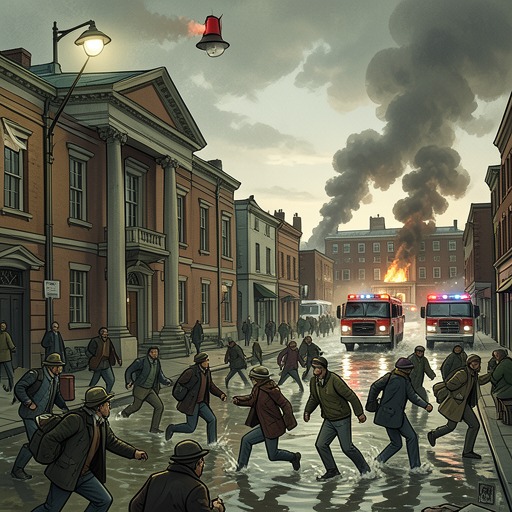
From the police-station steps, an unidentified man cups his hand around his mouth and screams toward the burning town, although the words are obscured by the town whistle, fire sirens, and the roar of the blaze. The station and courthouse therefore appear not as a place of control but as a fixed point inside a spreading emergency: the building remains standing while communication and response around it become confused and ineffective.
The breakdown is partly infrastructural. The hydrants serving the area have been vandalized, and water pressure from the city mains is inadequate from Spring Street to Grass Plaza. The fire at the school consequently cannot be contained by the arriving fire crews. The station’s proximity to the school makes the failure especially stark; Officer Jacob Plessy later confirms that the school could be seen from a station window, only a block and a half away.
Alarm and Failed Coordination
A police account places the first official warning in the station’s communication chain. Sheriff Otis Doyle testifies that he received a radio transmission from Officer Jacob Plessy at 10:21, reporting that trouble had broken out at Ewen High School. Yet the station is not fully staffed when the emergency develops. A detained man, left alone in an open cell, says that the fire whistle frightened him into running upstairs, where he found no one in the office. The absence of an officer at the desk turns a procedural lapse into another sign that ordinary civic systems have already failed.
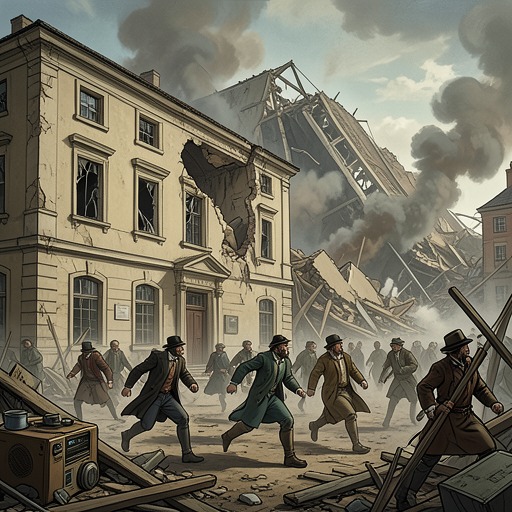
The station’s limitations are amplified by the wider collapse of communication. At 12:10 A.M., the telephone exchange is jammed, leaving the operators unable to handle the calls still coming through. At 12:06 A.M., a Jackson Avenue gas main is opened, and at 12:17 an ambulance attendant’s discarded cigarette ignites an explosion that destroys nearly half a block, including the offices of the Chamberlain Clarion. By 12:18, Chamberlain is cut off from the surrounding country. The police station and courthouse thus belong to a civic network whose physical buildings may remain, even as its hydrants, telephones, newspapers, and roads cease to function as a coherent system.
Refuge and Survivor Witnessing
As the disaster spreads through Chamberlain, the station becomes a place of temporary shelter. One survivor recalls reaching it by morning and lying on a blanket there with many other people, including a few young survivors still wearing their prom clothes. The same testimony describes people walking down Carlin Street in a group that may have numbered thirty or more, though the witness cannot be certain because of the shock. The station gathers the displaced without restoring what they have lost; it is a shelter after the disaster, not a successful defense against it.
The building also provides a point of recognition amid confusion. Testimony later records that Cora Simard identified Carrie White simply because she knew it was Carrie White. Another witness insists that Carrie White was responsible for the destruction. These statements show how the station’s legal function turns traumatic perception into official evidence, even when the testimony contains uncertainty, memory gaps, or knowledge that witnesses cannot fully explain.
Testimony and the Search for Responsibility
The courthouse side of the building becomes associated with the White Commission and the State Investigatory Board of Maine, where survivors and officials are questioned about the night. Susan Snell is pressed about her alleged meeting with Carrie White and challenged over how she could know Carrie was present when she had not heard her. She answers by invoking the unexplained recognition shared by Tom Quillan, Cora Simard, and Victor Mooney, then asks whether the investigators are seeking the truth or merely a scapegoat.
The questioning narrows the disaster into questions of personal knowledge and culpability. Susan Snell denies prior knowledge of Carrie White’s whereabouts, while the board treats that denial as an issue requiring formal examination. The contrast is central to the location’s meaning: the police station and courthouse preserve statements and demand answers, but the official setting cannot easily contain the larger chain of causes involving persecution, sabotage, institutional failure, and the supernatural force attributed to Carrie White.
Aftermath and Civic Memory
The station remains one of the few recognizable civic spaces in a town whose social and physical order has been shattered. Later accounts describe Chamberlain as a blackened and fractured center surrounded by residential streets that are still standing, with black wreaths on occupied houses and For Sale signs on many others. In that landscape, the station and courthouse symbolize both continuity and inadequacy. They survive as institutions of law and refuge, but their presence cannot undo the deaths, the fire, the communications collapse, or the exodus from the town.
Its narrative role is therefore deliberately double. The building is where warning should become action, where survivors can be protected, and where testimony can become public record. Instead, it witnesses the failure of response and then participates in the struggle to explain that failure. The courthouse’s later inquiry offers a language of evidence and responsibility, while the station’s earlier scenes preserve the more chaotic truth of the night: alarms were heard, the school was visible, people ran for safety, and the civic machinery of Chamberlain could not keep pace with the disaster.