Margaret White
Stephen King Three Classic Novels Box Set: Carrie, 'Salem's Lot, the ShiningMargaret White is Carrie White’s widowed mother and the central domestic force behind Carrie’s emotional and physical confinement. Living with her daughter in the White house on Carlin Street, Margaret turns religion into discipline: menstruation becomes sin, female embodiment becomes contamination, and Carrie’s developing telekinesis becomes proof of demonic inheritance. Her authority is not merely background pressure. It structures Carrie’s childhood, limits her contact with other people, and helps convert humiliation at Ewen High into a catastrophe that reaches far beyond the household.
Identity and Background
Margaret was born Margaret Brigham and raised in Motton, a town bordering Chamberlain. Her parents owned The Jolly Roadhouse, a prosperous night spot outside the town limits, but her family life was marked by rupture. Her father, John Brigham, was killed in a barroom shooting in the summer of 1959. Margaret was then almost thirty and began attending fundamentalist prayer meetings. She condemned her mother Judith Brigham and Judith’s new husband, Harold Allison, believing that their relationship was sinful; they, in turn, wanted her out of the house. Margaret remained until 1960, when she met Ralph White at a revival meeting and moved from Motton to a small flat in Chamberlain Center.
Margaret’s marriage to Ralph White did not produce a stable family narrative. Ralph died in February 1963 when a steel girder fell from a carrying sling at a housing-project job in Portland. Margaret continued living alone in the suburban White bungalow, and she gave birth to Carrie White on September 21, 1963. The account of Carrie’s birth describes the circumstances as bizarre and presents Carrie as the only child of a family already defined by religious extremity, bereavement, and inherited strangeness. By the time the Rain of Stones struck the White house on August 17, Margaret was a widow living with her three-year-old daughter; the stones extensively damaged the roof, ruined two gutters and a downspout, and established the supernatural threat that Margaret would later associate with Carrie.
Religious Rule and Domestic Punishment
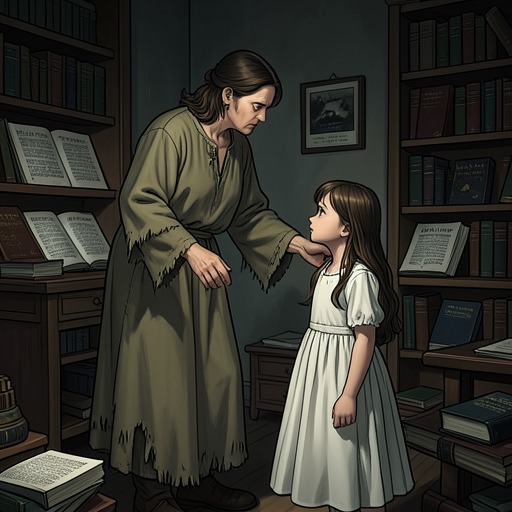
Margaret’s religion governs the house through commands, confinement, and bodily punishment. When Carrie first menstruates, she does not explain what is happening or protect her daughter from fear. Instead, she tells Carrie, “You're a woman,” then responds to Carrie’s terror with physical violence and biblical justification. Margaret strikes her across the jaw, kicks her as she crawls toward the household altar, and declares, “And God made Eve from the rib of Adam,” framing womanhood as a condition of weakness, wickedness, and sin.
The punishment culminates in the prayer closet. Margaret orders Carrie, “Go to your closet now,” and when Carrie resists, repeats the command and tells her to pray in secret and ask forgiveness. The closet is therefore more than a room used for discipline: it is the architectural form of Margaret’s theology. Carrie’s fear, sexuality, and emerging independence are sealed inside a private space where punishment is presented as salvation. Margaret’s insistence that safety exists only within the red circle of religious obedience extends the same logic into Carrie’s memory of childhood. Carrie remembers being marked as an outsider from her first day at Barker Street Grammar School, when public prayer provoked laughter; later, after Margaret forbade Christian Youth Camp, Carrie earned her own money through sewing, attended anyway, endured practical jokes and bullying, and returned home early. Margaret interpreted that suffering as proof that she was right and sent Carrie to the closet for six hours.
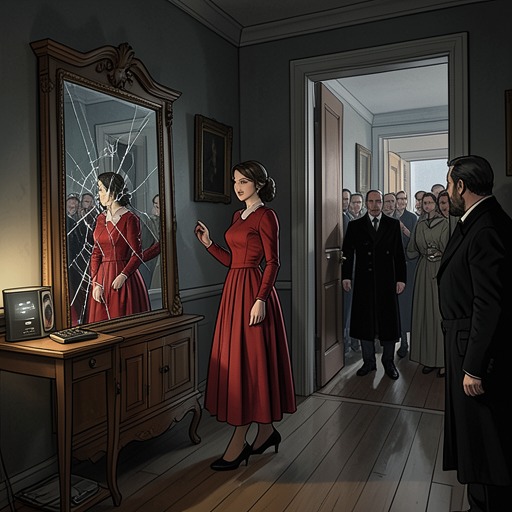
This pattern makes Margaret an intimate source of the stigma that follows Carrie through school. At Ewen High, the other girls see Carrie as a permanent object of ridicule: she stands under the communal showers, physically conspicuous and socially isolated, while the girls stare. Margaret’s prohibition of ordinary clothing and feminine self-presentation deepens that isolation. Carrie dresses in heavy, restrictive garments and imagines the condemnation Margaret would attach to the shorter skirts, patterned underwear, and exposed body shown in Seventeen. Margaret’s moral vocabulary has become part of Carrie’s self-surveillance, so that the daughter anticipates the judgment of both her mother and her classmates even when alone.
Fear of Sexuality and the Telekinetic Inheritance
Margaret interprets puberty as a sequence of spiritual and supernatural contamination. She believes that blood and sexual development summon the Devil, and she recognizes Carrie’s telekinesis as the return of an ability present in the maternal line. Margaret recalls her own grandmother lighting a fireplace without moving from her rocker and making the sugar bowl whirl across the supper table. The grandmother displayed the power alongside religiously coded signs of madness, including cackling, drooling, panting, and the Evil Eye; she died of a heart attack at sixty-six. Less than four weeks after the funeral, Margaret saw infant Carrie laughing while a bottle hung in midair above her crib.
That memory turns Margaret’s response to Carrie’s power into both fear and repetition. Margaret remembers trying to impose her duty when Carrie was three, after catching the child looking toward a neighbor’s daughter whom she calls the Devil’s slut. Stones then came, and Margaret weakened; thirteen years later, the power rose again after Carrie’s menstruation. Margaret feels the force as something that crawls and lifts around her, and she interprets it through the biblical command “Thou shalt not suffer a witch to live.” The same evidence that might identify Carrie as a person with an unusual inherited ability is thus transformed by Margaret into a case for religious eradication.
Margaret’s understanding also reflects the novel’s larger conflict between supernatural fact and social interpretation. A later account argues that telekinesis may emerge only under extreme personal stress and that a potential of immense magnitude existed within Carrie White. Margaret does not possess a scientific framework for that distinction. She collapses bodily change, sexual knowledge, inherited power, and moral guilt into one explanation: first the blood, then the power, and therefore the Devil. Her certainty prevents her from seeing Carrie’s ability as something that might be understood or guided; it can only be suppressed, punished, or destroyed.
The Final Conflict with Carrie
Margaret’s control reaches its decisive crisis when Carrie prepares for the Spring Ball. Carrie’s prom dress represents an attempt to stand upright within the social world rather than remain inside the clothing and shame imposed by home. Margaret meets her wearing a white sweater, carrying a black pocketbook and Daddy Ralph’s Bible. Carrie straightens in a shaft of spring sunshine and insists that the body Margaret condemns is ordinary: “Those are my breasts, Momma. Every woman has them.” Margaret answers by ordering her to remove the dress, promising to burn it in the incinerator and perform penance while they pray for the Pentecostal Fire.
Carrie refuses. That refusal is a small sentence with irreversible force: for the first time, Margaret’s command does not produce obedience. Margaret’s attempt to preserve religious authority therefore becomes a direct confrontation with Carrie’s emerging self-possession. The scene’s domestic objects, especially the Bible and the dress, place inherited doctrine beside the daughter’s claim to her own body. Carrie’s resistance does not free her from Margaret’s influence, but it breaks the household’s established pattern of command and submission.
After the Spring Ball disaster, Carrie returns to the White house in a wrecked prom dress streaked with clotted pig blood, with grease on her forehead and scraped knees. Margaret sees her daughter enter in a twisted, shrunken, crone-like condition and responds by narrating the catastrophe as the return of a long-awaited religious ordeal. She says that she had almost killed herself, that Ralph had spoken of atonement before his death, and that she had once mistaken her illness for divine punishment. She then reveals that, when the pains began, she took out Margaret’s carving knife and waited for Carrie so she could make a sacrifice. She had held the knife before, when Carrie was three, but had “backslid” both times; now, she says, the Devil has come home.
The revelation makes explicit that Margaret’s violence has always contained a sacrificial logic. Carrie is not simply a disobedient daughter in Margaret’s account; she is the object through which Margaret believes sin can be confronted and expiated. Maternal care, repentance, and attempted murder become indistinguishable. Margaret’s religious language gives her a framework for attacking Carrie while allowing her to imagine the act as duty rather than cruelty.
Death and Narrative Significance
When Carrie pleads for help and falls to her knees, Margaret leans forward and brings the knife down in a shining arc. Carrie jerks back, and the blade enters Margaret’s shoulder to the hilt instead of piercing Carrie’s back. Margaret’s feet catch in the chair legs, and she collapses in a sitting sprawl while mother and daughter stare at one another. The scene reverses the household’s old arrangement: the kneeling daughter is no longer helpless, and the mother’s weapon turns against the person wielding it.
Margaret’s death is the final consequence of the power she spent years naming, fearing, and trying to suppress. Her attempt to make Carrie into an instrument of religious punishment ends with Carrie’s telekinetic and bodily resistance interrupting the sacrifice. Yet the ending is not a simple liberation. Carrie leaves wounded, covered in blood, and still carrying the psychological burden of Margaret’s theology; the disaster at Chamberlain has already been set in motion. News reports describe the destruction as a disaster of major proportions, while later commentary says that the Carrie White affair is over but warns that the future consequences of telekinesis may be severe.
Margaret’s narrative role lies in the way she joins private abuse to public catastrophe. At school, Carrie is treated as a stigmatized object: girls mock her first menstrual period, call her names, and tell her to “plug it up.” At home, Margaret gives the same social shame a sacred vocabulary, enclosing Carrie within sin, blood, and punishment. The result is a feedback loop in which school cruelty confirms Margaret’s worldview, Margaret’s control intensifies Carrie’s isolation, and Carrie’s accumulated stress releases a power that neither family nor institution can contain. Margaret is therefore both a mother and a self-appointed moral authority, but her attempt to manage the supposed threat ultimately helps create the disaster she believes she is preventing.