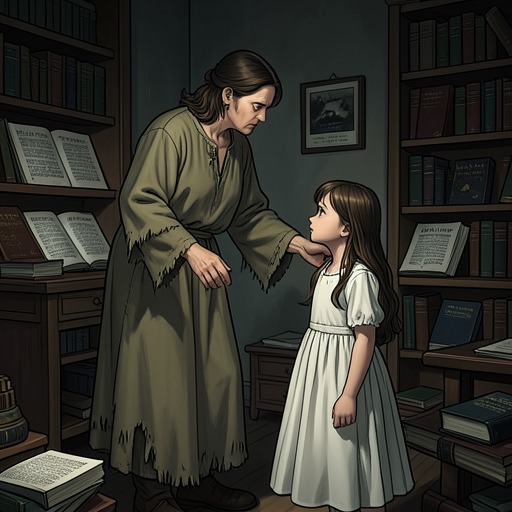
Margaret White's religious fundamentalism
Stephen King Three Classic Novels Box Set: Carrie, 'Salem's Lot, the ShiningMargaret White’s religious fundamentalism is not merely a set of private convictions but the governing system of the White household: it defines the body as sinful, ordinary desire as spiritual danger, and obedience as the only safe response. Its effects reach beyond the home, shaping Carrie White’s shame and isolation and intensifying their conflict whenever Carrie tries to claim an independent life.
Origins and Household Practice
Carrie White was born on September 21, 1963, in circumstances later described as bizarre. During the period of bereavement before her labor, Margaret White had no friends to support her; when labor began seven months later, she was alone. The account connects that isolation to the family’s near-fanatical fundamentalist beliefs. It presents religion as more than a source of comfort: Margaret’s convictions had also cut her off from companionship and ordinary communal support.
Margaret and her husband had once been Baptists, but the couple left that church after deciding that the Baptists were doing the work of the Antichrist. Thereafter, worship took place at home, with Margaret as minister and Carrie as congregation. Their services were held on Sundays, Tuesdays, and Fridays, each designated a Holy Day, and lasted two to three hours. The household’s religious order was therefore frequent, prolonged, and controlled by Margaret; Carrie had no wider congregation within the family’s regular practice.
The details of Margaret’s appearance reinforce the material presence of that authority. She carried a large black satchel containing a black King James Bible with her name stamped in gold and orange religious tracts held together by a rubber band. The Bible and tracts accompanied her as practical instruments of a faith she imposed at home and carried into public life. Her convictions also shaped how she interpreted the surrounding world: in Carrie’s recollection, Margaret treated politicians as sinners and feared that a Godless Communist takeover would put believers, Catholics included, against a wall. Political suspicion, denominational distrust, and religious discipline belonged to the same closed worldview.
Sin, the Body, and Carrie’s Inheritance
Margaret’s teaching gave puberty and sexuality a punitive theological meaning. In her account of the Fall, Eve’s weakness unleashes Sin, intercourse becomes the first sin, and the Curse of Blood accompanies expulsion from Eden and pregnancy. Menstruation is thus not explained to Carrie as a bodily process but placed inside a story of female transgression and divine punishment. The doctrine makes Carrie’s changing body evidence against her rather than a condition she can understand without shame.
That interpretation reaches into Carrie’s private thoughts. When she undresses, she measures her clothing and underwear against the smooth, fashionable images she has seen in Seventeen, but anticipates that Margaret would call such styles easy and would understand them as invitations to lust. Carrie imagines her nakedness as evil and exhibitionistic, and believes others can see how self-conscious she feels. In the school showers, amid girls who stare, her sense of being exposed and set apart exists alongside the social humiliation of her body. The novel’s account thus distinguishes the source of the shame from its reach: Margaret’s moral vocabulary has become part of the way Carrie judges herself even beyond Margaret’s immediate presence.
Margaret also taught Carrie to fear an ancient, evil Something that could make a person Feeble and bring thoughts of sexual activity in parking lots and roadhouses. Carrie’s recollection of a dream in which Margaret drives The Black Man out of the house with a broom shows how this supernatural vocabulary could make her mother seem like the sole defender against evil. In the dream, The Black Man flees up Carlin Street, his cloven feet striking sparks from the cement. Carrie’s religious imagination therefore contains both terror and dependence: Margaret identifies the danger, but also appears as the person able to defeat it.
Discipline and Resistance
The doctrine of sin becomes physical discipline. During worship, Margaret invokes Eve’s weakness and wickedness, then kicks Carrie and orders her to rise and pray. She asks God to help the sinning woman beside her see the sin in her conduct, and sends Carrie to the closet. On another occasion, after Carrie’s first menstrual period, Margaret again directs her to the closet and speaks of boys as what comes after blood, describing them as predatory figures drawn by its smell. The repeated movement from bodily change to accusation, prayer, and confinement makes the closet a mechanism of religious punishment, not a refuge chosen by Carrie.
Carrie’s memory of her first day at Barker Street Grammar School extends the pattern beyond the home. She had carried a Bible and knelt to pray before lunch; the other children stared, then laughed. She later understood that moment as the beginning of a long social mark, a Red-plague circle drawn around her. The scene does not make school cruelty an expression of Margaret’s beliefs, but it shows how Carrie’s visible religious behavior made her vulnerable to ridicule and how that ridicule accumulated alongside the discipline at home. At Ewen High School, other girls’ staring in the communal showers further deepens her sense of being watched and excluded.
Margaret’s own public history shows that her convictions could also produce conflict outside the household. A retrospective account says she had been suspended twice while at school. One suspension followed her beating a classmate with her purse; the story that she acted after seeing the classmate smoke was presented as legend, not established fact. The same speaker recalled Margaret condemning a teacher for giving students an outline of Darwin’s beliefs on evolution. This recollection depicts a pattern of treating conduct and ideas she regarded as sinful or threatening as matters requiring forceful correction. It also cautions against treating every detail of the story as certain: the smoking explanation is explicitly hearsay.
Carrie eventually voices a direct rejection of the life Margaret has prescribed. During an argument, Carrie says she does not want to fight, but wants to be allowed to live her own life and does not like Margaret’s. Margaret responds by calling her a witch and invoking the biblical prohibition against letting a witch live, adding that Carrie’s father did the Lord’s work. Afterward, Margaret whispers an exorcism prayer from Deuteronomy rather than the Lord’s Prayer. Her response recasts a daughter’s demand for independence as evidence of supernatural evil, closing off the possibility of treating Carrie’s objection as an ordinary expression of will.
Escalation and Significance
The conflict over Carrie’s autonomy recurs when she prepares for the Spring Ball. Margaret demands that Carrie take off her dress so they can burn it together, then proposes staying home from work while Carrie stays home from school, praying and doing penance until they receive a Sign and the Pentecostal Fire. She interprets the dress as a source of sin whose red must be cast away. The scene repeats the religious logic first attached to menstruation: the sight of blood or red fabric becomes a reason for fear, purification, and confinement.
The book leaves uncertain how fully Margaret recognized Carrie’s telekinetic ability, or what she thought of it. A later discussion suggests that the ability emerged most clearly under extreme personal stress, which could help explain why earlier instances went unnoticed; it does not establish Margaret’s knowledge or give her a definite supernatural diagnosis of Carrie. That uncertainty matters. Margaret’s rhetoric makes witchcraft and spiritual corruption available as explanations for defiance, but the evidence does not warrant claiming that she understood Carrie’s power in any systematic way.
Margaret’s fundamentalism gives the family’s private conflicts their governing language: blood becomes a curse, sexual maturity a threat, and disagreement a sign of evil. Its force lies both in Margaret’s punishments and in the beliefs Carrie has absorbed, which continue to shape her understanding of her own body and her place among others. When Carrie asks to live her own life, the two women are not simply disputing a dress or a rule. They are confronting incompatible claims about whether religious obedience can determine the limits of a daughter’s existence.