Pregnancy denial
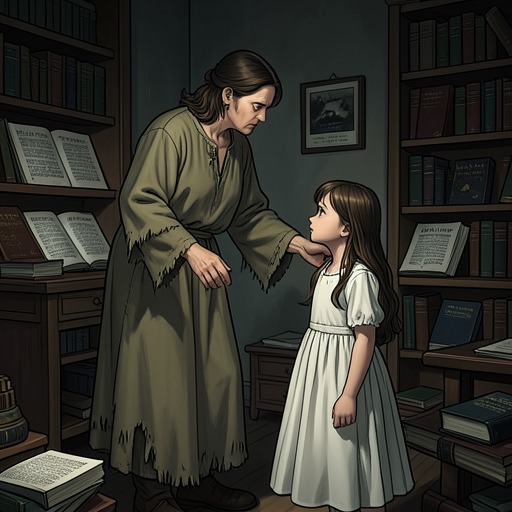
Stephen King Three Classic Novels Box Set: Carrie, 'Salem's Lot, the ShiningPregnancy denial is the contested explanation for how Margaret White could carry and give birth to Carrie while rejecting the possibility of sexual intercourse and, apparently, interpreting the physical signs of pregnancy as illness. Its significance lies in the gap between religious doctrine and bodily fact: Margaret’s letters insist that any child would be divine, yet Carrie’s birth follows the death of Ralph White and takes place amid blood, isolation, and delayed intervention. The novel leaves the exact nature of Margaret’s understanding uncertain, presenting the case through documentary accounts and later interpretation rather than a single conclusive diagnosis.
Evidence and Competing Explanations
Margaret’s August 19, 1962, letter to her mother-in-law, Judith Allison, declares that she and Ralph were living without intercourse, which she called the “Curse of Intercourse.” She urges Judith and Harold Allison to abandon their allegedly sinful household and presents abstinence as the only protection from a future “Rain of Blood.” Near the letter’s end, Margaret says that if there is a child, it should be divine. The calendar undermines that declaration: Carrie was conceived later in the same year. The contradiction establishes the central uncertainty of the state. Margaret’s language may reflect sincere conviction, denial, or an effort to make an actual pregnancy fit a religious framework that condemned sex.
Judith Allison offered a separate, earlier possibility: she thought Margaret might have suffered a miscarriage, in which case the pregnancy would have been conceived outside marriage. The account presents this as Judith’s suspicion, not as a confirmed event. Its importance is interpretive: if correct, it would further complicate Margaret’s claim to have lived without sexual relations, but the evidence does not resolve whether such a miscarriage occurred.
Later analysis proposes that Margaret did not simply fail to recognize pregnancy. The account considers it more plausible that the association between pregnancy and the sin of intercourse had been blocked from her mind, or that she refused to accept that pregnancy could happen to her. This remains a hypothesis rather than a definitive medical finding. The difference matters: the record gives access to Margaret’s statements and the circumstances of the birth, but not an authoritative account of her private understanding.
Pregnancy, Bereavement, and Carrie’s Birth
Ralph White died in February 1963 when a steel girder fell from a carrying sling at a Portland housing project. Margaret continued living alone in the White house in Chamberlain. Her near-fanatical religious beliefs had left her without friends to support her through bereavement; when labor began about seven months after Ralph’s death, she was alone. These circumstances place the birth within both isolation and loss, without establishing how Margaret understood the pregnancy or its timing.
Neighbors on Carlin Street began hearing screams at approximately 1:30 p.m. on September 21, 1963, but the police were not called until after 6:00 p.m. One resident, Georgia McLaughlin, later said she believed the screams had something to do with “holy rollin’.” The account offers two possible explanations for the delay: the neighbors may have wished to avoid involvement with the police, or their dislike of Margaret may have made them willing to wait. Neither possibility is proven. The delay nonetheless shows how Margaret’s religious reputation and her neighbors’ distance from her shaped the circumstances in which the birth went unattended.
When police arrived at 6:22 p.m., Margaret was upstairs in bed, the bed drenched in blood, with a butcher knife on the floor. The investigating officer initially thought she had been assaulted. He then saw the baby, still partly enclosed in the placental membrane, at Margaret’s breast. The account says Margaret apparently cut the umbilical cord herself with the knife. This physical scene supplies the starkest evidence of the birth, but it does not settle whether she had consciously known she was pregnant beforehand.
Religious Language and Reproductive Knowledge
Margaret’s letter makes the conflict explicit by describing intercourse as sin and insisting that any child would be divine. Pregnancy denial therefore appears not only as a question of recognition but also as a collision between bodily experience and an intensely restrictive religious explanation of sex. The documentary record does not allow a simple distinction between deliberate concealment and sincere refusal to believe; instead, it shows statements that cannot be reconciled with the known chronology of Carrie’s conception and birth.
The consequences of this framework extend to Carrie’s knowledge of her own body. When Carrie later begins menstruating at school, she has no understanding of what is happening and believes she may be bleeding to death. The account of the shower-room incident notes the exceptional lateness and trauma of her first menstrual period, which medical and psychological writers consider a possible trigger for her latent telekinetic ability. That proposed connection concerns Carrie’s experience and remains a qualified explanation; it does not establish that Margaret’s pregnancy denial caused the ability. Still, the parallel is significant: the daughter reaches a major reproductive change without the knowledge needed to interpret it, just as the mother’s pregnancy is narrated through denial, religious belief, and retrospective conjecture.
Documentary Record and Limits of Interpretation
The account assembles letters, witness statements, the police response, and later scholarly interpretations rather than presenting pregnancy denial as a diagnosis confirmed by examination. The letters document what Margaret said about intercourse and pregnancy; Judith Allison’s recollection supplies a suspicion about a possible miscarriage; and the birth account records what police found. These sources answer different questions and should not be treated as interchangeable proof. In particular, the claim that Margaret’s mind blocked the concept of pregnancy is an explanatory hypothesis, while the bloody bed, the baby, and the cut umbilical cord are reported physical circumstances.
That documentary form preserves uncertainty while making the contradiction impossible to overlook. Margaret’s insistence on a sinless marriage precedes Carrie’s conception, and her later letters describe a supposed cancer of the female parts and an expectation that she would soon join Ralph in heaven. The letters indicate that, from about the fifth month of pregnancy, she interpreted her condition as a fatal illness rather than acknowledging it as pregnancy. Whether this reflected psychological denial, religiously shaped belief, or both remains unresolved. Pregnancy denial thus names the rupture between what Margaret could say about sex and what her body was undergoing, a rupture that frames Carrie’s birth and foreshadows the daughter’s later ignorance of menstruation.