The Shadow Exploded
Stephen King Three Classic Novels Box Set: Carrie, 'Salem's Lot, the ShiningThe Shadow Exploded functions as a documentary record of the Carrie White affair and as one of the book’s chief instruments for examining how catastrophe is converted into evidence, public memory, and political argument. Rather than offering a single authoritative account, it assembles competing forms of knowledge: investigative conclusions, testimony, newspaper reporting, scientific commentary, and retrospective speculation. The result is a record whose very structure preserves the instability of the event it attempts to explain.
Documentary Form and Scope
The book appears as a source of excerpts embedded within the larger narrative, including passages identified by page number and material attributed to official or journalistic records. Its subjects range from the White Commission’s reconstruction of the Spring Ball disaster to the later scientific debate over the TK gene. This broad temporal reach shifts the reader from the immediate violence in Chamberlain to the longer institutional consequences of the affair, showing that the catastrophe does not end when the fires go out.
Its documentary method is notably composite. The record places analytical prose beside sworn questions and answers, allowing a formal investigation’s language to sit next to testimony marked by uncertainty, silence, or defiance. It also includes local reporting on the devastated town and scientific discussion of whether similar cases might recur. The book therefore does not merely preserve events; it displays the systems that claim the right to define them.
Evidence, Testimony, and Uncertainty
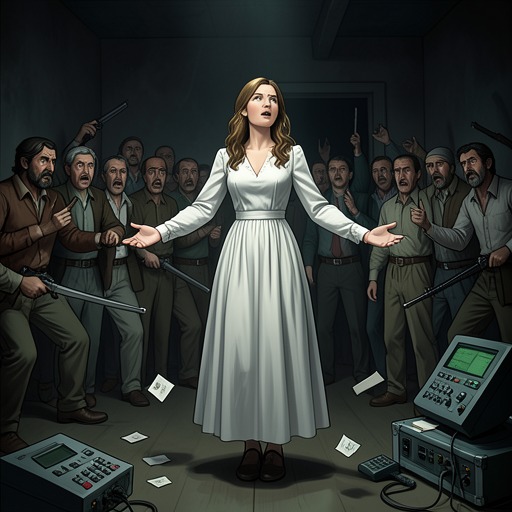
The White Commission’s account of the trigger for the disaster is presented as weak and vacillating. It attributes the two buckets of pig blood suspended above the stage to the conspiracy surrounding Christine Hargensen, while acknowledging that the concrete proof is scant. The passage further reports hearsay from Billy Nolan’s immediate circle and suggests that Nolan may have taken control of this part of the plan on his own initiative. The wording exposes a gap between the commission’s need for a stable causal explanation and the fragmentary evidence available to support one.
The testimony of Mrs. Simard illustrates another form of evidentiary certainty. Asked how she knew it was Carrie White, she answered that she simply knew; when asked whether she was personally sure that Carrie White had done it, she answered yes. Such answers are decisive but not explanatory. They show how traumatic recognition can appear in an official record as conviction without a demonstrable chain of observation.
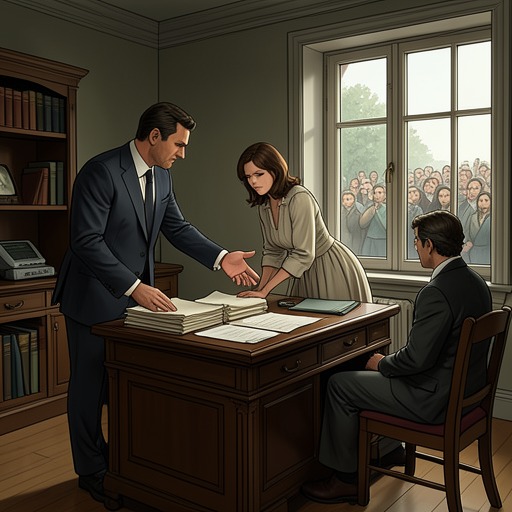
Susan Snell’s testimony makes the conflict more explicit. During questioning before the State Investigatory Board of Maine, she was challenged about how she could know Carrie White had been present when she had not heard her. Susan answered by invoking Tom Quillan, Cora Simard, and Victor Mooney, asking how any of them could have known. When the examiner demanded whether she denied prior knowledge of Carrie White’s whereabouts, she called the accusation absurd and asked whether the Board wanted the truth or merely a scapegoat. The exchange turns the investigation itself into part of the evidence: official inquiry appears not only to seek facts but also to pressure witnesses toward a convenient allocation of blame.
The Disaster and Its Public Record
The Shadow Exploded records Chamberlain’s immediate collapse with precise times and practical details. By 12:45 on the morning of May 28, the situation was critical: Ewen High School had burned itself out on relatively isolated ground, while the entire downtown area was ablaze. Much of the city water in the affected district had been tapped, and only low-pressure water from the Deighan Street mains could protect the business buildings below Main and Oak streets. The explosion at Tony’s Citgo on upper Summer Street produced a ferocious fire that continued until nearly ten o’clock that morning, while firefighters and equipment from Lewiston, Auburn, Lisbon, and Brunswick did not arrive until one o’clock.
The later account presents the disaster not as a temporary emergency but as a continuing civic condition. Chamberlain is declared a disaster area, yet rebuilding money and the clearing of the main road do little to restore communal life. Four hundred and forty people are reported dead, eighteen remain unaccounted for, and sixty-seven of the dead are Ewen High School seniors approaching graduation. They are buried in three mass ceremonies on June 1 and 2, followed by a memorial service in the town square on June 3 attended by thousands. The school band, reduced from fifty-six members to forty, plays the school song and taps, turning institutional music into an audible measure of loss.
The altered graduation at Motton Academy intensifies that sense of rupture. Only fifty-two seniors remain to receive diplomas, and the valedictorian, Henry Stampel, breaks down during his speech. There are no Graduation Night parties; the survivors take their diplomas and go home. The ordinary rituals of adolescence persist in outline but have lost their social meaning, demonstrating how the documentary aftermath measures damage not only in bodies and burned buildings but also in interrupted futures.
Memory, Place, and Institutional Containment
The book’s account of Chamberlain is also a study of traumatic landscape. Residential streets on the East Side remain intact beneath old oaks, and houses on Morin Street and Brickyard Hill still appear neat, but this pastoral surface borders a blackened and shattered center. The Congregational Church on Carlin Street has vanished, while the Catholic and Methodist churches remain standing, though attendance is poor. Black wreaths mark occupied homes, and the old men still sit in Courthouse Square without much interest in checkers or conversation. The town’s surviving objects and buildings become witnesses to what cannot be repaired by physical reconstruction.
The report describes curiosity-seekers moving through the damaged town, making disaster itself an object of visitation. At the same time, residents experience each newly discovered body as the reopening of a wound. The continuing funerals dominate the town’s business, and the overall impression is of a community waiting to die. This contrast between outsiders’ curiosity and residents’ exhausted grief gives the record an ethical dimension: public knowledge can preserve an event while also consuming it as spectacle.
The book repeatedly questions the effort to contain the affair bureaucratically. Its later discussion warns that authorities are taking a grave risk by burying the Carrie White affair under official procedure and specifically criticizes the White Commission’s desire to present TK as a once-in-a-lifetime phenomenon. The scientific possibility of isolating the TK gene raises a further moral problem: even if testing became routine, the text asks whether society would remove a child from her parents at puberty and confine her indefinitely. The affair thus becomes a test of whether scientific control can be separated from coercion and whether institutional reassurance can be trusted.
Closure, Recurrence, and the Unfinished Record
The Shadow Exploded declares that the Carrie White affair is over and urges attention toward the future, but the apparent closure is immediately unsettled by the warning that the risk of genetic recurrence is extremely high. The record ends not with secure containment but with a return to uncertainty: the public is encouraged to regard Chamberlain as an isolated fluke even as scientific evidence suggests that the underlying phenomenon may recur. The documentary form therefore converts closure into a disputed claim rather than an achieved fact.
The final pages connect public documentation with private writing. The book recalls a line from Bob Dylan repeatedly written in one of Carrie White’s school notebooks and offers further Dylan lyrics as a possible epitaph for her. This gesture does not resolve Carrie White’s motives or suffering; it acknowledges that no bureaucratic report can fully translate them. Alongside that proposed epitaph stands Susan Snell’s statement that her own little book is finished and that she hopes to go somewhere where nobody knows her, leaving her to think about what to do before her life ends. The two forms of writing—an investigative compilation and a survivor’s personal account—thus close together, preserving different kinds of incompleteness.
The Shadow Exploded is significant because it makes the politics of aftermath visible. It records facts, but it also records hesitation, accusation, institutional pressure, memorial ritual, scientific anxiety, and the damage carried by a town after the official story has been declared complete. Its fragmented testimony and retrospective commentary ensure that the reader cannot treat the Chamberlain disaster as a closed case. The record survives precisely because the event continues to resist a final explanation.