Tony's Citgo
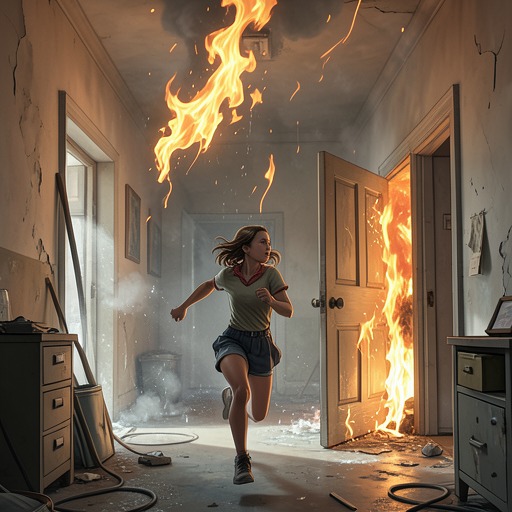
Stephen King Three Classic Novels Box Set: Carrie, 'Salem's Lot, the ShiningTony's Citgo is the gas station on upper Summer Street whose explosion becomes one of the decisive escalations of the Chamberlain disaster. At 11:15 p.m., while Otis Doyle and Thomas K. Quillan are trying to understand the violence at Ewen Consolidated High School, the station suddenly erupts, turning the street bright as day and sending an oily column of fire over Courthouse Park. Its destruction marks the point at which the catastrophe leaves the school grounds and begins consuming Chamberlain itself.
Setting and First Explosion
Tony's Citgo stands on Summer Street, within a town Doyle knows through ordinary civic routines: iced tea on his mother's sun porch, PAL basketball, and late-night drives past The Cavalier. That familiar setting makes the blast more than a fire at a commercial site. Doyle experiences it as an assault on the town's identity, struggling to accept that the burning place is Chamberlain rather than some distant disaster.
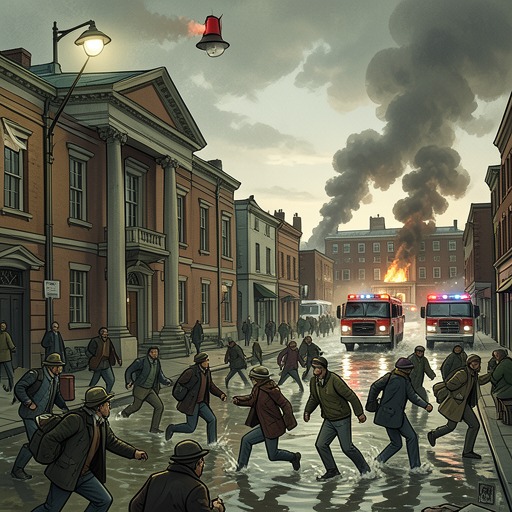
The explosion is described as a coughing roar followed by a daylight-bright flash. An oily cloud of fire climbed above the elms in Courthouse Park, illuminating the duck pond and the Little League diamond in scarlet. Glass, wood, and pieces of gas-station cinderblock rattled back to earth, and a secondary explosion forced Doyle and Quillan to shield themselves again. The station therefore appears not as an isolated flame but as a violent, expanding mechanism whose force reaches into the town's public landscape.
Place in the Disaster's Chain Reaction
News of the explosion travels amid confused reports from Ewen Consolidated High School. Jackie Talbot recounts that Carrie White and Tommy Ross had been named King and Queen before blood was dumped on them, that Carrie White ran out, and that the school caught fire. He then lists the explosions at Teddy's Amoco and the station on Summer Street; Billy Nolan corrects the latter's name to Tony's Citgo, a small verbal correction made grotesquely inadequate by the scale of the destruction.
The station's destruction is not merely another item in the sequence. The wider fire cannot be controlled until nearly ten o'clock the next morning, although water is available on Summer Street. The problem is that no firemen or firefighting equipment are available to use it. Equipment from Lewiston, Auburn, Lisbon, and Brunswick is already on its way, but nothing reaches the town until one o'clock. Tony's Citgo thus exposes the difference between having a resource and having the infrastructure, personnel, and time needed to turn that resource into rescue.
Isolation and Municipal Breakdown
The explosion helps sever Chamberlain from outside assistance. At 12:06 a.m., a gas main on Jackson Avenue is opened; at 12:17, an ambulance attendant throws a cigarette butt from a rescue vehicle traveling toward Summer Street, and the resulting explosion destroys nearly half a block, including the offices of the Chamberlain Clarion. By 12:18, Chamberlain is cut off from the country beyond. Tony's Citgo is therefore part of a cascading failure in which fuel, gas mains, streets, communications, and emergency response cease to function as separate systems.
The crisis is intensified by the failure of water and communications. Hydrants around the school have been vandalized, and water pressure from the city mains between Spring Street and Grass Plaza is reported to be dangerously inadequate. The telephone exchange is overwhelmed by a complete jam of every remaining town line, leaving the operators unable to place the calls demanded by the emergency. Tony's Citgo stands within this network of failures: its fire is made more destructive because the town's systems cannot deliver water, equipment, information, or coordinated assistance quickly enough.
Consequences and Narrative Significance
The station's explosion changes the emotional scale of the disaster for Otis Doyle. Before it, he is responding to a school emergency; afterward, he recognizes that his entire town is burning. His disbelief is not abstract: the explosion overlays the familiar parks, streets, and routines of Chamberlain with an image of civic ruin. The place becomes a landmark of the moment when local order gives way to unreality.
Later accounts place Tony's Citgo within the geography of a town whose downtown area is ablaze by 12:45 a.m. The school has burned out, the Summer Street fire still rages, Carlin Street is threatened by an electrical fire from downed lines, and a gas-main explosion below Brickyard Hill produces the worst destruction. The September account in The Lewiston Daily Sun describes Chamberlain as a blackened and shattered hub, with homes marked by black wreaths and many others carrying FOR SALE signs. Tony's Citgo consequently survives in the disaster's memory not as an ordinary station but as one of the material sites through which the Spring Ball disaster becomes the destruction of Chamberlain.