Westover Mercy Hospital
Stephen King Three Classic Novels Box Set: Carrie, 'Salem's Lot, the ShiningWestover Mercy Hospital is the institution where Carrie White’s death receives its most formal and impersonal confirmation. After the destruction surrounding Ewen Consolidated High School and the wider collapse of Chamberlain, the hospital’s report of decease records Carrie not as the center of a supernatural catastrophe but as a deceased patient: a body brought in without treatment, classified through medical fields, and identified by Susan Snell. The hospital therefore stands at the threshold between the violent narrative of the disaster and the documentary record that follows it.
Role in the Disaster Record
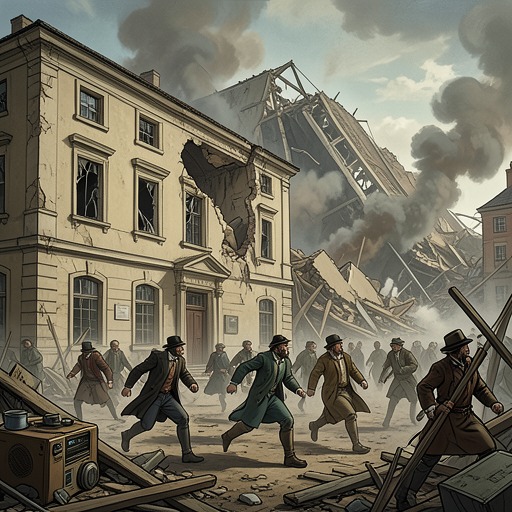
Westover Mercy Hospital appears in the wreckage section of the account, after the school fire, explosions, blocked communications, and spreading disorder have made ordinary rescue and reporting increasingly difficult. The surrounding reports describe a fire raging out of control at Ewen Consolidated High School, with fire crews unable to respond effectively because area hydrants had been vandalized. Later, a gas-main explosion destroyed nearly half a block, while the telephone exchange became jammed with calls. Against that civic-scale breakdown, the hospital report supplies a sharply bounded administrative document: a name, an address, an ambulance number, a time, and a cause of death.
The hospital’s significance lies partly in this contrast. The disaster is experienced as fire, pressure, panic, unavailable water, failed communication, and mass movement through the streets. Westover Mercy Hospital reorganizes that disorder into a form designed for institutional legibility. What cannot be controlled in Chamberlain can at least be entered into a record, even though the record cannot restore the dead or explain the full chain of events that produced the death.
Carrie White’s Admission Record
The report lists the deceased as White, Carietta, with the address 47 Carlin Street, Chamberlain, Maine 02249. It records no emergency-room treatment and no treatment administered, while identifying Ambulance #16 as the vehicle associated with her arrival. The notation that she was dead on arrival establishes that Westover Mercy Hospital did not become a site of attempted medical recovery for Carrie White. It became the place where her already completed death was received, documented, and certified.
The report fixes the time of death as approximately 2:00 AM on May 28, 1979. The approximation preserves a small residue of uncertainty within an otherwise highly controlled form. The night’s events had unfolded through confused testimony, delayed warnings, destroyed infrastructure, and incomplete information; even at the hospital, the exact moment of death cannot be stated with absolute precision. Nevertheless, the entry gives the catastrophe a temporal endpoint, placing Carrie White’s death in the early hours after the Spring Ball disaster rather than within the first eruption of violence at the school.
Medical Language and Identification
Westover Mercy Hospital records the cause of death as hemorrhage and shock, with coronary occlusion and/or coronary thrombosis listed as possible contributing conditions. The wording is clinical and qualified. It identifies the immediate bodily consequences of Carrie White’s condition while leaving uncertainty over the precise cardiac mechanism. Such language differs from the surrounding accounts that frame the night through fire, terror, revenge, or the destructive reach of telekinesis. The medical form does not narrate why Carrie White was endangered, what had happened at the dance, or how her injuries belonged to the larger destruction of Chamberlain. It names the physiological failure that the institution can recognize.
Susan Snell is listed as the person who identified the deceased, giving the report a human connection otherwise absent from its bureaucratic structure. Susan Snell’s presence also links the hospital document to the surviving witness whose relationship with Carrie White had developed through guilt, attempted atonement, and their final psychic encounter. The identification is thus more than a clerical detail: it is the point at which a survivor confirms that the anonymous body in the hospital is Carrie White.
Aftermath and Narrative Significance
The report’s placement in the wreckage section anticipates the broader aftermath of the Chamberlain disaster. Later accounts state that 440 people were known dead, with 18 still unaccounted for, including 67 Ewen High School seniors who had been close to graduation. The dead were buried in three mass ceremonies on June 1 and 2, followed by a memorial service in the town square on June 3. Westover Mercy Hospital’s single death record therefore participates in a movement from individual confirmation to collective mourning, from one body marked dead on arrival to a town whose principal business for months became funerals.
The hospital record also demonstrates how the novel’s documentary forms distribute truth among different institutions. The AP ticker conveys immediate public alarm; sworn testimony reconstructs fragments of responsibility and sequence; later journalism describes a damaged town covered with black wreaths; Susan Snell’s account preserves the inward burden of survival. Westover Mercy Hospital contributes another kind of testimony, one that is stripped of dramatic language but not of consequence. Its categories make Carrie White medically visible even as they leave her social suffering, psychic power, and final experience outside the form.
In this sense, Westover Mercy Hospital is a location of closure without resolution. It confirms Carrie White’s death, records the address from which she came, preserves Susan Snell’s act of recognition, and supplies a probable medical explanation. Yet the report cannot contain the meaning of what happened. The hospital can certify hemorrhage, shock, and possible coronary failure; it cannot certify the long history of humiliation, the retaliatory force released at the Spring Ball, or the devastation that continued through Chamberlain after the school was gone. Its austere record is powerful precisely because it narrows the catastrophe to a few official facts while leaving the surrounding horror unmistakably larger than any form intended to describe it.