White family home
Stephen King Three Classic Novels Box Set: Carrie, 'Salem's Lot, the ShiningThe White family home is the central domestic space of the White family and the final destination of Carrie White’s route through the burning town. Its decisive significance lies in the way it turns family secrecy into visible catastrophe: the house contains Margaret White’s last attempt to control Carrie, receives Carrie’s wounded return from the Spring Ball massacre, and is then consumed by the surrounding fire as the boundary between home and disaster disappears.
Domestic Setting and Hidden Violence
The house functions first as a private enclosure, a place whose walls separate the White family from Chamberlain while preserving Margaret White’s authority over Carrie. That privacy is inseparable from repression. The home is not merely a residence but the architectural form of a closed religious world, where maternal power, fear, and punishment have been concentrated. By the time the catastrophe reaches it, the apparently ordinary household has become a chamber of concealed violence, with Margaret waiting inside and Carrie approaching from the wreckage outside.
The house’s domestic objects register the destruction before the two women confront one another. A picture falls from the wall, followed by the Black Forest cuckoo clock; its mechanical bird gives a small, strangled squawk and then becomes still. These failures of familiar household order make the room’s material environment suddenly conspicuous. Objects that once served as unnoticed fixtures now announce the instability of the home itself, as if its routines can no longer hold against the forces moving through it.
The House During the Fire
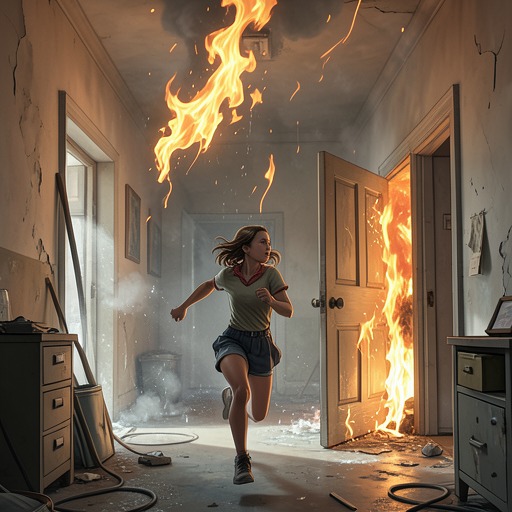
The surrounding disaster reaches the White family home through both fire and infrastructural collapse. The electrical power has failed, leaving the house lit only by the fire burning up the street. Sirens sound continuously from the town, while the external emergency has become an immediate presence at the property. The house therefore stands at the intersection of private conflict and municipal catastrophe: what began within the family is no longer containable within its walls, and what is destroying Chamberlain is simultaneously illuminating the final scene inside the home.
The danger outside is not limited to flame. On Branch and Carlin Street, the road is already on fire, no trucks are available to fight the blaze, and sawhorses block both ends beneath a warning sign for live wires. This detail places the house within a broader breakdown of civic protection. The home is not an isolated gothic ruin detached from the town; it is part of a burning urban route through which Carrie has moved, and its location makes the family’s last confrontation inseparable from the destruction of Chamberlain.
Carrie’s Return
Carrie enters through the kitchen door after the events at the Spring Ball. Her appearance carries the physical record of the disaster: the prom dress has been reduced to tatters and loose flaps, the pig blood has begun to clot and streak, and a smear of grease marks her forehead. Both knees are scraped and raw-looking. The damaged dress connects the home directly to the public humiliation at the dance, bringing the spectacle of the school back into the most private space of Carrie’s life.
Her body is also altered by injury and exhaustion. She appears twisted, shrunken, and almost crone-like, while her eyes are unnaturally bright and hawklike. Yet her entrance is not presented as a simple transformation into a monster. Her mouth trembles, and she addresses Margaret as “Momma,” preserving the language of dependence even after the violence of the evening has made that dependence unbearable. The resemblance between mother and daughter becomes especially stark at this moment: both are enclosed by the same house, both are marked by extremity, and neither can return to the former domestic order.
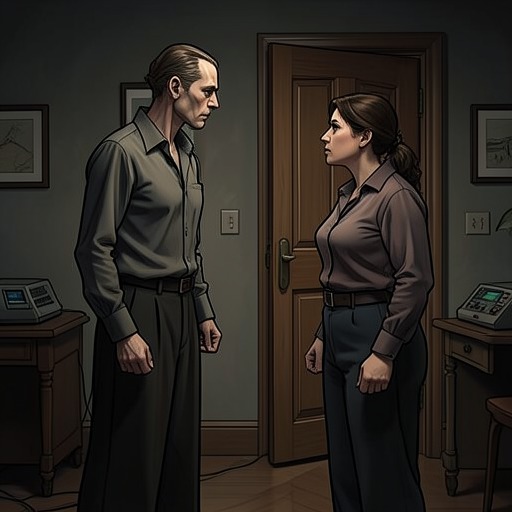
Margaret is waiting on the kitchen stool with the carving knife concealed among the folds of her dress in her lap. The object gives the room a concealed but immediate threat. Before the attack is fully enacted, the house has already become a scene of suspended violence, with Carrie entering wounded and Margaret prepared to strike. The home’s familiar interior consequently serves not as refuge but as the final mechanism of the mother’s control.
Wounding and Escape
Margaret’s attack leaves Carrie badly hurt. Dizziness and nausea pass over her, and she tastes blood at the back of her throat while acrid smoke begins drifting through the windows. The flames have reached the neighboring property, and sparks are already capable of settling on the roof that has been brutally pierced by stones. Carrie’s bodily collapse and the house’s physical exposure develop together: she is losing blood as the building loses its protection, and the invasion of smoke makes the domestic room part of the larger burning environment.
Carrie tries to rise but fails, then pulls herself up by Margaret’s stool. The gesture binds her escape to the very piece of furniture associated with her mother’s position in the kitchen. Even in flight, the house remains materially involved in the struggle. Carrie finally goes out the back door, staggers across the lawn, and rests against a tree while wondering where her mother is. The question reveals that the violence has not erased the emotional claim of the home; Carrie leaves it injured, confused, and still drawn toward the person who has made it dangerous.
The house’s destruction continues after Carrie has departed. When Susan Snell later reaches the area, the White family home is in flames and its roof is blazing, making it impossible to approach closely enough to look inside. Yet the burning structure also provides the first usable evidence of Carrie’s passage. In the strong firelight, Susan sees a splashed trail of Carrie’s blood leading away from the house. The home thus becomes both the site of an attempted killing and the point from which the wounded survivor can be traced into the darkened outskirts of Chamberlain.
The House as Carrie’s Destination
The White family home is not only the place Carrie leaves; it is the destination toward which her destruction has been unconsciously directed. The municipal pattern of fires and explosions traces a wandering, looping route through Chamberlain, yet the route has an almost certain endpoint: home. That pattern gives the house a grim gravitational force. After the Spring Ball massacre, Carrie does not simply disappear into the town; she returns to the enclosed space where the catastrophe began, carrying the school’s blood and violence back to the domestic source of her suffering.
The return also changes the meaning of the house as a shelter. Carrie’s route through the town has transformed public humiliation into civic disaster, but the final confrontation reveals that the catastrophe cannot be understood solely as retaliation against the school. The house concentrates the older conflict between Carrie and Margaret White, and the destruction moving through Chamberlain converges there as though the town’s violence and the family’s violence were parts of one system. Home is therefore both refuge imagined by habit and destination imposed by an emotional bond that has survived abuse.
Fire, Ruin, and Aftermath
The fire removes the last distinction between the White family’s private world and the wreckage of Chamberlain. Earlier, the house’s walls concealed Margaret White’s authority and Carrie’s suffering; by the time Susan Snell finds it, the roof is blazing and the building cannot be entered. The burning structure turns concealed history into an exposed ruin. Its destruction is not an incidental consequence of the townwide disaster but the material culmination of the household’s role in Carrie’s life.
The blood trail gives the ruined house a second function. Susan follows the splashed marks past the larger spots where Carrie has rested, through a hedge, across a Willow Street backyard, and into scrub pine and oak beyond the developed streets. The trail converts the home into a point of departure for an urgent search. Susan cannot recover Carrie by entering the building, because the flames make direct examination impossible; she must read the ground outside it instead. The house’s final evidence is thus external and corporeal: not a surviving room or document, but the blood of the daughter who has escaped it.
The scene leaves the home caught between two kinds of disappearance. Margaret White remains inside a structure already being consumed, while Carrie moves away from it in a badly wounded condition. The building loses its function as a family residence at the same moment that the family’s defining relationship reaches its terminal violence. Its collapse completes the conversion of domestic enclosure into public catastrophe, making the White family home one of the clearest physical embodiments of the Chamberlain disaster.