William Nolan
Stephen King Three Classic Novels Box Set: Carrie, 'Salem's Lot, the ShiningWilliam Nolan, commonly called Billy Nolan, is the principal male accomplice in Christine Hargensen’s campaign against Carrie White. He is presented not as an independent strategist but as a dangerous executor whose bodily presence, violence, and absolute attachment to Christine help turn a spiteful school grievance into the Spring Ball disaster. His decisive significance lies in the combination of passivity and force: he can appear blank and almost vacant while carrying out actions whose consequences are lethal.
Identity and Presence
Billy first appears beside Christine in a public encounter with Sue Snell. He saunters over with his thumbs hooked into his side-hitched garrison belt and his fingers hanging toward the stuffed crotch of his pegged jeans, an aggressively performed image of delinquent masculinity. Sue experiences his arrival as a wave of unreality, and Billy intensifies that impression by offering a casual greeting before immediately massaging Christine’s shoulder. His face is utterly blank, as though he were testing a cut of beef. The gesture joins sexual possession, emotional vacancy, and physical intimidation in a single entrance.
Billy’s manner is therefore not merely rough. His masculinity is staged through clothes, posture, touch, and the display of a body made threateningly available to Christine. Yet the performance also reveals his lack of inward independence. He does not arrive with an argument of his own or explain himself to Sue; he slides into Christine’s space and becomes an extension of her social presence. His blankness makes him difficult to read, but it also makes him available for direction.
Loyalty to Christine Hargensen
Christine announces that she and Billy may crash the prom as a protest, though she immediately retreats from the idea and admits uncertainty. Her uncertainty does not weaken the danger of the pair. It shows instead how impulse, resentment, and performance circulate between them: Christine supplies the grievance and the emotional charge, while Billy supplies the physical capacity to act. Her fury at Carrie White abruptly erupts into a wish that Carrie would abandon her religious routine, and Billy remains the silent partner beside her rather than questioning the hostility.
The retrospective account of the prank identifies Christine as its probable brains but stresses that even she possessed only vague ideas about how to ruin Carrie. Billy’s role is more concrete. He is the person capable of turning an imprecise fantasy into a sequence of acts involving vehicles, tools, animals, blood, and concealment. The narrative says that everything he did was for Christine, just as it had been since she descended from her college-course Olympus and made herself vulnerable to him. His devotion is described in absolute terms: he would have committed murder for her, and more. That formulation establishes his attachment as both romanticized and catastrophic. Christine’s importance to him does not humanize his violence; it gives the violence its organizing purpose.
The Pig-Blood Harvest
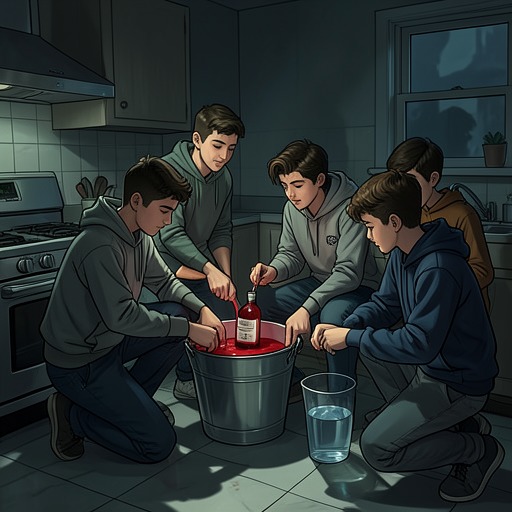
Christine’s revenge plan takes material form when William Nolan and his companions drive to Irwin Henty’s farm in North Chamberlain. Billy drives the battered 1961 Biscayne up the rutted Stack End Road at sixty-five miles per hour. The car is rusted, fender-dented, jacked in the back, fitted with dual glasspack mufflers, and missing a functioning headlight; the remaining light flickers whenever the vehicle hits a severe bump. Jackie Talbot, Henry Blake, Steve Deighan, and the Garson brothers, Kenny and Lou, are crowded inside, while three joints pass through the darkness. Billy is thus embedded in a collective of young men, but the account keeps his control of the car and his connection to Christine at the center.
At the farm, the group prepares a nine-pound sledge and two galvanized steel pails taken from an ice chest. Henry swings the sledge experimentally while Billy handles the buckets. The task is not presented as spontaneous chaos. It has equipment, a destination, a division of labor, and a stated purpose, even though the group disguises that purpose with jokes about Freddy Overlock. Billy knows that the act is not really for Freddy, whom the narrative dismisses as an unpleasant man. It is for Christine.
Billy then brings the sledge down. One sow dies with its tongue protruding and its eyes still open, potato-chip crumbs around its snout; after the first bucket is filled, the second sow is called back to the fence and struck as well. The remaining blood runs into the ground, leaving a rank coppery smell, and Billy is slimed with pig blood to the forearms. He makes the symbolic connection explicit in his mind: pig blood is appropriate because the target is Carrie, and the logic of the prank is reduced to the refrain, “Pig blood for a pig.” He caps the pails, nests them in crushed ice, shuts the chest, and orders the group to leave. The blood is no longer simply animal waste or a by-product of slaughter; under Billy’s handling, it becomes a weapon prepared for public humiliation.
Coordination and Consequences
By the evening of the Ewen Spring Ball, Christine Hargensen and William Nolan meet in a room above The Cavalier, a local tavern at the town limits. Records later establish that they have been meeting there for some time, although the surviving account leaves uncertain whether their plans were already complete and irrevocable or whether they proceeded partly on a whim. This uncertainty does not absolve Billy. It places him within a sustained preparation whose exact design may have remained unstable while its intention was already fixed.
Billy’s actions connect several levels of the disaster. Christine’s anger toward Carrie supplies the emotional motive; the rural expedition supplies the pig blood; Billy’s loyalty supplies the labor and violence required to obtain it; and the meeting above The Cavalier places the conspirators in position as the Spring Ball approaches. The result is a progression from insult to plan, from plan to bodily harm against animals, and from bodily harm to the staged public punishment of Carrie White. Billy is one of the figures through whom private cruelty acquires logistics.
Narrative and Thematic Role
Billy embodies the danger of a grievance that has found an instrument. He is not shown developing a reflective understanding of Carrie, Christine, or the damage he causes. Instead, people are sorted according to immediate allegiance: Christine is the person for whom everything is done, while others are objects, obstacles, or targets. His blank face and blunt physicality make that moral simplification visible. He can touch Christine with apparent intimacy and kill a sow with the same emotionally emptied surface.
His role also exposes the instability beneath the prank’s apparent theatricality. Christine may describe the proposed prom crash as a protest and may not know exactly what she intends, but Billy’s participation gives the fantasy weight. The sledge, the pails, the ice chest, the blood on his forearms, and the rendezvous above The Cavalier are concrete signs that the coming humiliation has passed beyond adolescent talk. Through William Nolan, the narrative shows how devotion can become an alibi for brutality: he acts for Christine, but the fact that he acts for someone does not make the action less his own.