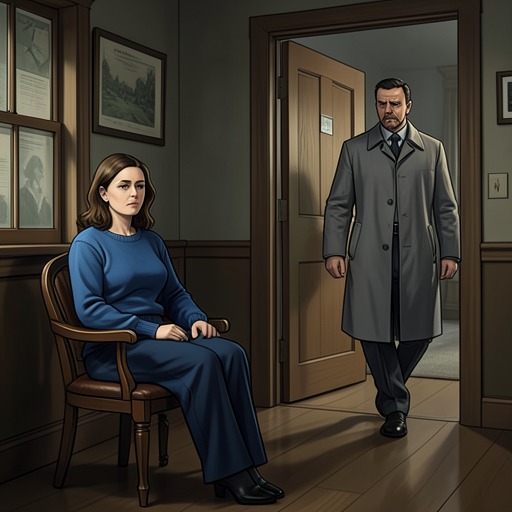
Bill O'Neill and Cheryl
Stolen WanderBill O’Neill and Cheryl’s marriage is remembered through a sharp contrast: a courtship Cheryl once considered beautiful, followed by years in which Bill’s drinking brought pain to the family. Her account preserves affection and injury side by side, while his later decision to enter rehabilitation offers a possibility of change without confirming that their marriage itself has been restored.
Courtship and the beginning of the marriage
Cheryl recalls meeting Bill while she was in college studying literature. At a party, he appeared handsome and smooth in a suit and tie, and let her hold his deputy badge. They walked together beneath the stars; she remembers the night as the most beautiful of her life. She gave herself to him, fell in love, and entered the relationship with the sense of romance that memory still holds.
That beginning makes the next part of her story more painful, not less. Cheryl says Bill began drinking only after he had her safely settled in the relationship. She cannot say whether he did so deliberately or whether he simply believed he no longer needed to treat her well once she was his. The uncertainty matters: she can describe the sequence and its effect, but cannot settle his original intention. Her recollection therefore holds both the charm of their first meeting and the suspicion that the tenderness did not last once commitment had been secured.
Drinking, endurance, and resentment
By the time Cheryl tells the story, Bill’s drinking has become central to how she understands their life together. Nancy O’Neill observes that her mother had been patient with Bill, but that patience had not made things turn out well. The remark lands painfully: Cheryl flinches, and Nancy immediately regrets bringing it up. Their exchange shows how Bill’s conduct remains present in the family even when they are speaking about other relationships. What happened between the parents has become part of the daughter’s measure of what patience can and cannot accomplish.
Cheryl says she hated Bill for a long time, but now pities him. That change is not presented as proof that the hurt has disappeared or that the marriage has healed. Rather, it marks a shift in how she regards the man whose drinking made their shared life miserable. Pity replaces hatred as her stated response, while the history behind both feelings remains intact.
The marriage as Nancy’s point of comparison
Bill’s place in Nancy’s understanding of love becomes especially clear when she compares him with Rex Foster. Nancy had feared that Rex might become like her father, and Bill’s behavior gives that fear its emotional force. But she recognizes an important difference: Rex left, whereas Bill stayed and made the family miserable. His continued presence was not, in her account, evidence that he had been a good husband or father. Staying could itself be part of the harm.
This comparison also complicates Nancy’s initial anger at Rex for leaving her. Her mother’s history offers no simple lesson that remaining together is always the better choice; Bill’s endurance in the household had not protected Cheryl or Nancy from suffering. Nancy’s realization that Rex and Bill are not the same gives her a way to judge Rex on his own actions rather than treating her father’s marriage as a template for every relationship. In that sense, the effects of Bill and Cheryl’s marriage reach into the next generation, shaping Nancy’s fears even as she begins to distinguish her future from her parents’ past.
Rehabilitation and an uncertain future
Bill later comes to Nancy’s home to tell her that he has arranged to enter a rehabilitation program. He says the program will last a year, with no outside contact during its first three months, and explains that he wants to prove he can become a better man. His apology acknowledges the harm done to Cheryl as well as to Nancy: he says he caused Cheryl hell and that Nancy did not deserve to grow up as she did. The admission recognizes the family cost of his drinking, though it does not erase it.
Nancy comforts him, but privately doubts her own reassurance that he can make things right. Bill’s tears and his promise to fight give the scene emotional weight, not certainty. Later, Nancy and Cheryl cautiously acknowledge that Bill may be getting better because he has gone longer without drinking than ever before. Their hope is explicitly guarded: they fear being disappointed, even as they allow themselves to imagine improvement. The marriage is thus left in a state of unresolved history and tentative change. Cheryl’s presence when she later walks Nancy down the aisle shows her continuing place in her daughter’s family life; it does not, by itself, establish that Cheryl and Bill have reconciled.