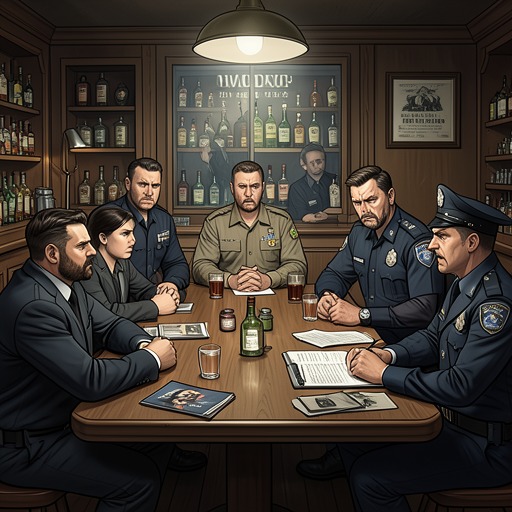
Markus
Stolen WanderMarkus, also known as the boss, is the senior authority of the Sons of Wolves Motorcycle Club and the man responsible for converting its unwritten loyalties into binding decisions. His importance lies in the tension he manages: the club demands permanence from patched members, yet Markus ultimately acknowledges that a member who can no longer remain must be given a principled path out, even when that path carries severe consequences.
Identity and Authority
Markus presides over the clubhouse as the club’s final decision-maker. His authority is not presented as ceremonial. When Rex Foster announces that he may no longer belong in the life he entered as a boy, Markus immediately understands that the statement threatens the club’s established order. Patched membership is normally treated as permanent precisely because the patch creates obligations that cannot casually be discarded.
Markus therefore requires Rex to distinguish a momentary outburst from a genuine decision. He warns that once Rex is unpatched, there will be no return, and that Rex must not change his mind afterward. This insistence makes Markus a guardian of institutional seriousness: leaving is possible, but it cannot be treated as a temporary gesture or a way to pressure the club.
Rex Foster’s Departure
When Rex says that he is tired of living a life he is no longer certain about and is almost sure the club is no longer the right place for him, Markus does not simply punish the disloyalty or dismiss the confession. He confirms that Rex has earned the right to leave, but defines the terms with precision. Rex cannot continue living in Salem, cannot enter the clubhouse or the club’s bars, and will no longer receive the club’s protection or responsibility for whatever happens to him.
The decision preserves two principles at once. Markus refuses to pretend that a patched member can walk away without consequence, but he also refuses to treat departure as an automatic death sentence. Rex is allowed to leave alive, yet he is expelled from the social and geographic space that once sheltered him. Markus’s ruling transforms personal uncertainty into an enforceable separation between the former member and the organization.
The Police Confrontation
Markus’s authority is tested almost immediately after Rex accepts the terms. Ralf Michaels enters with thirteen men dressed in civilian clothes but moving with the unmistakable bearing of police officers. Their arrival turns the clubhouse into a site of confrontation, and Michaels approaches Markus first, addressing him as though the club were already under pressure from the state.
Markus answers with controlled hostility. He insists that everyone is fine, points out that there is room for everyone, and offers drinks on the house, using hospitality as a thin public cover for anger. The gesture does not soften the confrontation. Michaels makes clear that the group has not come for drinks and moves past Markus to threaten Rex directly.
Markus’s position in this scene is complicated by Rex’s newly altered status. Rex tells Snake not to speak for him because he is no longer a Son of a Wolf and has surrendered his right to protection. Markus’s earlier ruling has therefore weakened the club’s formal obligation toward Rex at the exact moment when an outside enemy seeks to exploit his isolation. The scene exposes the cost of Markus’s law: a fair decision can still leave the departing man vulnerable.
Leadership and Ethical Limits
Markus’s response to Rex is shaped by both duty and consequence. He protects the club’s structure by making departure irreversible, but he also grants Rex the courtesy of leaving without being killed. The decision rejects the simplest version of gang authority, in which membership can end only through death or absolute obedience. Markus recognizes that the club’s rules must contain a narrow space for personal change, even if the institution can offer no continuing protection afterward.
His leadership also contrasts with the performance of masculine power surrounding the clubhouse. Rex demands a clear choice between being killed and being released; Markus supplies a third quality that violence alone cannot provide: terms. Michaels arrives with a large group and the posture of official force, while Markus attempts to control the encounter through composure, language, and the authority of the room. His power is therefore shown as procedural as well as physical.
Narrative Significance
Markus functions as the threshold guardian of Rex Foster’s transformation. He stands between Rex’s past as a committed club member and an uncertain life beyond it, making the passage costly but possible. By demanding that Rex mean what he says, Markus ensures that the departure becomes a genuine change of identity rather than another temporary rebellion.
At the same time, Markus embodies the unresolved contradiction at the heart of the Sons of Wolves Motorcycle Club. The organization can recognize loyalty, grant earned rights, and refrain from killing a departing member, yet it still expels him from Salem and withdraws its protection. Markus’s decision is thus neither simple mercy nor simple punishment. It is a controlled act of institutional adaptation, one that preserves the club’s code while revealing how much that code asks its members to surrender.