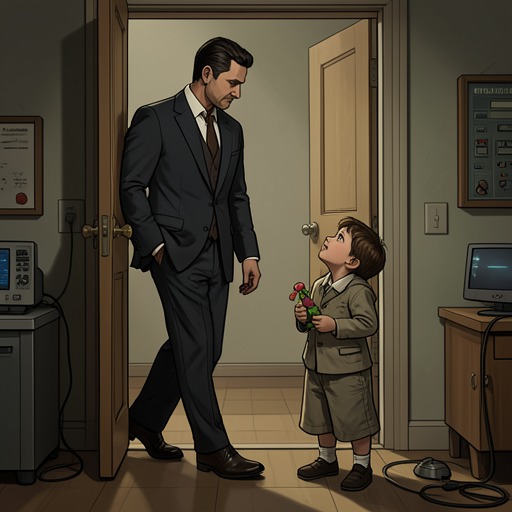
Rex Foster and Sebastian
Stolen WanderRex Foster and Sebastian’s relationship is first formed as a test of whether Rex can break with the abandonment that shaped his own childhood. Rex initially recoils from fatherhood and leaves Nancy O’Neill after learning she is pregnant, but later promises to share the work of raising their child and chooses a life beyond the club. By the wedding, Sebastian is two months old, and Rex’s sight of him with Nancy’s family gives the commitment a concrete form: this is no longer only a future child Rex fears failing, but a son he wants to protect.
Inheritance and Fear
Before Sebastian’s birth, fatherhood is bound up with Rex’s own history. He says that he never wanted to be a father because his own father left before Rex was born. His bitterness turns that experience into a defense against family itself: he dismisses the value of family rather than risk needing what he never had. The pregnancy makes that rejection consequential. Sebastian is not an abstract possibility; Rex knows Nancy is carrying his baby, and the prospect confronts him with the role his absent father refused.
Rex’s first response repeats the pattern he fears, though not in precisely the same form: he leaves Nancy after finding the pregnancy test. Three days later, while forced to clean a deliberately filthy car, he cannot stop thinking about her and regrets choosing flight. He imagines an alternative in which Nancy tells him about the pregnancy while they are holding each other, and he stays so they can work things out together. His regret does not undo the abandonment, but it marks a change in his understanding of what he has risked: the child’s future is already connected to his decision to disappear.
A Promise Made Concrete
When Rex returns to Nancy, he does not limit his offer to a general declaration of love. He imagines accompanying her to medical appointments, looking at the ultrasound even though he expects not to understand the image, and being present when the baby is born. He also pictures ordinary future responsibilities, including taking the child to school and soccer. The examples matter because they turn fatherhood from a feared identity into a sequence of acts of presence.
Nancy does not accept the promise without naming its weakness. Rex has already walked out and failed to come back; she points out that their reunion happens because she sought him out, not because he returned on his own. Her doubt places the burden on Rex to make his intentions credible over time. He answers that he is not his father and says he will not ruin the child’s life or become the reason a fifteen-year-old joins a biker club. He has left the club and explains that he has been banished from Salem; he presents that break as part of his decision to return to Nancy and build a different future.
Breaking a Generational Pattern
The fear of repetition is reinforced by the family history around Nancy. Cheryl recalls falling in love with Bill O’Neill before his drinking began, and describes how he later caused her and Nancy years of pain. Nancy recognizes that she had feared Rex might become like Bill, and that Rex’s departure had intensified the fear. But she also identifies a distinction: Bill stayed and made his family miserable, whereas Rex left. That distinction does not excuse Rex’s choice; it helps Nancy understand that the men’s actions and histories are not interchangeable.
The parallel makes Rex’s claim that he is not his father a promise rather than proof. He must do more than reject his absent father’s example in words: he must remain present where his father was absent. His decision to leave the club is therefore tied to the kind of life he wants Sebastian to inherit. The story shows the decision and the commitment, but does not yet recount Sebastian’s childhood or establish how Rex performs the everyday duties he describes.
Sebastian’s Place in the New Family
At the wedding, Sebastian is two months old. Rex sees him smiling and pawing at Cheryl’s chin while Nancy’s family stands on one side and Sal and his wife stand on the other. The scene brings together the child, the bride, and the surrounding family at the precise moment Rex makes his vows. Rather than treating marriage as a private resolution between adults, the narration places Sebastian in the crowd as part of the future Rex is choosing.
Rex describes an unfamiliar warmth when he looks at Nancy and Sebastian and wants to wrap his arms around them and protect them. The contrast with his earlier dismissal of family is sharp: the inherited idea of family as overrated gives way to a particular attachment to his son and the family gathered around him. His wedding vow does not erase his uncertainty about whether he deserves this life. He still questions his worth, but resolves to spend his life trying to become worthy of it. His relationship with Sebastian thus closes on intention and responsibility rather than a claim that the past has been repaired all at once.
Narrative Significance
Sebastian’s relationship with Rex gives the romance’s reconciliation an intergenerational stake. Rex’s return is not only a reunion with Nancy; it is also a chance to refuse the absence that defined his own beginning. The narrative links that refusal to concrete choices—leaving the club, promising to attend appointments and care for the child, and standing at the wedding with Sebastian present—while retaining Nancy’s justified concern that promises must survive beyond the reunion.
The ending offers a hopeful image, not a detailed account of fatherhood: Sebastian is still an infant, and the future parenting Rex describes remains ahead. What the wedding establishes is the direction of change. The child Rex once approached through fear becomes someone he wants to protect, and the family he once rejected becomes the commitment against which he intends to measure the rest of his life.