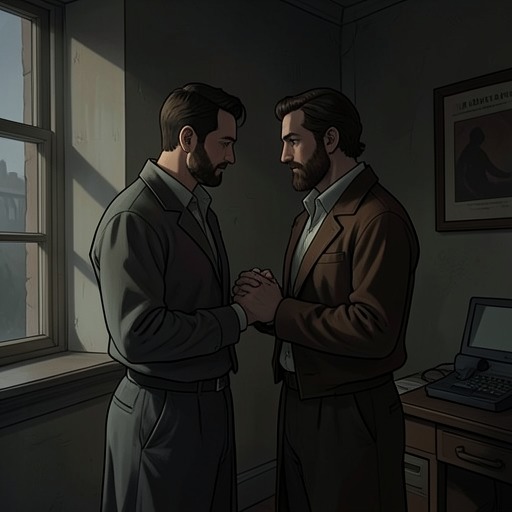
Angelo
Straight ManAngelo is Lily’s father, a figure whose comic charm and steadfast devotion coexist with rank bigotry and an armed confrontation that brings him into legal trouble. His story is defined by the difficult persistence of Lily’s love: she is ashamed and angered by his prejudice, yet cannot forget the father who carried her through her mother’s death. When he returns to the family’s life after his arrest, that unresolved bond becomes practical as well as emotional, involving bail, a trial, and a stay of more than two months in Lily and Hank’s home.
Identity and Family Background
Angelo’s relationship with Lily changed sharply after she left for the university. As a girl, she and her father had been a team, and his devotion to his little girl helped her endure her mother’s death. But within months of Lily leaving home, the closeness was disrupted: she returned from university with new language and ideas, and asked him not to use some of the old words he favored. Their former intimacy gave way to a sense that they spoke different languages.
The separation was not simply a loss of affection. Lily began dating men Angelo disapproved of and eventually married Hank, whom Angelo regarded as the worst of the lot. He saw his daughter’s education, speech, parenting, and concern for young people he considered dangerous social misfits as signs that she had repudiated him as a man and father. The narrator places this conflict in the context of a lower-middle-class hope that children sent away to be educated will return more prosperous but otherwise unchanged. Angelo’s disappointment takes a personal form: shortly before Lily and Hank married, he took them to dinner while they were living in a shabby apartment and trying to save money, listened to Hank describe his plans, then asked Lily where he had gone wrong.
The Bond with Lily
Lily’s feelings toward Angelo hold affection and rejection together. His bigotry shames her and makes her angry, but it does not erase the memory of his childhood devotion or her love for him. That combination makes their relationship more complicated than a simple estrangement: she is not indifferent, and the pain of their distance is bound up with her continuing attachment.
Lily and Hank had agreed not to let either of their fathers become the cause of a serious conflict between them. Hank remembers Lily finding his father, William Henry Devereaux, Sr., charming, while he still finds Angelo hilarious, even as he acknowledges that Angelo has never threatened him with a loaded shotgun. The comparison also marks a difference between the families. Hank considers his emotional distance from his own father sensible and prudent; Angelo, by contrast, can ask Lily where he failed because he knows she loves him too much to answer. For Lily, that very love makes the question difficult rather than harmless.
Arrest and Philadelphia Incident
When Hank learns that Angelo is the serious problem Lily has been hesitant to discuss, he asks whether her father is all right. Her answer is that he is both all right and not all right. Hank suspects a relapse into drinking, but the later account establishes a different immediate crisis: Angelo has been in jail for more than a week, too stubborn or embarrassed to tell anyone where he was. He was arrested on several charges, including public endangerment and discharging a weapon in the city.
Lily reconstructed the incident from a police report and a neighbor’s account. A young Black man went onto Angelo’s porch, rang the bell, and did not leave when Angelo, standing at the door with a pump-action shotgun, told him to go. Hank acknowledges that this account leaves much unexplained, but he is reluctant to press Lily for details that would make the incident more vivid. Her attempt to arrange bail occupies much of her Friday, but Angelo remains in the county lockup through the weekend. The information reaches Hank gradually because Lily is careful about discussing her father and because the couple’s agreement makes the subject especially sensitive.
Trial and Stay with Lily’s Family
Angelo returns to Philadelphia in early August for trial, which ends in the expected conviction. By then he has spent more than two months with Lily’s family. The bail money Lily had provided is returned when he goes back to face trial. The judge appears to connect Angelo’s ability to cope with his living circumstances: he may receive a suspended sentence if he agrees to sell his house and move out of the neighborhood. He is also to pay LeBrother’s reasonable medical expenses.
During the period at home, Angelo is present in a scene that brings him into the family’s grief and care for one another. After Hank leaves the hospital, he returns home with Lily and Angelo. Once they have convinced Finny that nobody blames him for Occam’s death, Hank wraps Occam in a sheet and carries him to the woods to bury him. Angelo wants to help; Lily and Hank’s mother are there as well. Hank spends about an hour digging, ruining a pair of loafers and his favorite chinos. Angelo’s presence does not resolve the conflicts between father and daughter, but it places him within the household during a moment of shared loss.
Character and Narrative Significance
Angelo’s predicament links private family strain to the consequences of behavior beyond the home. His devotion to Lily is real, as are the prejudices that alienate her; neither cancels the other. The porch incident turns the family’s long-standing disagreement over his character into a public and legal crisis, while Lily’s efforts to arrange bail show that emotional distance has not severed responsibility or attachment.
The account also reaches the reader through layers of partial knowledge. Lily pieces events together from a police report and a neighbor, while Hank admits he has chosen not to ask for a fuller version. That restraint echoes the couple’s pact about their fathers: love and loyalty persist, but neither daughter nor son-in-law claims the power to make Angelo into someone else. His conviction and the possible conditions of a suspended sentence leave the consequences concrete, while the family’s uneasy welcome keeps the relationship unresolved.