Angelo’s shotgun
Straight ManAngelo’s shotgun moves from emergency object to instrument of threat and finally to the means of an “imperfect solution.” In Angelo Caprice’s account of a confrontation at his Philadelphia home, merely bringing the weapon out changes the encounter: it makes his words consequential, narrows his choices, and leaves him facing the possibility of killing a young man he does not want to shoot. The episode ends not with the threatened shot at a person, but with Angelo firing into the porch roof and bringing the decrepit structure down on himself and his opponent.
The gun kept for emergencies
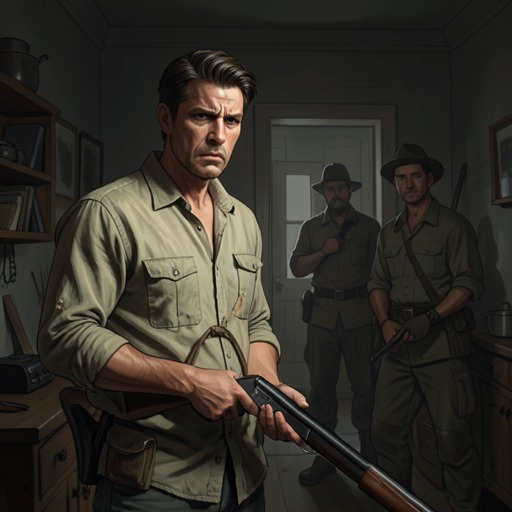
Angelo says he keeps the pump-action shotgun in the hall closet for unforeseen circumstances. When men arrive at his stoop demanding money they claim he owes, he tells them to wait while he goes inside. He returns with the gun rather than the money, presenting it as the answer to a demand he considers illegitimate. His account makes the weapon’s presence part of a policy: he refuses to give money to strangers, and believes the shotgun makes that refusal unmistakable.
The explanation Angelo gives his visitors is larger than the immediate dispute. He recalls a time when his young daughter could ride her bicycle around the neighborhood because it was safe, contrasting it with the present-day block as he describes it: prostitutes, crack dealers, dark-windowed cars, and neighbors armed to the teeth. He says that, when he was a police officer, he was the only person within ten blocks who kept a gun at home. Now, he tells the men, weapons are common behind the doors around them. The shotgun is thus both a practical object in Angelo’s account and a prop in his effort to make his visitors understand the changed conditions he believes he faces.
A threat that acquires its own force
The two companions begin backing down the porch steps as soon as Angelo displays the shotgun. The man Angelo identifies as the supposed brother of Raschid does not retreat, however, and tells Angelo to lower the weapon if he wants him to leave. Angelo interprets the man’s refusal to back down as evidence that he does not understand the danger. He raises the stakes by announcing that he will count to three, making the gun part of a public, timed ultimatum rather than a silent warning.
Angelo’s narration emphasizes the difference between what the weapon can do and what he can bring himself to do. His companions have already left the porch and are calling for the man to come away; they recognize the danger and fear Angelo will shoot. Angelo, by contrast, admits that he does not want to kill the young man. He also imagines the consequences for himself: he is nearing seventy-three, sees himself as no longer useful, and measures his remaining years against the much younger man’s. The shotgun concentrates that unequal prospect into a choice that Angelo cannot dismiss as mere bravado.
The count and the “imperfect solution”
Angelo describes his predicament as one created partly by his own threat. In his view, once he has gone back inside for the shotgun, brought it out, and promised to count to three, simply putting it away would undermine the seriousness of any future warning. He invokes his experience as a police officer to explain the principle: a person who is not prepared to use a gun should not take it out. The lesson turns the weapon into more than a means of physical force. In Angelo’s telling, displaying it and announcing a deadline create an obligation to act, even as he recoils from the action that the threat seems to demand.
Lily, who is traveling with him as he tells the story, quietly asks him to finish before they bring it into the house. Angelo agrees, but continues to reason through the narrow interval after the count reaches three: the expected next sound is a shot, not another number. His account makes the gun’s threat depend on timing and credibility as much as on its physical capacity. Once the ultimatum has been issued, hesitation itself could change how the other man understands the danger.
The outcome is neither a shot at the young man nor a simple retreat. Angelo fires the shotgun into the porch roof, causing the decrepit structure to collapse on both of them. The neighbors have to dig Angelo and the man out from under the rubble. Angelo later calls the choice an “imperfect solution”: the discharge fulfills his threat to use the gun without his shooting the person he says he cannot shoot, but it turns a standoff into a physical collapse that injures or traps them both. The shotgun resolves the immediate impasse by redirecting violence toward the structure around them.
What the weapon makes visible
In the episode, the shotgun’s significance lies in the distance between possessing force and accepting its consequences. Angelo first uses it to make a demand for money stop; then, when the man refuses to leave, the display becomes a promise whose credibility Angelo believes he must preserve. His reluctance does not cancel the threat but makes the choice more precarious: he has to find an action that avoids shooting the man while still answering the ultimatum he himself has created.
The final shot does not restore the situation to safety. It brings the porch down, leaving Angelo and his opponent beneath the wreckage and requiring the neighbors’ intervention. The gun’s immediate purpose changes across the scene—from household protection, to coercion, to destructive release—but each use carries consequences beyond the act itself. Angelo’s account turns the shotgun into the material center of a conflict between a rule about armed threats and the human limit that prevents him from following that rule literally.