Campus Duck Pond
Straight ManCampus Duck Pond becomes the stage for William Henry Devereaux Jr.’s televised protest against university budget priorities and, the next day, for an animal-rights demonstration against him. Its birds are not merely background: their noise, movements, and presence repeatedly disrupt the human attempts to frame the scene, while cameras turn the pond into a public arena where the meaning of the protest quickly escapes its maker.
Setting and First Broadcast
At the water’s edge, ducks and geese gather along the bank while a local television crew sets up a tripod and feeds them popcorn. The young reporter rehearses a lead-in describing the area as the future site of the Technical Careers Complex. Her repeated takes, interrupted by the birds and the practical work of getting a usable sound level, reveal a place being treated simultaneously as wildlife habitat, construction site, and television backdrop.
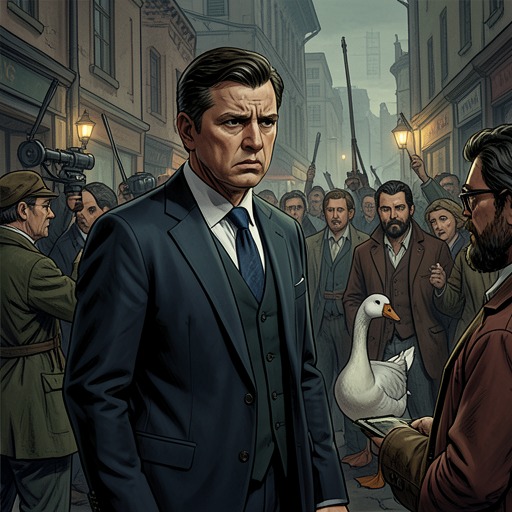
The pond draws William Henry Devereaux Jr. and Tony Coniglia into the broadcast. When Tony’s joke leaves William Henry facing the camera, Finny the Goose recognizes him from earlier and nips at his hand. The goose then pulls the fake nose and glasses William Henry has in his pocket, forcing him to struggle to retrieve them. This small contest changes the scene: what began as a routine campus report becomes an unscripted spectacle, and the crew recognizes that the disturbance may make better television than its planned story.
From Campus Setting to Protest Stage
Still wearing the disguise, William Henry turns the camera toward himself and identifies the problem he wants viewers to notice: his department lacks a budget for the adjunct instructors needed to cover freshman composition, even as the university has committed millions to a new building. He specifies that roughly a dozen additional course sections are needed and contrasts their modest cost with the construction project. The pond thus places competing kinds of university spending in the same frame: a highly visible building plan and the less conspicuous labor required to teach students.
William Henry makes a televised threat to kill a duck each day until he receives a budget, although the bird he is holding up for the camera is Finny the Goose. That mismatch, and the fake disguise, give the protest the structure of a comic provocation; the budget demand beneath it is nonetheless concrete. Applause grows around him, and Dickie Pope, the campus executive officer, and a state representative arrive after the scene has already acquired its own momentum. At the pond, a departmental complaint becomes a public performance whose audience includes students, officials, the television crew, and viewers at home.
The Pond on Television
The report’s later broadcast at The Tracks shows how the camera can alter the apparent meaning of the pond encounter. William Henry sees himself briefly on the large screen before the full story airs. When it does, the editor has retained most of his unrehearsed remarks. In close-up, the disguise is less convincing than he expected, while Finny’s visible alarm makes the threat appear more serious. The pond scene that William Henry had experienced as a mixture of anger, exhilaration, and protest now reaches viewers as an image of a professor displaying a frightened goose.
The broadcast also turns the officials’ brief appearance into part of the spectacle: Dickie Pope and the representative receive boos from the bar’s audience, while the studio team’s laughter prompts another cheer. The response makes William Henry seem momentarily celebrated, but the sequence establishes that publicity does not leave him in control of the event. The pond supplied the setting; editing, reaction, and repetition supplied new interpretations.
Return of the Protesters
The following day, the same spot is occupied by a large group carrying signs and chanting in defense of the birds. The television crew has returned as well. By the time William Henry reaches the student center’s corner, the site of his performance has become the site of a counter-demonstration. The sound of the protesters overlaps with the ducks’ clucking and the geese’s calls, making it difficult to separate the animal sounds from the human crowd’s message.
Protesters link arms in a semicircle around the birds and direct their chant at William Henry. Finny breaks through their line, honking as he moves away from the protection surrounding him. The crowd grows to about 150 people; Dickie Pope and Lou Steinmetz stand at its edge, while the television sound technician prepares to record. The arrangement reverses the previous day’s image: William Henry had raised a goose before the camera, but now a human barrier forms around the flock and turns him into the focus of protest.
Narrative Significance
Campus Duck Pond connects the university’s budget conflict to a dispute over how animals are treated, without allowing either issue to remain neatly separate. William Henry uses the birds’ presence to dramatize the department’s exclusion from spending priorities; protesters make those same birds the center of their own claim. The pond’s role changes in less than a day, from the setting for a planned construction report to the scene of an improvised ultimatum and then an organized response.
The episode also gives the birds a measure of narrative agency. Finny’s recognition, pursuit of the pocket, and escape through the protesters’ line repeatedly redirect human attention and action. The pond is therefore more than a picturesque campus feature or convenient backdrop: it is the point where institutional arguments, television framing, and animal behavior collide, and where a theatrical gesture acquires consequences beyond the person who made it.