Campus animal-rights protest against Hank
Straight ManThe campus animal-rights protest against Hank transforms William Henry Devereaux, Jr.’s televised budget ultimatum into a public confrontation at the pond. Organized in roughly fourteen hours and staged before a returning television crew, it places the threatened ducks and geese at the center of a dispute that had begun as Hank’s attempt to expose the university’s priorities. The demonstration also turns Hank himself into its emblem: his image is carried on signs, and its participants eventually direct their chant at him.
Causes and Preparation
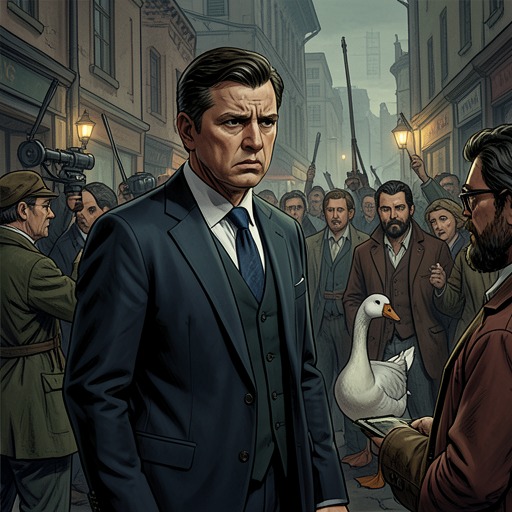
The protest follows Hank’s appearance on local television beside Finny the Goose. Wearing a fake nose and glasses, he had identified himself as a department chair who wished to remain anonymous and argued that the university could fund a new building while failing to provide the modest amount needed for additional freshman composition sections. He then threatened to kill a duck each day until he received a budget. The comic disguise and deliberately extravagant demand had made an immediate spectacle, but the threat gave animal-rights demonstrators a clear target.
The television segment had first played as entertainment for the crowd at The Tracks. When the story aired, the station showed much of Hank’s unprepared speech and repeated his threat; viewers saw him holding a frightened goose while the fake nose and glasses made his attempted anonymity look uncertain. The bar crowd applauded, and Hank was treated as a hero there. That response, however, was not the only public reaction. At the pond the following day, a sound technician warned him that animal-rights activists had arrived and were taking the matter seriously. The contrast between the cheering audience at The Tracks and the protesters gathering on campus marks the shift from comic performance to a dispute with real public stakes.
The activists’ speed becomes part of the scene. Hank estimates that they have had only about fourteen hours to organize, find and enlarge the book-jacket photograph of him, and mount it on placards. Their efficiency impresses him even as he recognizes that the image has made him the demonstration’s designated villain. The participants are not all strangers: he spots a young faculty member from meetings, who points him out to two women, and watches recognition pass through the crowd as people compare him with the younger figure on the posters.
The Demonstration at the Pond
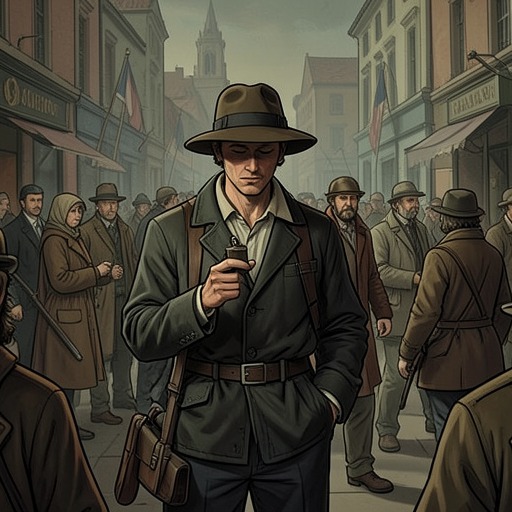
When Hank returns to the place where he faced the cameras the night before, a large group has assembled beside the ducks and geese. Placards call for an end to the slaughter, and the protesters chant in time with the birds’ clucking, quacking, honking, and trumpeting. Missy Blaylock and the television crew have also returned. Their presence makes the demonstration both a protest against Hank’s threat and a second televised scene in the story already unfolding around him.
Hank initially helps the crew carry equipment toward the pond, hoping not to attract attention. That effort fails as the group recognizes him. The activists link arms into a semicircle around the birds, physically presenting themselves as a line of protection. Their chant changes to name Hank directly as well as call for an end to the slaughter. Finny the Goose breaks through the protective line, trumpeting loudly; the animal at the center of the controversy does not simply remain a symbol arranged by either side, but moves through the demonstration on its own.
The crowd grows to about 150 people. At its edge, Dickie Pope watches with a grin and points toward the sky; Lou Steinmetz stands nearby, grim and apparently prepared to act if events get out of hand. The sky has darkened during the forty-five minutes Hank has been away from Dickie’s office, and the clouds overhead appear ominous. These details leave the confrontation unsettled: the scene gathers people, cameras, animals, and university figures without showing a resolution.
Media, Image, and Escalation
Television connects the protest to the episode that provoked it, but it also changes the terms of the conflict. In the earlier broadcast, Hank’s threat is preserved in the edit, while Finny’s bulging eyes and flapping wings make the animal’s distress visible to viewers. In the next day’s demonstration, the crew returns to film activists carrying Hank’s enlarged photograph. The same media attention that made him a briefly celebrated figure at The Tracks now helps turn his image into a public accusation.
The photograph matters because it collapses the distinction Hank tried to create between his public identity and his disguise. On television, the plastic nose and glasses had not made him unrecognizable; the close-up showed that they looked like an obvious fake. At the protest, activists use a photograph from his book jacket, and faculty acquaintances help others identify the man represented on their signs. His attempted anonymity gives way to recognition from several directions: broadcast image, printed poster, and face-to-face encounter.
The event also reverses the comic staging of Hank’s ultimatum. He had used a goose, a disguise, and a mock demand to force attention onto the department’s shortage of course funding. The protesters answer by organizing around the animals and making the threat itself the focus. Their linked arms and repeated chant give the birds a visible place in the dispute, while Hank’s earlier performance becomes evidence against him. The available scene records this shift in public meaning, not a final decision about the budget or the protest’s demands.
Consequences and Significance
The demonstration makes it difficult for Hank to treat the television appearance as a one-night joke. He notices that students have been avoiding his eye, then discovers the protest at the very spot where he had addressed the camera. Once the crowd identifies him and its chant names him, he decides it is time to leave. Missy’s response to his recollection of carrying a protest sign during the Vietnam era further underlines the distance between his remembered role as a demonstrator and his present position as the target of one.
The protest’s immediate consequence is therefore a change in Hank’s standing within the campus scene: applause and apparent heroism give way to exposure, embarrassment, and a confrontation over what he threatened to do. Yet the episode does not show the activists harming him, the birds being killed, or the university granting the requested funds. Instead, it ends its account with the crowd, the returning cameras, the birds breaking through the human formation, and the ominous weather. The unresolved ending keeps both the animal-rights dispute and the university’s budget conflict in view, while showing how quickly a provocative performance can escape its intended frame.