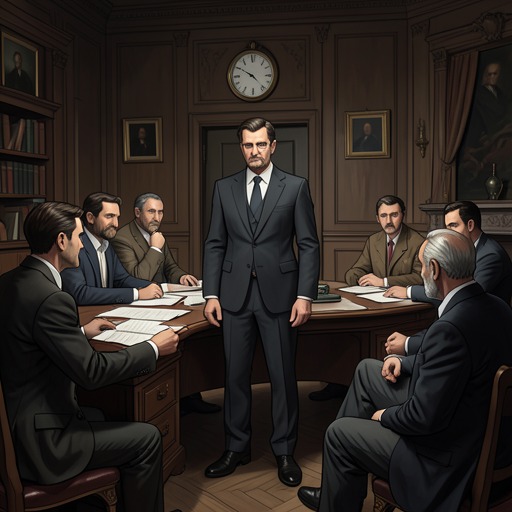
Dickie Pope
Straight ManDickie Pope, the campus executive officer at West Central Pennsylvania University, stands at the point where institutional budget anxiety becomes a personal and political question: who will lose resources, who may be spared, and who will be held responsible. A specialist in budgets and fundraising rather than academics, he presents the proposed cuts as both a mandate from above and an opportunity to remake the university in the name of efficiency.
Role and Background
Pope was hired two years before the events described as campus executive officer. His strengths lay in budgeting and fundraising, a profile that quickly fed campus rumors that he had been brought in to oversee cuts and faculty dismissals. So far, however, his handling of academic positions had largely involved absorbing vacancies created by retirements into his own budget—a practice that colleagues at other institutions regarded as ordinary.
That record gives the rumors an ambiguous foundation: Pope is associated with retrenchment, but the evidence does not show him carrying out a purge. The contrast between his fiscal role and the academic consequences of budget decisions shapes his dealings with the English department, where uncertainty about staffing and resources is already being read as a sign of larger institutional change.
Budget Uncertainty and the Department
Pope’s account of the budget chain makes clear that the delay is not confined to his office. He explains that the English department lacks a budget because Jacob Rose lacks one, Pope lacks one, and the chancellor in turn lacks a budget while the legislature delays action. The chancellor has been promised a budget early the following week, and Pope expects his own allocation by the end of that week. He apologizes and asks Devereaux to convey the complexity of the situation, presenting the delay as an institutional bottleneck rather than a decision directed at the department.
Pope also recognizes that Devereaux’s televised threat to kill a duck a day until he receives a budget has changed the exchange. He tells Devereaux that the protest did the administration a favor: although Pope says he had been furious enough the previous night to imagine stabbing him through the throat with an ice pick, reflection led him to see that the incident could be used. His response turns a confrontation into an opening for negotiation, without making the underlying budget problem disappear.
The Twenty-Percent Mandate
In a private conversation, Pope explains that the chancellor has given every campus executive officer a systemwide mandate to devise a plan reducing staff and costs across the curriculum by twenty percent. He emphasizes that the plan may never have to be implemented, but that drawing it up is required. The distinction between a required plan and a guaranteed round of cuts offers limited reassurance: the possibility of implementation remains real, while responsibility is distributed upward through the university system.
Pope frames the mandate as a response to changing conditions. With the baby-boom generation no longer supplying the same student numbers, he predicts that the colleges that survive the decade will become leaner and more efficient. His language casts downsizing as a force of nature and institutional adaptation, even as the proposed reductions would affect staff and academic programs. When Devereaux questions the fit between efficiency and education, Pope affirms the principle rather than addressing that tension.
Devereaux, Blame, and Institutional Strategy
Pope does not approach Devereaux only as a department chair whose budget is delayed. He praises his standing on campus, describing him as a respected teacher and a published author, and suggests that Devereaux could benefit politically if cuts proceed. The administration, Pope argues, will take the blame because the mandate comes from the chancellor and the system rather than from the department chair. In his account, the institution, students, and taxpayers may all gain if supposedly unproductive elements are removed.
This pitch combines reassurance with recruitment. Pope invites Devereaux to see himself as someone who might save allies and let opponents bear the consequences, while also warning that the alternative to managing the reductions could be worse. His emphasis on institutional continuity, vision, and efficiency makes him a spokesman for the administrative logic of retrenchment; his offer to shelter Devereaux from the political fallout makes that logic personal. The exchange leaves Pope neither simply a villain nor a neutral courier: he communicates a genuine systemwide constraint while trying to enlist Devereaux in the way it will be interpreted and managed.