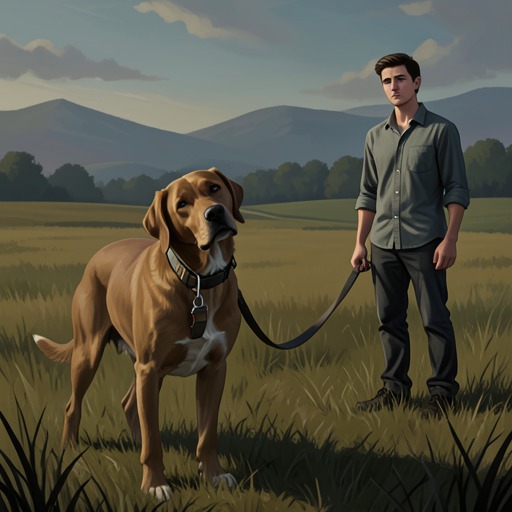
Dogs
Straight ManDogs are not incidental pets in Hank Devereaux’s family history: they mark a child’s persistent loneliness, expose the compromises hidden inside parental promises, and later become recipients of the patience and care that adult life demands. The contrast between the elderly Irish setter his parents choose for him and Occam, the stray German shepherd who becomes a confident member of the household, shows how an imagined ideal gives way to attachment to particular animals with their own histories and needs.
Childhood Longing and the Family Home
At nine, Hank had lived in four university-owned houses with his academic parents. Their elegant, high-ceilinged homes hosted faculty gatherings and dinner parties, but Hank recalls himself as the only child in these adult spaces and as intensely lonely. More than anything, he wanted a dog. The houses’ association with the university made a restriction on pets seem likely, though the narrator presents this as a supposition rather than a known rule. His parents did not want a dog, and he spent a year or two pressing the request, turning Christmas, birthdays, and even the contents of his ham sandwich into occasions to ask for one.
His persistence became a contest of endurance. His mother tried to make the dog conditional on good behavior, telling him that a dog was something a child had to earn. Hank answered with a campaign of his own: he talked about dogs morning and night, redirected other conversations toward them, borrowed six dog books from the library every two weeks, and filled the house with open books and reminders of dogs seen on television, in magazines, and on the street. The elaborate repetition makes his wish visible as more than a passing preference; it is a demand his parents cannot simply wait out.
The bargain eventually shifts to a smaller, specific test: Hank must stop slamming the screen door. Its tight spring and wooden edge make the sound carry through the house with startling force, and his mother says it is like living in a shooting gallery. She promises to consider a dog if he can remember not to slam it. Hank succeeds about half the time, sometimes returns to apologize, and carries an expensive collar and leash everywhere. After a week of reduced slamming, his father leaves on a Saturday morning without explaining where he is going. Hank understands that a dog is coming, though his mother says she does not know what kind.
The Dog Hank Did Not Imagine
When Hank’s father returns, Hank sees the animal’s chin resting on the back seat of the car. The dog does not appear to notice that the car has stopped; his father has to open the door, reach inside, take him by the collar, and pull him out. The dog unfolds long legs and steps tentatively, with an arthritic gait. Hank recognizes at once the gap between the dog he had pictured and the one before him: he had imagined puppies or a young, energetic dog, while this animal seems barely able to walk.
The dog is a handsome, purebred, rust-colored Irish setter, meticulously groomed and wonderfully mannered. Hank reads those qualities as evidence of how safely the animal will fit into a university-owned house—and as signs that his parents have chosen a dog who will not make much trouble. He later learns that the setter belonged to a university professor emeritus who had entered a nursing home earlier that week, leaving the animal without its owner. To Hank, the dog seems almost like a portrait of a dog, an animal he can hardly imagine moving. His father brings him into the kitchen reluctantly, closing the screen door carefully behind them; his mother studies Hank’s visible disappointment and then his father. The account establishes the mismatch but does not describe what becomes of this setter afterward.
Occam’s Arrival and Recovery
Occam enters the family’s later life in a very different way: not as a carefully selected answer to a child’s demand, but as a nearly full-grown white German shepherd who appears in the driveway. He stands there barking without advancing, repeatedly starting toward the family, yelping in a different register, and retreating. Lily thinks he wants them to follow him. On closer inspection, the apparent gold tooth in his lopsided grin proves to be a treble hook embedded in his lip, with monofilament line trailing behind him. He has dragged about a hundred yards of line, apparently from a lake two miles away. Lily holds him still while Hank cuts the line and removes the hook with wire cutters; after the hook is out, the dog waits patiently for what will happen next.
The family advertises and posts signs in the neighborhood, but no owner comes forward. They feed Occam and watch him double in size. His arrival changes the household’s encounter with visitors: although few people have visited since the dog came, Occam delights in this one. When Teddy comes over, the excited dog burrows his pointed snout into Teddy’s crotch and lifts, sending Teddy onto his tiptoes. Lily’s raised voice finally gets through to Occam, and a rolled-up newspaper on his snout makes him retreat, dragging his haunches and yelping. Hank tells him he is a good dog, confusing the reprimand and praise; Occam’s tail comes out from between his legs and sweeps the floor. The episode sets his unrestrained pleasure in company beside the household’s attempts to manage his exuberance.
Trust, Discipline, and Attachment
Occam’s behavior carries a history the family cannot fully know. Hank has long suspected that some previous owner abused him as a puppy and connects that possibility with the dog’s lingering mistrust. Only in the last few months, he observes, has Occam become a joyous, confident animal, secure enough to thrust his nose at strangers without fear of punishment. This account does not establish what happened to Occam before he arrived, but it presents trust as a gradual change rather than an innate trait. The dog’s exuberance is particularly meaningful against the earlier image of him waiting injured in the driveway and against his melodramatic retreat when disciplined.
A later domestic scene makes that change tangible without turning Occam into a human speaker. After a telephone call, he approaches Hank with his haunches held just above the carpet, still looking guilty. Hank reassures him because he dislikes provoking guilt, even in animals, and scratches his lowered head. When Lily speaks from the doorway, Occam starts and watches her warily; he relaxes only when he sees she is not carrying a rolled-up newspaper. The small recognition joins discipline to familiarity: he remembers a previous correction, but can also settle into the ordinary comfort of being scratched behind the ears.
Dogs therefore connect two sharply different forms of family attachment. Hank’s childhood wish meets a parental compromise that supplies a real dog but not the imagined puppy, while Occam’s arrival begins with injury, uncertainty, and the absence of any returning owner. The contrast gives the animals distinct narrative weight: the setter reveals the limits of fulfilling a wish on adult terms, whereas Occam’s changing responses register the possibility of trust built through care. Neither animal is only an emblem of Hank’s feelings; each is presented through concrete behavior, bodily vulnerability, and the particular demands of living alongside a dog.