Ducks
Straight ManDucks are part of the campus pond’s everyday wildlife, but during William Henry Devereaux, Jr.’s budget protest they become the ostensible target of a threat that turns a financial dispute into a public animal-rights controversy. The episode depends on a distinction its human participants repeatedly blur: the bird William Henry Devereaux, Jr. holds before the cameras is Finny the Goose, not a duck. That confusion gives the spectacle its comic surface, while the gathering birds, later protests, and reports of another death make the consequences less easily dismissed.
Setting and distinction
At the pond, ducks and geese gather along the bank while a local television crew prepares a report about the planned Technical Careers project. The birds are present before the protest begins: station staff toss popcorn toward them, and their calls complicate the crew’s attempt to record a clean sound level. The setting brings campus wildlife, media production, and university business into the same frame. The building project has a visible television presence; the teaching resources William Henry Devereaux, Jr. says his department needs do not.
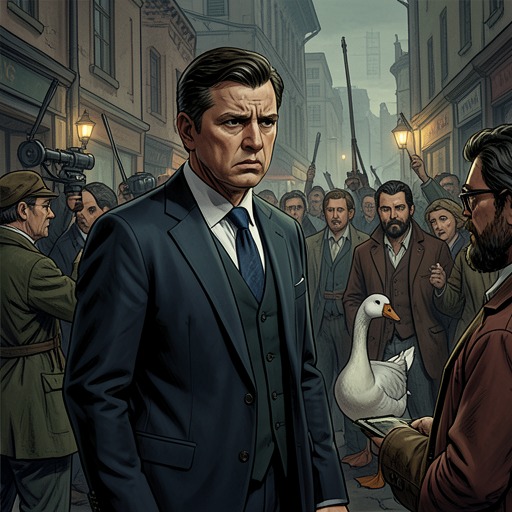
Finny is the individual bird around whom the scene turns, but he is a goose. When a reporter casually refers to losing a duck, Tony Coniglia corrects her: the small dark birds are ducks, while the larger, vocal bird is a goose. The correction is brief, but it establishes a useful distinction between the actual animals and the loose language that makes them interchangeable in the human drama. William Henry Devereaux, Jr. later voices a threat about killing a duck while holding Finny, so the threatened animal and the bird displayed to the cameras are not the same.
The budget protest
William Henry Devereaux, Jr. arrives at the pond already unsettled by signs that the university’s priorities may be changing. Against the millions committed to a new building, he says, his department lacks funds for the additional freshman composition sections needed in the coming term. In that setting, the birds become the unlikely means by which he puts the budget dispute before a television audience.
He picks up Finny, faces the camera, and speaks as an anonymous department chair, wearing a fake nose and glasses. He explains the mismatch between the building expenditure and the comparatively small sum needed for composition instruction. Then, in a deliberately theatrical ultimatum, he threatens to kill a duck each day until the budget is supplied. He shakes the frightened goose for emphasis. The gesture converts an argument about university spending into a scene in which an animal is physically present as more than a symbol: Finny’s visible distress is part of what the camera records.
The immediate response encourages the performance. A crowd gathers and applauds, while Dickie Pope and state representative Jack Proctor arrive at the scene. On the television broadcast, the threat and Finny’s agitation make the spectacle appear more serious than its comic setup may have intended. At The Tracks, viewers cheer William Henry Devereaux, Jr., and urge him to take a bow; the officials’ brief appearance is met with boos. What plays as a triumphant stunt in the bar will soon be read differently by people who organize around the birds’ welfare.
Protest and public reversal
The following day, William Henry Devereaux, Jr. finds protesters assembled at the same place. They carry signs and chant against the slaughter of animals; some use an enlarged image from his book jacket to identify him as the villain of their demonstration. The group has mobilized in roughly fourteen hours. Its speed and coordination impress him even as the display makes clear that his televised threat has escaped his control.
The protest changes shape as it grows. Participants link arms in a semicircle around the ducks and geese, and their chant turns directly toward William Henry Devereaux, Jr. and his threat. Finny breaks through the protective line, honking as he moves. The birds’ presence is not merely a backdrop to the confrontation: the human formation is built around them, while the goose’s movement disrupts the orderly image the demonstrators are trying to make. The crowd reaches about a hundred and fifty people, and the television crew returns to cover the gathering.
William Henry Devereaux, Jr.’s earlier celebrity thus becomes exposure to a different audience and judgment. The fake disguise that helped make the first broadcast theatrical does not prevent protesters from recognizing him. He leaves as the demonstration intensifies. Later, watching the recorded report, he recognizes that the image of a middle-aged professor gripping a terrified goose may not be funny. The shift matters: public laughter had let the threat pass as entertainment, but the bird’s visible fear and the protest make its underlying harm harder to keep at a comic distance.
Deaths, reports, and consequences
The duck threat recurs after the first demonstration. When another duck has died, William Henry Devereaux, Jr. guesses that this is why a local news interview is underway; Lou Steinmetz says the authorities claim to know the perpetrator’s identity. The evidence here establishes a reported death and a claim about identification, not who caused it. The uncertainty keeps the birds entangled in the controversy without resolving the accusation in this moment.
The death also changes what reaches the campus audience. By the time William Henry Devereaux, Jr. reads the newspaper, the story about an incident in Tony Coniglia’s classroom has been moved to page two below the fold, displaced by the preceding day’s dead bird and his growing celebrity. In his workshop, students ask whether he has been fired for killing ducks. Their question shows how thoroughly the threat has become shorthand for his public identity, whether or not the students know what happened to any particular bird.
The department’s response to the incident remains unsettled in a later conversation. Teddy Barnes says he does not think William Henry Devereaux, Jr. killed the goose, expressing regret rather than certainty. The line returns to the distinction established at the pond: the public story speaks loosely of ducks, while the bird at the center of the original television scene was Finny, a goose. Elsewhere, William Henry Devereaux, Jr. frames the eventual outcome as a chain of cause and effect beginning with his comic threat and ending with Finny at his feet. The birds therefore connect a budget stunt to consequences that no longer seem safely contained within the joke. Their role is not simply to represent campus politics; their presence, vulnerability, and uncertain fate expose the cost of making animals props in a human performance.