Ellipses
Straight ManEllipses are William Henry Devereaux, Jr.’s term for brief, unaccounted-for gaps in his experience of time. They make his unease about time concrete: a moment disappears, leaving him to infer that it passed at all. The phenomenon is introduced not as a confirmed diagnosis but as an unsettling observation, one that others can interpret more casually than Devereaux himself can. Its importance lies both in the missing moments and in the difficulty of deciding what they mean.
Naming the Gaps
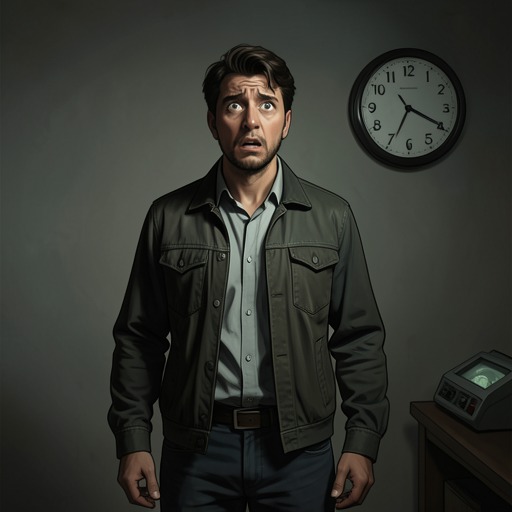
Devereaux first gives the experience an expansive, almost philosophical formulation: “Time is slipping.” When asked whether he means that time is slipping away, he resists the simplification. What he describes is more specific: he suddenly becomes aware that a small stretch of time has passed without his being able to account for it. Calling these episodes his ellipses gives a name to an absence rather than explaining its cause. The word suggests a break in continuity: something has dropped out of the account, and the person experiencing the break cannot fill it in.
The distinction matters. Devereaux is not simply saying that time passes quickly or that he loses himself in a task. His concern is the discontinuity between one moment he can remember and the next moment he can recognize. The experience is initially presented through his own attempt to describe it, with its boundaries defined by what he can report: a gap has occurred, but its contents remain unavailable. The name organizes that uncertainty without resolving it.
An Ordinary Scene Made Uncertain
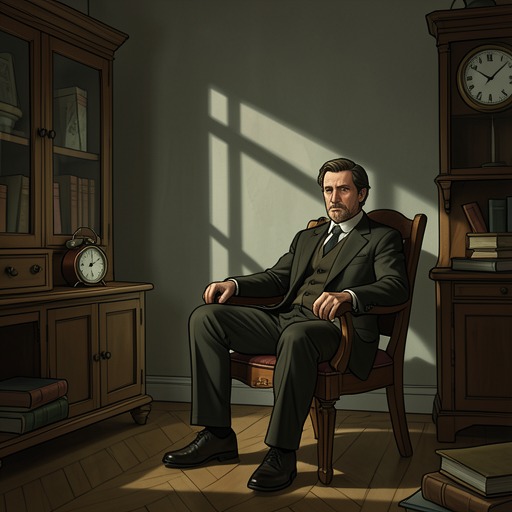
The clearest example Devereaux gives Phil Watson comes from Bodie Pie’s office the previous Friday. One moment, Bodie is sitting there trying not to light a cigarette; in the next recollected moment, she asks Devereaux where he has been. A half-smoked cigarette is dangling from her lips. The cigarette provides a small, concrete measure of the missing interval: something has changed during the gap, even though Devereaux cannot account for the transition. The scene is not described as a dramatic collapse. Its disturbance comes from the mismatch between the ordinary room and the absent piece of experience.
Bodie’s question gives the omission a social consequence. From her perspective, Devereaux has apparently been gone long enough for her to ask where he went; from his perspective, he cannot supply the intervening account. The difference between those viewpoints is the episode’s central fact. The missing time is not merely an inward sensation: it disrupts his ability to make his conduct intelligible to someone else. Yet the evidence does not establish what Devereaux did during the interval, how long it lasted, or what caused it. The gap remains a gap.
Interpretation and Age
After hearing the example, Phil Watson calls it “simple abstraction” and says it is interesting. His response offers an alternative to Devereaux’s more troubling account: perhaps the experience amounts to ordinary absorption rather than something more serious. But the interpretation is provisional. Phil has heard Devereaux’s description, not recovered the missing moment, and his shrug does not settle the question. The exchange leaves the reader between an everyday explanation and the unease of an experience Devereaux cannot account for.
Phil then asks how old Devereaux is. Devereaux admits that he will be fifty that summer, and Phil calls it a rough age. The sequence places the lapses beside an explicit acknowledgment of age, without proving that age causes them. Instead, the exchange gives Devereaux’s report a midlife frame: his concern about time is not only a metaphor for its passage but a description of discontinuity in his own perception. The age reference sharpens the emotional context while leaving the medical meaning open.
Memory, Choice, and Narrative Form
The idea of an unremembered interval has an echo in Devereaux’s reflection on his life among his university colleagues. While hidden above a departmental meeting, he considers how much time meetings have consumed and wonders how many books he might have written. He acknowledges the choice to remain in that life, then emphasizes that he cannot remember making it. This is not the same as the office episode: one concerns an immediate gap in experience, the other an inability to recall a decisive choice. Still, the parallel extends the concept’s resonance. In both cases, Devereaux confronts a present reality whose passage or origin he cannot fully reconstruct.
Ellipses therefore connect the mechanics of the story’s timekeeping with Devereaux’s larger difficulty of making a coherent account of himself. The phenomenon is presented through omissions rather than recovered explanations: the narrative can show the before and after, but Devereaux cannot bridge them from memory. That form makes uncertainty part of the reader’s experience without converting it into proof of a particular cause. The gaps are brief, yet they disturb the continuity on which a confident story of action, choice, and identity depends.