Faculty Union
Straight ManThe Faculty Union becomes a central counterweight to university administrators as West Central Pennsylvania University faces a systemwide mandate to reduce staff and costs by twenty percent. It can make the prospect of layoffs politically dangerous, recruit influential faculty into its campaign, and threaten a strike; yet the faculty’s eventual refusal to strike shows that union leadership cannot guarantee collective compliance.
Institutional Setting and Stakes
The union’s conflict with the administration takes shape amid severe budget uncertainty. Dickie Pope explains that the chancellor has instructed every campus executive officer to draw up a plan cutting staff and costs by twenty percent across the curriculum. The plan is mandatory to prepare but not guaranteed to be implemented; delayed legislative action has left the university’s budgets unsettled. This distinction between a required plan and a certain round of layoffs leaves room for both administrative persuasion and faculty resistance.
Dickie Pope presents the union as an established source of institutional pressure, describing it as having held the university in its grip for a long time. His counterargument is a language of efficiency: with fewer traditional-age students ahead, he expects surviving colleges to become smaller and more cost-conscious. The dispute is therefore not only over individual jobs. It pits the union’s capacity to defend faculty against an administrative program that treats reductions in staffing and spending as a response to changing conditions.
The planned construction of a College of Technical Careers building sharpens the uncertainty. The project has been awarded to the campus and is expected to proceed, while rumors circulate that tenured faculty may be dismissed on grounds of financial hardship. To William Henry Devereaux, Jr., investment in a new facility seems difficult to reconcile with claims of impending cuts, but it does not settle whether the rumored purge is real. The union’s later acquisition of a copy of a faculty list gives those suspicions a more concrete political focus, without establishing in the available account exactly how the list was produced or what it contains.
Recruitment and Faculty Alignment
Herbert Schonberg seeks to bring William Henry Devereaux, Jr. onto the union’s side. He invokes Devereaux’s effective performance on television and proposes that he serve as a public point man or rally colleagues in the English Department, which Herbert says has more votes than any other department. The appeal mixes an argument about the cause with a practical calculation about influence: the union wants both Devereaux’s visibility and the votes he might help organize.
Herbert also makes clear that the department is already divided into consequential alliances. He says he has spoken with Teddy Barnes and June Barnes, who, in his account, have aligned with Paul Rourke and Finny. Devereaux understands the subtext: the invitation to join the union’s effort comes alongside a warning that colleagues and friends may already be positioned against him. Herbert asks him to declare whom he can be counted on to support and portrays neutrality as a risky choice. The exchange reveals organizing as both coalition-building and pressure on an individual whose loyalties matter to competing factions.
The union’s prospective influence also figures in a separate threat by Billy Quigley. Billy tells Devereaux that he will vote with Finny and another opponent in a planned effort to recall him if Devereaux does not help him. Devereaux recognizes the threat as a lie, but Billy’s attempt to deploy a vote as leverage shows how the prospect of collective action can be invoked in personal and departmental conflicts. It does not, by itself, establish that the union directed Billy or adopted his demand.
Lists, Leverage, and the Strike Threat
Paul Rourke tells Devereaux that Herbert has called to report that the union has obtained a copy of the list. Devereaux had maintained that he did not make such a list; Rourke pointedly distinguishes that denial from a claim that no list exists. The moment leaves the document’s origin and contents unresolved, but it shows the union gaining access to information that may bear on the threatened cuts. In a climate of rumor, possession of the list gives the union a potential means to contest decisions and makes the administration’s handling of staffing more visible to faculty.
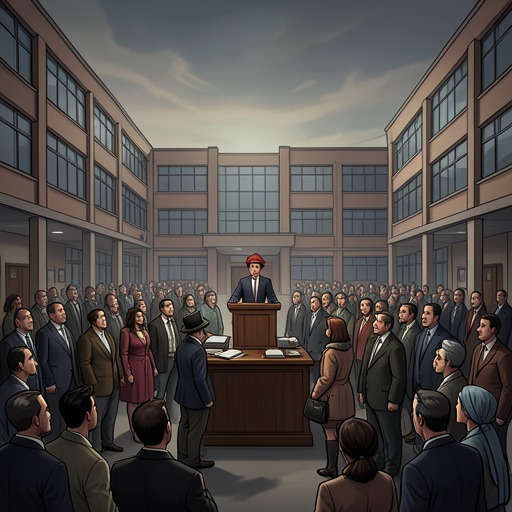
Herbert calls for a strike vote with only a week left in the academic term. He explains that the aim is to prevent seniors from graduating, describing that disruption as the closest thing to genuine political clout the faculty can muster. The timing makes the tactic unusually consequential: rather than merely registering opposition, a strike could affect students at a decisive point in their education. The union’s leverage thus rests partly on its ability to make the consequences of an administrative impasse reach beyond faculty employment.
The Vote and Its Limits
The strike threat does not end in a strike. According to the Railton Rear View, after Dickie Pope is dismissed and Jacob Rose, a longtime and respected figure at the university, becomes Chief Executive Officer, the faculty vote overwhelmingly against striking. Their decision runs counter to the position urged by their own union and also cuts against the interests of faculty such as Finny, who are expected to be directly affected by the next year’s budget cuts.
That reversal defines both the union’s power and its limits. It can organize a vote, publicize a staffing list, recruit prominent allies, and threaten an action capable of disrupting graduation. But a union position is not the same as a unified faculty decision: members can reject the tactic even when some of them face its consequences. The episode leaves the organization influential but unable to command solidarity, and makes the outcome turn on faculty judgment as well as leadership strategy.