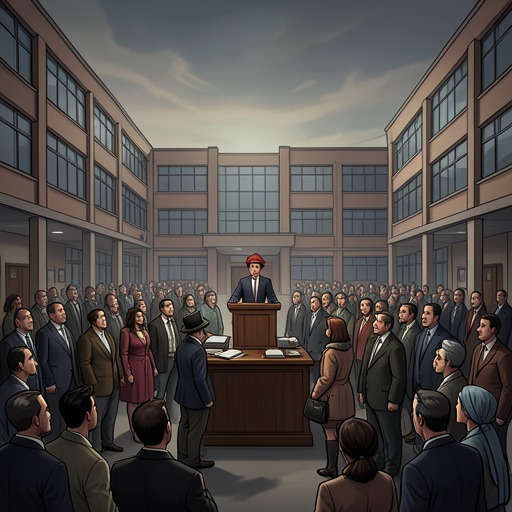
Faculty Vote Against the Strike
Straight ManThe faculty vote against the strike is a decisive defeat for the Faculty Union’s effort to use a walkout as leverage in West Central Pennsylvania University’s budget crisis. Called with only a week remaining in the term, the vote was meant to exert pressure by threatening the seniors’ graduation. Its overwhelming rejection, after major changes in university leadership, reveals how quickly collective support can shift when the immediate political circumstances change.
Background and Stakes
The vote takes shape amid overlapping struggles over the university’s finances, faculty positions, and control of the institution. Herbert Schonberg tells William Henry Devereaux, Jr. that the union needs his support, not because he is expected to become a committed union advocate, but because his public profile and the English Department’s large number of votes could help rally faculty. Herbert presents the proposed alliance as a practical way to win the conflict and then return to the more independent posture William Henry Devereaux, Jr. had previously maintained.
That appeal also carries a warning. Herbert says he has spoken with Teddy Barnes and June Barnes, who have aligned themselves with Paul Rourke and Finny—an unexpected combination, in his view. William Henry Devereaux, Jr. recognizes that Herbert’s invitation has a second meaning: his department and friends may already be arrayed against him, and remaining outside the factions could leave him isolated. The strike vote thus belongs to a wider contest in which formal labor action and personal loyalties are entangled, even though they are not the same dispute.
The Call for a Strike Vote
Herbert announces that he is calling for a strike vote that afternoon. William Henry Devereaux, Jr. emphasizes the timing: the term has only a week to run. Herbert explains that the point is to prevent the seniors from graduating, describing that prospect as the closest thing the faculty can muster to genuine political clout. The proposed strike therefore depends on a stark form of leverage: disrupting a milestone for students in order to make faculty power felt by the university.
The timing gives the vote a different urgency from an ordinary expression of union support. With graduation near, the threat could impose a direct consequence on students, while also making the faculty’s ability to act collectively visible to administrators. The available account does not describe the voting procedure, the precise number of ballots, or the duration of a possible strike. It does establish the intended pressure point, the imminent deadline, and the fact that Herbert is seeking a vote rather than simply announcing that a strike will occur.
The Faculty’s Decision
The result is reported afterward in the Railton Rear View. By then, Dickie Pope has been fired, and Jacob Rose—someone the faculty have known and respected for years—has become the new chief executive officer. Learning of these developments, the faculty vote overwhelmingly against striking. Their decision defeats the position urged by their own union and also runs against the interests of faculty members, including Finny, who would be directly affected by the following year’s budget cuts.
The contrast between the union’s recommendation and the faculty’s vote is central to the event. The proposed strike had been presented as a means to create leverage, but the membership does not follow that strategy once the leadership picture changes. The account links the shift in circumstances to the vote without detailing individual voters’ motives; it does not establish that every faculty member supported the new administration or that the budget cuts had ceased to threaten anyone. What it makes clear is that the personnel changes were enough to coincide with a decisive rejection of the union’s call.
Consequences and Significance
The vote ends the immediate prospect of a strike as the Faculty Union had urged it, and it leaves those vulnerable to next year’s reductions without the collective action that might have strengthened their position. Finny is among those whose interests are exposed by the decision. The faculty’s choice is therefore not presented as a resolution of the budget crisis, but as a refusal of one proposed response to it.
The event also sharpens the novel’s distinction between organized representation and actual solidarity. Herbert seeks a unified faculty action and views William Henry Devereaux, Jr. as a potentially influential ally; elsewhere, the department’s factions and individual alliances complicate that appeal. At the ballot, however, the decisive division is between the union’s recommended course and the faculty’s overwhelming choice not to strike. The threatened disruption of graduation gives the conflict its leverage, while the vote demonstrates the limits of that leverage when members do not accept the union’s judgment.