Finny the Goose
Straight ManFinny the Goose is a campus goose whose encounters with Henry Devereaux turn a budget protest into a public animal-rights controversy. First named by Henry during a day at the campus pond, Finny becomes both the unwilling focus of Henry’s televised threat and a living presence that resists being reduced to a symbol. His later appearance in a foam neck brace and his plaintive exchange with Henry complicate the spectacle: amid the arguments about budgets, protests, and a goose’s death, Finny remains an animal with his own reactions and apparent dignity.
Identity and Introduction
Henry dubs the goose Finny while watching him at the pond. The name distinguishes this bird from the man also called Finny, a distinction the narration later makes explicit. The first glimpse is not a portrait of a passive campus ornament: Finny is angry because the popcorn he had been receiving is gone. He hisses at the discarded empty bag and then at the hand that had held it. His reaction gives the encounter its own immediate cause, separate from the university dispute developing nearby.
Finny’s behavior is repeatedly described through visible actions: hissing, honking, holding his ground, and attempting to fly. These are not explanations of what he thinks, but they make him more than background scenery in a human confrontation. Henry interprets his bearing and later his sounds, while the scene also shows the limits of that interpretation: Finny cannot answer Henry in human language, and the account of his apparent feelings remains Henry’s reading of him.
The Televised Budget Ultimatum
When a television crew records a report near the pond, Finny is already in a tense encounter with the man who had been feeding him. Nearby, the soundman complains that the surrounding noise is interfering with the recording. A stamp of the foot sends several mallards into awkward flight, but Finny stays where he is, hissing and honking more vehemently. His refusal to flee makes him conspicuous just as Henry’s anger and excitement converge into an impulsive public intervention.
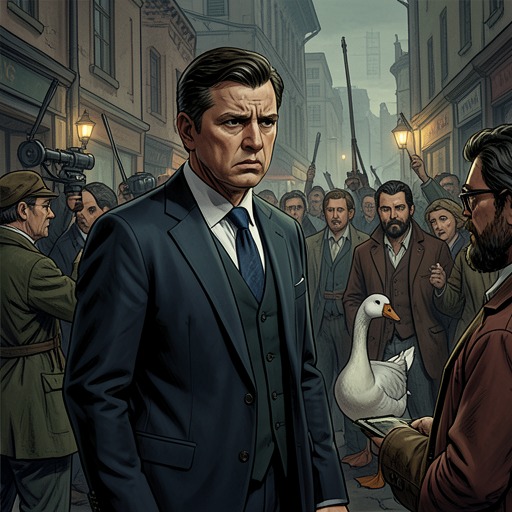
Henry grabs Finny by the neck and raises him before the camera. Wearing a fake nose and glasses, Henry identifies himself as a department chair who wishes to remain anonymous, then explains that he lacks next year’s budget for the adjunct instructors needed to cover freshman composition. He contrasts the university’s multimillion-dollar Technical Careers project with the comparatively small cost of the additional course sections his department needs. The crowd applauds, and the camera continues recording as Henry turns the scene into an ultimatum.
Henry threatens to kill a duck each day until he receives a budget, making the demand that the money be on his desk by Monday morning. Although the threat names ducks, Finny is the goose Henry is holding while he delivers it. Henry gives the frightened bird a quick shake for emphasis, prompting more squawking and renewed attempts to fly. The mismatch between the threatened animals and the bird being brandished sharpens the episode’s theatrical absurdity, but it does not make Finny’s predicament less real within the scene. The arriving campus executive officer and state representative encounter a tenured professor in disguise, holding a terrified goose before a camera; Finny is at once an animal caught in the commotion and the most visible instrument of Henry’s protest.
Protest and the Pond
The televised threat produces demonstrations against Henry. Later, protesters link arms around the ducks and geese, forming a semicircle and chanting against him and the threatened slaughter. Finny breaks through their protective line and honks loudly. His movement briefly unsettles the protesters’ arrangement: the bird they are trying to protect does not remain where their human demonstration has placed him. Henry, meanwhile, recalls his own experience carrying protest signs during the Vietnam era, but Missy Blaylock’s agreement that some things never change helps persuade him that he should leave. The scene places Finny’s unpredictable behavior alongside the organized moral language of the crowd without making him a spokesman for either side.
After the demonstrators and television crews depart, Henry circles back past the pond. A single protest placard remains planted on the bank, while the fowl are left without their human guard. Finny is still there, now wearing a foam neck brace. The account does not establish how he came to wear it. Henry reads the bird’s curious look as apprehension that he might become the subject of another joke, and compares his appearance to a cartoon goose in a turtleneck. That comic comparison sits beside Henry’s claim that animals, like humans, are determined to maintain their dignity. Finny’s apparent difficulty meeting Henry’s eye belongs to Henry’s interpretation, but the scene makes that interpretation consequential: the once-brandished bird is now approached as a presence to sit beside and listen to.
Voice, Dignity, and Narrative Role
Henry speaks to Finny in Spanish and waits. A sound comes from the goose that Henry does not associate with his earlier hissing and honking: he hears it as higher, thinner, and lamenting. He imagines Finny asking whether this is a fine state of affairs, then sits on a nearby bench for several minutes, listening. The exchange is not presented as literal speech. Its importance lies in the change of posture: Henry, who had used Finny to amplify a public demand, now gives time and attention to the bird without a camera or crowd directing the scene.
The contrast gives Finny a narrative role beyond the original stunt. His anger over the empty popcorn bag, his resistance to the demonstrators’ protective line, and his changed appearance at the pond all keep him distinct from the human meanings assigned to him. Henry’s threat makes the goose a prop in a political performance; his later visit recasts him as a listener to an animal he believes is lamenting. Finny does not resolve the university’s budget dispute, and the evidence does not establish what becomes of him. Instead, his repeated presence exposes the distance between declaring concern for animals in public and attending to one particular animal in an unguarded moment.
The later controversy concerns a goose found hanging from a tree on campus. A campus security employee reports that Lou Steinmetz immediately suspects Henry, and demonstrators subsequently protest the death of a single goose. The account identifies the dead animal as a goose, not as Finny; Finny’s earlier appearance in the neck brace should not be conflated with that reported death. In the later television encounter, Henry is asked whether he knows anything about the incident and gives no comment. Finny’s story thus remains distinct from the accusation, even as his name and the earlier threat have helped turn campus geese into the focus of a public dispute.