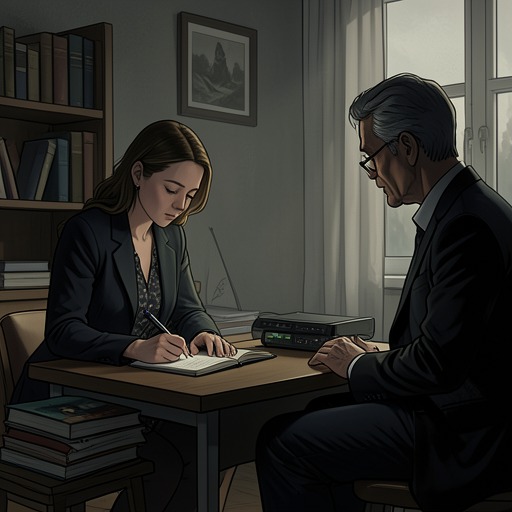
Hank Devereaux Mentors Rachel Williams and Advances Her Fiction Career
Straight ManWilliam Henry Devereaux, Jr.’s relationship with Rachel Williams is a mentorship that changes her writing career while testing the limits of his good intentions. He has spent more than a year telling her that her stories are terrific, and he ultimately sends them to his agent without asking her first. The resulting offer of representation and sale confirm his judgment, but Rachel’s alarm forces him to recognize that advancing her career is not the same as having the right to decide for her.
A mentor who sees the writer
William Henry Devereaux, Jr.’s confidence in Rachel rests on sustained attention to her fiction, not merely on a single encouraging response. When she panics at the prospect that the agent wants to represent her, he reminds her that he has praised the stories for over a year. His teasing insistence that the agent is not the final arbiter—and that he has been telling Rachel the stories are good all along—reveals a mentor who wants her to trust her own work rather than wait for an outside authority to certify it.
His understanding of Rachel extends beyond her pages. He knows from reading her stories about her lower-class roots and the effort she has made to master manners and polite behavior. He notices how carefully she has practiced middle-class clothes, posture, and gestures, and how her diction can still betray the work involved. The detail gives his encouragement a particular intimacy: he has been reading not only what Rachel writes but also the experience and discipline that shape her voice. In the moment when she is distressed, he tells her to sit, locks the office door against interruption, and waits while she bends forward with her head between her knees, struggling not to hyperventilate. His response is practical and protective, even as he privately feels guilty.
The breach behind the opportunity
That guilt has a concrete cause. William Henry Devereaux, Jr. has sent Rachel’s stories to Wendy, his agent, without Rachel’s permission. When Rachel quietly tells him that Wendy called, he initially does not know what to say. Her fear is not what he had expected: she is horrified that the agent wants to represent her, and then even more unsettled by the news that Wendy called the stories terrific. The praise does not immediately free Rachel from self-doubt; it makes the prospect of being judged and recognized feel more frightening.
Rachel’s distress changes how William Henry Devereaux, Jr. understands his action. He recognizes that he has failed to imagine the effect Wendy’s direct, busy, and tactless manner might have on her. He considers Wendy honest rather than cruel, but that distinction does not erase his own responsibility: he set the encounter in motion without asking Rachel whether she wanted her work submitted. His mentorship is therefore not presented as uncomplicated benevolence. He has helped create an opportunity, but he must also confront the presumption embedded in helping on someone else’s behalf.
Encouragement, intimacy, and professional success
After Rachel asks what she should do, William Henry Devereaux, Jr. urges her to enjoy the moment and take pride in it. He encourages her to boast about the success and even to tell her former husband that she had been right. The humor is part of his method: rather than treating Rachel’s fear as proof that she cannot meet the demands of writing, he tries to make recognition feel like something she is allowed to claim. His suggestion that she may rupture something by keeping her satisfaction inside turns confidence into a bodily, comic image.
Their exchange also carries an intimacy beyond professional instruction. William Henry Devereaux, Jr. reflects that being perfectly understood is wonderful, especially by a woman he could love under the right circumstances, and imagines Rachel’s secret heart singing while his own hums in response. The attraction remains a possibility shaped by circumstances, not a declared relationship. That distinction matters: his delight in Rachel’s success is personal as well as professional, yet the scene does not turn the mentorship into a romance or make her achievement merely an occasion for his feelings.
The sale and the echo of an earlier call
The later phone call from Wendy confirms that the stories have been sold. When William Henry Devereaux, Jr. asks whether she liked them, Wendy pauses and tells him that she not only liked them but sold them; the sale took place about twenty minutes earlier. Wendy admits that telling him before the author is unprofessional, but explains that she knows he helped Rachel and thought he would be thrilled. His reply reassures Wendy, though she notices that he sounds funny about the news.
His reaction opens onto his own history. More than twenty years earlier, Wendy had called to say that a trade publisher had bought Off the Road. That sale was followed by Julie’s conception and by decisions that rooted William Henry Devereaux, Jr. and his family in Allegheny Wells, including buying land and his refusal to sell to Paul Rourke. He cannot know what the call will mean for Rachel, but he understands that her life is about to change. Wendy cautions that the book will bring little money and may not sell widely amid the market for grunge fiction; he counters that grunge is also abundant in real life. The exchange places Rachel’s new career inside a larger pattern of uncertain consequences: a phone call can begin a chain of changes that no one can fully foresee.
William Henry Devereaux, Jr.’s decisive contribution is thus both artistic and relational. He recognizes Rachel’s talent before the agent’s verdict, helps place her work before a publisher, and celebrates a sale that she may not yet know how to welcome. At the same time, her panic makes visible the cost of his unauthorized intervention. Their mentorship advances Rachel’s fiction career, but its deepest test is whether his confidence in her can coexist with respect for her authority over her own work.