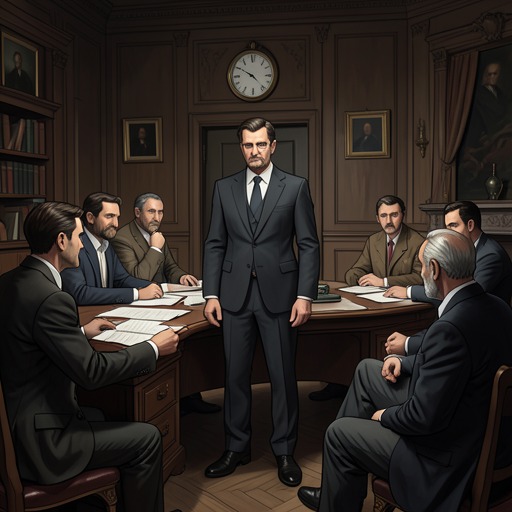
Hank Devereaux Threatens to Kill Ducks to Secure Funding
Straight ManWilliam Henry Devereaux, Jr.’s televised duck-killing ultimatum begins as an improvised protest over the English Department’s budget and becomes a public test of the boundary between comic threat and real consequence. Wearing a disguise and holding Finny the Goose before a television camera, he demands funding for composition courses; after a goose is found dead, his words return as an accusation, a campus controversy, and a problem for his students to reason through.
Causes and Public Performance
The immediate grievance is specific: Devereaux says the department lacks money to hire the adjunct staff needed to cover roughly a dozen freshman composition sections the following fall. He contrasts that shortfall with the university’s commitment of millions of dollars to a new Technical Careers building project, presenting the proposed courses as a modest expense beside the construction plans. The budget complaint is therefore not simply a plea for more money; it is an accusation about which kinds of university activity receive support.
The televised scene grows out of a chance encounter at the Campus Duck Pond. A local television crew is filming a reporter’s repeated lead-in about the future building site, while Devereaux and Tony Coniglia watch nearby. When Finny follows Devereaux’s hand toward his pocket and pulls out the fake nose and glasses Devereaux has there, the encounter becomes unruly and conspicuous. Devereaux’s anger at the bird, his excitement about the administration’s treatment of his department, and what he experiences as a sudden sense of righteousness converge. Before reconsidering, he lifts the goose for the camera.
The disguise is meant to make the performance appear comic, while the message underneath is pointed. Devereaux identifies himself as an English Department chair who wishes to remain anonymous, then explains the staffing shortage and the university’s competing investment. He delivers the complaint briefly and with deliberate irony, mindful of television’s time limits. He ends by announcing that he will kill a duck each day beginning Monday unless the requested budget is on his desk. The absurdity of the threatened remedy is part of its force: it converts an administrative grievance into a demand the camera can carry.
From Broadcast to Campus Controversy
The station’s camera records more of Devereaux’s unprepared speech than he later wishes it had. The segment is previewed and then shown at The Tracks, where the crowd responds with applause and treats him as a hero. The broadcast also makes the disguise less effective than he had imagined: close-up, the nose and glasses look like an imperfect alteration rather than an unmistakable costume. The same images that first give his protest comic theatricality make him appear, on television, to be a professor gripping a startled goose while making a threat.
The response changes sharply when animal-rights protesters gather at the spot where Devereaux made the announcement. Students carry signs and chant against him, and the television crew returns. The public frame has shifted: the budget dispute that Devereaux tried to put at the center is now entangled with the treatment of campus animals and the threat itself. The scene shows how quickly television exposure can enlarge a personal protest while narrowing the terms on which the public sees it.
That shift becomes sharper after a goose is found hanging from a tree on campus. During a later interview, Missy Blaylock reminds viewers of Devereaux’s earlier threat and asks whether he knows anything about the incident. He gives no comment. Asked whether he has received the budget, he acknowledges that he has not. When pressed about a possible connection between the missing funds and the dead bird, he again declines to answer. He then suggests that Richard Pope, the campus executive officer, could have been involved because Pope also lacks a budget. The remark is an unsupported, provocative inference, not evidence identifying who killed the goose; the available account does not establish the culprit.
The Threat Reconsidered in Class
The controversy follows Devereaux into his afternoon composition class. Students object that he has asked for their advice in essays and then apparently acted before they could turn in their work. Some of them were also present for his televised interview, where he did not deny being responsible for the threat and had implied that the threatened killings could continue. Devereaux has read the essays and separated them into two unequal piles. Most of the papers advise killing a duck, and he reads three anonymously in an effort to make the students hear their own reasoning and encounter doubt.
The students’ arguments turn on credibility: if Devereaux does not carry out a public threat, they reason, future threats will not be taken seriously. The essays invoke foreign policy and war, including Desert Storm and the Second World War, but their analogies stray from the assignment and contain serious historical errors. In a class of twenty-three, a small minority dares to show disagreement while the majority’s loud approval makes dissent difficult. Blair, his strongest student, hesitates to speak, and Devereaux finally calls on her rather than letting her retreat into silence.
Devereaux tells the class that he is not persuaded, a response the majority expects from him. He asks why Blair was right to be surprised by his public threat, but the class falls silent until the bell ends the discussion. His answer is that the threat was comic, delivered by a man in a fake nose and glasses, and that carrying a comic threat through to a serious consequence makes no sense. The distinction does not settle the matter. The class began in comic argument and ends in confusion and anger, leaving Devereaux’s own separation of comedy from tragedy in doubt.
Consequences and Significance
The event produces no evidence that Devereaux receives the requested budget, and the later interview explicitly establishes that it has not arrived. Nor does the account resolve who killed the goose. Instead, the sequence leaves the threat suspended between performance and consequence: the costume and the deliberately absurd demand signal comedy, while the dead bird and the protest prevent the spectacle from remaining harmless entertainment.
In class, the dispute becomes an ethical question about whether a public threat should be treated as a joke, a promise, or an obligation to act. Devereaux’s students expose one danger of the tactic: once the threat circulates independently of its comic framing, its audience may treat follow-through as proof of seriousness. Yet Devereaux’s final explanation cannot restore that framing, and his own lesson is unsettled when a student objects to the way he has put Blair on the spot. The budget protest thus moves through several competing interpretations—administrative complaint, television spectacle, animal-rights controversy, and classroom argument—without yielding the money or a definitive account of the goose’s death.