Hank Devereaux’s midlife and existential crisis
Straight ManHank Devereaux’s midlife and existential crisis is a struggle to accept that his life remains exposed to consequence. Nearly fifty, still a department chair, and the author of a book once favorably reviewed by The New York Times, he has built a comic distance from trouble. But a department crisis, a brush with mortality, and the possibility of losing what he loves make that distance harder to maintain. His crisis is not a single revelation or a clean conversion: he recognizes danger and possibility, then resists the lessons either might impose.
Identity and the Limits of Detachment
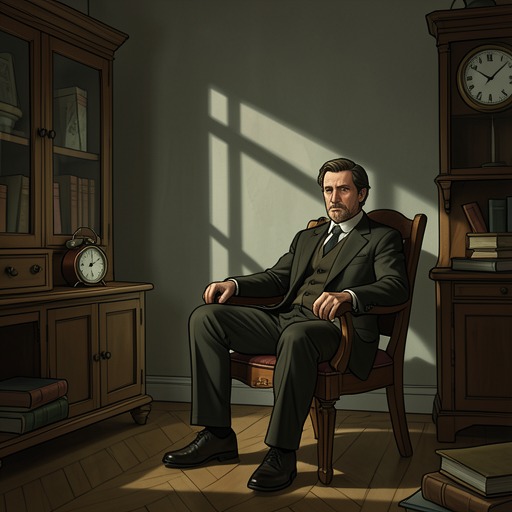
Hank’s crisis sharpens when he takes stock of the contrast between his public standing and his immediate predicament. He has dressed for the part of a professor, in a button-down shirt, tie, loafers, and tweed coat; he is also trapped in the ceiling space of the Modern Languages Building after a department vote. The gap between these identities—established academic and man unable to descend safely—turns his usual irony back on himself. He can list the facts that ought to signify stability, including professional success and institutional authority, but they do not make the scene less alarming.
His attempt to get out of the crawl space makes the crisis visible rather than merely inward. After moving through the dark, he cannot return to his office without encountering colleagues searching for him. He eventually descends into the women’s restroom and sees himself in its long mirror, his clothing and face marked by the dust and grime of the ceiling. The reflection recalls his earlier appearance on television holding Finny the goose, but the resemblance no longer feels safely comic. The mirror gives him no flattering version of the story: he recognizes that his situation is serious. When Gracie and Jacob try the locked restroom door, he considers letting them in, yet decides he will not climb back into the ceiling. Even this limited decision marks a change: he has admitted that he is in trouble and refuses to repeat the escape that put him there.
Mortality, Loss, and Desire
The crisis widens beyond the immediate humiliation when Hank looks at freight cars and, for a moment, sees them as the skyline of a submerged city. The vision passes; the boxcars return to being boxcars. Its briefness matters. He does not claim a lasting transformation, but the altered view makes the ordinary world seem capable of becoming strange, then ordinary again. Nearby, William Cherry has recently died by lying on the railroad track. Hank wonders whether the world changed for William before his death or remained unchanged to the end. The question puts his own fleeting perception beside another person’s irreversible ending without pretending he can know what William experienced.
Hank is clear that he does not want to die, yet he also acknowledges a disturbing ambivalence. He dreads the possibility that Phil Watson may find a tumor, while admitting that some part of him might be thrilled by such news. He does not explain this contradiction away. His uncertainty also reaches into his marriage: he does not want Lily to leave, but imagines that the prospect of her finding a new love moves him more than the thought of growing old together in contentment. He can half-wish for that love even as he does not welcome the loss it would entail. The tension is not a decision to end the marriage; it is evidence that security alone no longer answers his desire for intensity or change.
Consequence and Resistance to Instruction
Hank later describes the winter incident on Pleasant Street Hill, where he lost control while trying to climb the slope, as the beginning of a loss of faith in consequence. He had felt protected by a life of gradual transitions, imagining himself fixed on Pleasant Street, beyond both catastrophe and ecstasy. His baseball metaphor gives that safety the shape of a career fading by increments: from left field to first base, then to designated hitter, a role that makes an aging player appear to remain in the game. The prospect of consequence now feels like a correction to that belief. As he waits outside the dean’s office on a clear day, he recognizes the appointment as the close of a distinct period in his life and expects that events may finally reach him.
But recognition does not make Hank teachable. Watching Lou Steinmetz explain to Leo where he went wrong, Hank doubts that punishment necessarily produces understanding. Leo may accept consequences without absorbing another person’s lesson; Hank recognizes something of himself in that refusal. His thought reaches beyond the immediate scene: even an encounter with God, he suspects, might not persuade someone determined not to learn. The crisis therefore does not resolve into a moral. Hank can see the danger of treating himself as exempt from consequence while remaining wary of the obedience that a ready-made lesson demands.
Narrative Significance
Hank’s crisis takes shape through reversals between comic image and serious recognition. The trapped department chair, the disheveled reflection, the familiar freight cars, and the slow movement from Pleasant Street to the dean’s office all make ordinary settings register differently without promising permanent revelation. His perspective repeatedly tests whether stability is real or merely a story he has told himself. The returned boxcars and the approaching consequences do not offer a single answer: one restores the everyday world, while the other makes its protections look fragile.
This unresolved movement is central to the crisis. Hank does not emerge as newly obedient, nor does he dismiss death, illness, or marital loss as jokes. He can state that he wants to live and still recognize attraction to upheaval; he can recognize that consequence has arrived and still question whether he will learn from it. The resulting tension is not simply between safety and danger, but between the desire for a life that remains predictable and the desire for events powerful enough to make him feel that he is still in it.