Hank Devereaux’s prolonged creative dormancy
Straight ManWilliam Henry Devereaux, Jr.’s prolonged creative dormancy is not simply an absence of books: it is a condition measured against the lingering, oddly local afterlife of his first one. Published twenty years earlier and forgotten by the wider world the following year, the book still circulates on campus, where colleagues treat its existence as evidence of literary success and its author confronts the long silence that followed it. When he briefly takes the book from a shelf and begins reading, the old work seems to call a new one into possibility—but the thought fades almost as soon as he voices it.
The First Book and the Measure of Success
William Henry Devereaux, Jr.’s reputation as a writer rests on a slender book, not on a continuing career of publication. Its initial print run was eight thousand copies. The final thousand were bought by the campus bookstore at remainder price and then sold there at full jacket price over the next fifteen years. When William Henry Devereaux, Jr. last checked, a couple of hundred copies were still in stock. The numbers describe a book that has neither vanished completely nor remained a meaningful public success: it persists in a small institutional market long after its broader moment has passed.
That limited afterlife nevertheless shapes other people’s perceptions. During an argument, Gracie DuBois acknowledges William Henry Devereaux, Jr. as a successful writer and says that she has given fifteen years to the institution and will not be moved aside. Her admission reveals how the old book functions in their department: even a work forgotten beyond campus can carry enough symbolic weight to provoke professional insecurity. William Henry Devereaux, Jr. recognizes the irony that the book’s modest record has become a source of jealousy. The campus bookstore’s remaining copies make that irony concrete: the work has endured, but endurance is not the same as renewed achievement.
A Reputation Encountered at Work
Dickie Pope’s office brings the book’s material presence into the present. As William Henry Devereaux, Jr. is ushered out, Dickie turns to his book-lined wall and searches the shelves in the place where he remembers seeing the book. The search is mistaken, and that mistake heartens William Henry Devereaux, Jr. The book is not where Dickie expects it to be because William Henry Devereaux, Jr. has stolen it from the office and carries it in his coat pocket. For a moment, the author stands before Dickie as a poor substitute for the object Dickie wants to find: the printed work has become more tangible, and perhaps more useful, than its living maker.
Dickie’s recollection of the book is complicated rather than dismissive. He says that he started it and liked it, then observes that William Henry Devereaux, Jr. does not write anymore. The reply distinguishes writing in general from writing books: William Henry Devereaux, Jr. points to the margins of student papers, while Dickie maintains that this is not the same activity. Their exchange turns the dormant career into a question of scale and attention. Marking student work is still a form of writing, but it does not answer the absence of another book. William Henry Devereaux, Jr.’s joke that both forms of writing go largely unread deflects the distinction without resolving it.
Dickie offers a practical explanation for his own failure to read more: lawyers and police occupy his time. He also asks William Henry Devereaux, Jr. to take the weekend to think things over and discuss the matter with Lila. The conversation therefore contains both a remembered reader’s genuine liking and a reminder that the book’s author is being treated as someone whose next decision still matters. The old book is at once a source of recognition and an awkward measure of what has not followed it.
The Book Returns to His Hands
The thought of writing again emerges during a private pause in the men’s room. William Henry Devereaux, Jr. notices a low droning sound and a tingling in his extremities, and wonders whether the brief temporal ellipses he has experienced over the preceding days signal illness. He also remembers that comparable disappearances occurred while he was working on the book now in his pocket. The association complicates the meaning of his lapses: they might be signs of a medical problem, but they also recall the absorption involved in making fiction.
That absorption had been visible to his family. Lily used to chide him when he seemed physically present at the dinner table but emotionally absent. Years later, his daughter Karen told him that she could tell whether he was really there or had gone into another world, revising fictional reality. These recollections place the act of writing within ordinary family life, where creative concentration could look like withdrawal. They do not establish that a new book is taking shape; instead, they show why the old experience remains available to his imagination as a possible explanation for his present state.
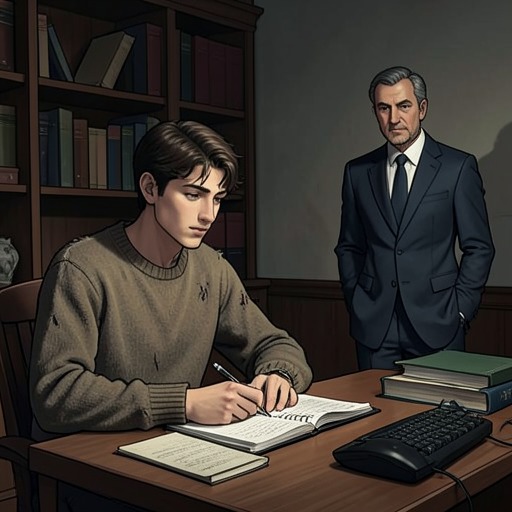
William Henry Devereaux, Jr. is wary of treating authorship as a romantic calling. He considers that both good and bad books might press for an author’s attention, and that an impulse to write need not be obeyed. His image of cotton for the ears turns creative possibility into something that can be deliberately resisted. Yet, back in his office, he takes the old book from his pocket. Beneath the small Tensor desk lamp, with a new blotter on the desk, he opens it and begins reading rather than putting it away as he had intended. The movement is small but decisive: after years of dormancy, he gives the book his attention again.
A Possibility That Does Not Settle
Rachel’s voice over the intercom interrupts the reading. When she asks whether he is there, the question catches the divided attention already at work in the scene: William Henry Devereaux, Jr. has been thinking about the earlier self who wrote the book and the present self who carries it. He tells Rachel that he is thinking about writing another book. Her surprised enthusiasm makes the statement newly real as something spoken to another person, rather than merely entertained in private.
The assertion does not become a decision. When Rachel asks whether he is really going to write again, William Henry Devereaux, Jr. admits that he probably will not; the idea seems to have dissipated. The sequence preserves both sides of the moment without forcing them into a simple account of recovery. He has returned to the first page, recognized a possible new impulse, and named it, but he has not committed himself to a manuscript or sustained work. Rachel’s joking suggestion of nouvelle cuisine and his observation that he is now playing straight man to his own secretary briefly extend the exchange into their working relationship, while leaving the question of authorship unresolved.
The sound that follows helps keep the scene grounded in competing explanations. The droning has returned and seems to him like distant thunder, but Rachel identifies the noise as asbestos removal. Relieved that the external world accounts for at least this sound, William Henry Devereaux, Jr. looks at the vibrating ceiling tiles. The episode closes not with proof that a new book has begun, but with a material noise interrupting an uncertain private possibility. His dormancy is momentarily disturbed by reading, memory, and speech; it is not yet over.