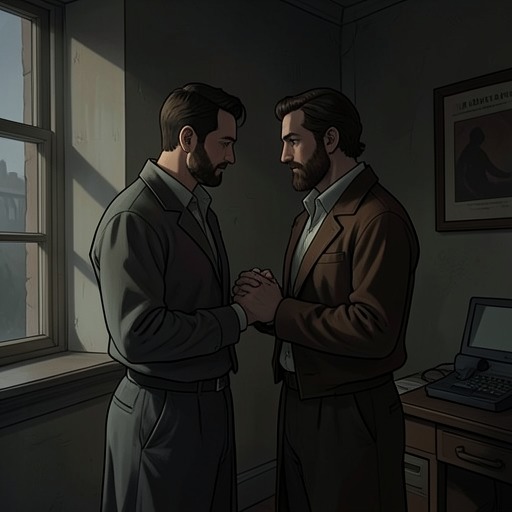
Hank and Lily Devereaux’s Twenty-Five-Year Marriage and Renewed Closeness
Straight ManWilliam Henry Devereaux, Jr. and Lily Devereaux’s marriage is both a durable private partnership and a relationship repeatedly exposed to misreading: by the newspaper audience that confuses Lily with his mother, by their daughter’s fear that the marriage is ending, and by William Henry Devereaux, Jr.’s own jealous imaginings. During a period of public provocation and personal disarray, their distance makes his dependence on Lily unmistakable, while her concern for him shows that intimacy includes both affection and clear-eyed warning.
Identity and Public Entanglement
The marriage sits inside a long-running public confusion created by William Henry Devereaux, Jr.’s mother. After being abandoned by William Henry Devereaux, Sr., she continues to publish under the name Mrs. William Henry Devereaux in the Railton Mirror. Readers consequently take her to be William Henry Devereaux, Jr.’s wife. He is drawn into defending opinions that are not Lily Devereaux’s, while Lily, as the other Mrs. William Henry Devereaux, is even more directly expected to answer for views she has never expressed and does not share. Their marriage is thus made visible in public under a borrowed name, with the resulting confusion burdening both partners in different ways.
That comic misidentification also carries a sharper family history: the name Lily is made to share is the name of the man who left William Henry Devereaux, Jr.’s mother. The newspaper byline collapses generations and relationships that the family itself has kept distinct. The situation is a recurring source of social awkwardness for the couple, not evidence of conflict between them; its strain comes from being assigned a public identity they did not choose.
Their Daughter’s Fear of Divorce
The children’s understanding of the marriage becomes part of its emotional life. Karen, the older daughter, has long been alert to the possibility that her parents might divorce. Several of her high-school friends experienced bitter parental separations, leaving Karen shaken and inclined to interpret what she saw at home as a warning. Ordinary bickering, and even conversations whose context she had missed, could become signs of impending dissolution in her mind. Because she was older, Karen also passed that anxiety on to Julie Devereaux.
Julie’s fear surfaces in a confrontation with her father. She resents that Lily tells Karen things she does not tell her, and says she could not bear her parents divorcing at that moment. William Henry Devereaux, Jr. registers the striking lack of irony in her appeal, but the scene makes clear that the marriage is not only a matter between spouses: their daughters observe it, interpret it, and worry about its survival. Julie’s outburst is followed by an incongruously defiant response to a waiting driver, giving the moment both family tenderness and comic abruptness without diminishing the seriousness of her fear.
Absence, Suspicion, and Public Conduct
When Lily is away in Philadelphia, William Henry Devereaux, Jr.’s sense of their connection becomes entangled with his own unruly behavior. After threatening on television to kill a duck each day until he receives a budget, he celebrates at The Tracks, drinks heavily, and repeatedly tries to reach her. He knows she would not approve of the televised threat, yet he is disappointed that she is absent to see it and eager to tell her what he has done. His desire for her attention persists even as he acts in ways likely to trouble her.
The same night, he imagines that Lily and Jacob Rose might be together in a Philadelphia hotel room. The possibility begins as a suspicion generated by his own narrative-making, not as a fact about Lily. He recalls that she and Jacob have been close friends and that she supported Jacob through personal disappointments; that history makes his imagined scenario feel plausible to him, but does not establish that anything has happened. When Lily’s recorded message gives the name and number of her hotel, he calls and gets no answer. He then asks the operator for Jacob Rose’s room and is told that no one by that name is registered, though a guest called Jack Rosen is. His jealousy redirects his attention from the ordinary explanation of Lily’s absence toward a story he has constructed.
The message itself adds to his unease. Lily leaves her hotel information and reminds him that he is due to visit her class. He hears flatness in her voice and wonders whether she has already sensed his misbehavior. Even in that uncertainty, he cannot tell whether his fear arises from what he has done or from what he suspects she might have done. The episode exposes the instability of his interpretations: he has limited information, but suspicion and imagination fill the gap quickly.
Care, Dependence, and Renewed Closeness
Lily’s response to his behavior is direct without being detached. During a call from a phone booth in the basement of the Modern Languages Building, she sounds weary and melancholy. William Henry Devereaux, Jr. recognizes how deeply the familiar sound of her voice affects him: hearing it restores his sense of himself and weakens the fantasies that had seemed compelling while they were apart. His response suggests that the marriage’s intimacy is not a grand declaration but a familiar voice capable of interrupting the stories he tells himself.
Lily also names a practical imbalance in their partnership. When he does not know details about Julie, she observes that he depends on her to know them. She is less worried about Julie than about her husband, particularly after seeing him on television. She urges him to request a leave of absence or resign rather than continue provoking the university until it fires him for something worse. Her concern is not abstract: she recognizes that his conspicuous conduct may have consequences and asks him to stop before those consequences escalate. Her advice pairs familiarity with candor; she knows his patterns well enough to worry that his behavior is carrying him toward a needless crisis.
Their conversation also recovers an older ease. William Henry Devereaux, Jr. remembers that he once made her laugh, and Lily corrects his exaggeration rather than simply agreeing. She recalls that they used to have more energy for laughter and for much else, and that more things once felt new. When he asks whether she wishes things were new again, she says that she sometimes does, but not often. The exchange acknowledges change and fatigue without treating them as proof that affection has vanished. Their shared humor remains, though it belongs to a life with less energy and novelty than before.
Family History and the Meaning of Partnership
Lily’s bond with her father, Angelo Caprice, offers another context for her capacity to remain attached through conflict. She cannot stop loving him despite his bigotry, which shames and angers her. After her mother died while Lily was still a girl, Angelo’s devotion helped carry her through the loss. They had been a close team until Lily went away to university; over time, education and changing language widened the distance between them. She asked him to abandon some of his familiar expressions, and he came to regard her life and choices as a repudiation of him. Lily eventually married William Henry Devereaux, Jr., whom Angelo considered the worst possible choice. Her relationship with her father therefore holds love and estrangement together, rather than resolving one into the other.
The couple had agreed not to let their respective fathers become the cause of serious conflict between them. They were each fond of the other’s parent, even while recognizing the parents’ flaws, and their agreement protected the marriage from being reduced to disputes about those men. This boundary matters because Lily’s attachment to Angelo is complicated and enduring; William Henry Devereaux, Jr. understands that her history with her father is not something a simple judgment can settle.
Across these episodes, the marriage is neither presented as untouched by strain nor shown ending in separation. Its pressures include public confusion, parental anxieties, distance, suspicion, and William Henry Devereaux, Jr.’s increasingly provocative conduct. Yet the evidence of closeness remains concrete: he seeks Lily’s attention, her voice steadies him, and she continues to advise him with intimate knowledge of his habits. The relationship’s renewed warmth comes not from restoring an earlier, untouched version of their life, but from recognizing how much they still rely on one another amid change.