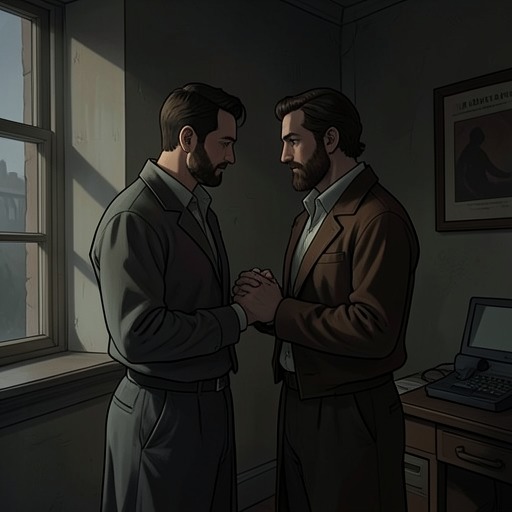
Hank and Lily’s marital unease
Straight ManHank and Lily’s marital unease is a quiet but consequential strain in a marriage approaching thirty years. Its central tension is not a confirmed betrayal or a declared decision to separate, but the gap between how secure William Henry Devereaux, Jr. assumes their bond to be and how poorly he understands Lily’s private feelings. His fantasies, their daughter’s alarm, and Lily’s efforts to reach him make that gap visible; gestures of affection suggest intimacy remains, without resolving the uncertainty.
A Marriage Read Through Uncertainty
William Henry Devereaux, Jr. is confident that Lily loves him and no one else, yet that confidence does not stop him from imagining her with other men. During a summer evening on the deck, he wonders whether a secret desire for surprise has led him to picture Lily and Teddy Barnes as lovers. The thought is not new: months earlier, he had imagined Lily becoming involved with Vince, a man she knew through her work at the high school. He tried to interpret signs of infatuation in her, though he eventually found the imagined evidence impossible to sustain.
The fantasies grow increasingly vivid to him, and their persistence is itself disturbing. William Henry Devereaux, Jr. reasons that Lily is attractive and could attract a lover; he also recognizes that it is arrogant to assume his place as her husband makes her immune to falling in love with someone else. At the same time, he believes she loves him alone, even when she is displeased with him. The contradiction is not resolved by proof of an affair. Rather, the narrative distinguishes his imagined scenarios from what he knows, leaving him to wonder why he repeatedly pictures his wife’s desire directed elsewhere.
An earlier encounter offers a small, concrete version of that uncertainty. After Lily shares a brief, chaste hug with Teddy Barnes, William Henry Devereaux, Jr. thinks Teddy has asked whether Lily believes he will be all right. He notices that the question seems to concern him rather than his injured nose, and he cannot hear Lily’s answer. Seeing his own reflection in a kitchen window, he assures himself that he will be fine; then Lily’s reflection appears behind his, and she tells him he can be a jerk. Her remark registers as friction, while Teddy’s concern and Lily’s presence also place their marriage within a circle of continuing care.
Their Daughter’s Fear of Divorce
The strain becomes more urgent when Julie Devereaux interprets her parents’ behavior as evidence that they are about to divorce. She punches her father and demands to know what is happening. William Henry Devereaux, Jr. catches her wrist when she begins to strike him again, then lets go to show that he trusts her. The confrontation is not evidence that a separation is planned: he tells her that she and her sister are imagining things and insists that nothing is wrong between him and Lily.
Julie’s fear has a family history. Her older sister Karen had become alert to the possibility of divorce after several friends’ parents went through painful separations. She began reading signs into her own parents’ petty disagreements and conversations she did not understand. Being older, Karen passed her anxiety on to Julie. Julie also resents that Lily tells Karen things she does not share with her, making the sisters’ closeness feel like a club from which she is excluded. The daughters’ fears therefore grow not from a disclosed plan to end the marriage, but from their interpretations of partial information and the emotional signals they believe they see.
Julie’s most direct explanation is that she could not bear for her parents to divorce at this point in her life. William Henry Devereaux, Jr. is struck by her sincerity, but her distress also exposes the limits of his reassurance. When she says that Lily is often unhappy and he never notices, he asks when Lily is unhappy, inadvertently demonstrating the very inattentiveness Julie has identified. The exchange makes the marriage’s private uncertainty a family concern: even without a confirmed crisis, the daughters are trying to understand—and in Julie’s case, plead against—a change they fear.
Affection, Avoidance, and Misreading
William Henry Devereaux, Jr. eventually carries Julie’s concern to Lily, asking whether she is unhappy. Lily answers that she is not often unhappy. When she comes over and kisses him on the forehead, he reads the moment as potentially intimate and thinks of asking her not to go to Philadelphia that weekend. Instead, he pretends that her touch has hurt an old scar. Lily looks disappointed, as if she recognizes the choice he has made and understands its reason before he does.
That exchange holds closeness and withdrawal together. Lily approaches him physically and touches him gently; he responds by performing injury rather than saying what he wants or accepting the intimacy he has imagined. Her explanation of her unhappiness separates a temporary circumstance from the deeper concern: she is unhappy to see him so lost. The scene does not establish that she is generally dissatisfied with their marriage. It shows, more narrowly, that she sees his disorientation and that he has difficulty meeting her attention directly. Her disappointment leaves the moment unresolved rather than turning affection into an easy reconciliation.
The novel also places this marital strain alongside the couple’s different relationships with their fathers. William Henry Devereaux, Jr. and Lily had agreed not to let either father become the source of serious conflict between them, in part because each was fond of the other’s parent. For Lily, however, love for Angelo coexists with shame and anger at his bigotry. After her mother’s death, his devotion had sustained her; her education and adult choices later widened the distance between them. That history gives their agreement a practical weight: the couple has tried to protect the marriage from a family conflict that cannot be simplified into either affection or rejection.
A Bond That Does Not Guarantee Understanding
The evidence presents a marriage under strain without declaring it broken. William Henry Devereaux, Jr. trusts that Lily loves him, yet his imagined rivals and Julie’s fears show how little that certainty can tell him about what Lily is feeling. Lily, in turn, can be tender and displeased, and can recognize his confusion even when he cannot recognize her unhappiness. Their enduring connection appears in ordinary gestures and in the family boundaries they have tried to maintain; their distance appears in what he imagines, avoids, or fails to notice.
This tension contributes to the novel’s wider interest in how people understand themselves only imperfectly. William Henry Devereaux, Jr. reflects that spouses, children, parents, colleagues, and friends can know a person better than that person knows himself. Julie’s blunt observation and Lily’s disappointed response supply precisely the knowledge he lacks: that being certain of someone’s love is not the same as attending to her state of mind. The marriage’s unease thus lies in a gap between attachment and understanding. The evidence offers moments of care, but no final declaration that all the distance has been overcome.