Hank and Tony Are Detained by Police at the Rail Yard
Straight ManWilliam Henry Devereaux, Jr. and Tony Coniglia are detained on the same snowy night after separate encounters with a young police officer, then discover that they have been placed in the same drunk tank. The episode turns a lonely stop at the Railton rail yard into an absurd reunion: William Henry Devereaux, Jr. uses his one phone call to reach the man who is already in the cell with him. Its comedy is edged with physical distress, thoughts of mortality, and the deeper memory that snow and darkness bring back to him.
Causes and Circumstances
After dinner, William Henry Devereaux, Jr. pays for his own meal and Tony Coniglia’s; Tony pays for June Barnes’s and Teddy Barnes’s. William Henry Devereaux, Jr. says he needs to stop at the men’s room, but, seeing that Tony is exhausted and anticipating that he may be gone for some time, tells him to head home. The two men separate, unaware that the night is about to bring them together again under very different circumstances.
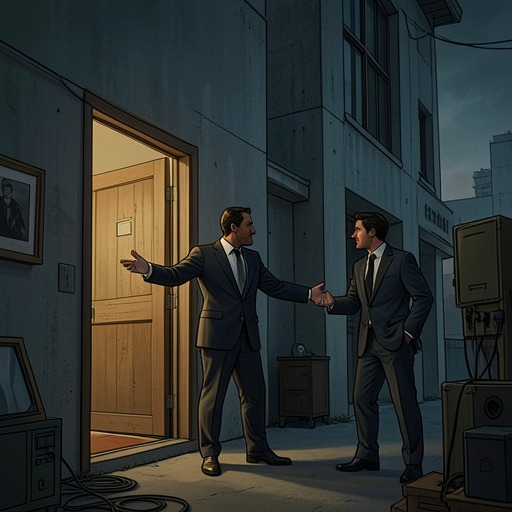
The immediate cause of William Henry Devereaux, Jr.’s stop is not a police pursuit. At the bottom of Pleasant Street Hill, he pulls into the gravel entrance to the rail yard and watches the only other car he has seen since leaving the restaurant struggle up the steep road. Its rear end slips sideways; after reaching a plateau, it pauses, then turns away. The little drama of hesitation and retreat catches his attention because he recognizes something of himself in the driver’s reluctance to continue. Once the car has gone, he looks across the dark yard at boxcars whose shapes suggest a buried city, with only the tops of its buildings showing through the snow.
The snow is falling heavily by then, wet flakes whitening the place where Tony’s car had been parked. William Henry Devereaux, Jr. thinks that the higher ground at Allegheny Wells is likely receiving even more snow. The setting makes the rail yard feel both exposed and strangely unreal: boxcars become an underground skyline, and the world seems to tilt. That imaginative shift leads into an old memory of his mother promising that the family would forget his father’s departure. The present night’s isolation therefore touches an earlier experience of absence, even as the immediate encounter with the police remains unexplained.
The Stop and Detention
A uniformed officer approaches through the snow, and William Henry Devereaux, Jr. notices the flashing blue and red lights of the cruiser in his rearview mirror. He provides his license when asked, and the officer checks it with a flashlight before shining the light in his face. Asked to get out of the vehicle, he agrees. Asked whether he has been drinking, he answers that he has; asked where he is going, he names Allegheny Wells, but the officer doubts that this is his real destination. The officer takes him by the elbow and puts him in the cruiser.
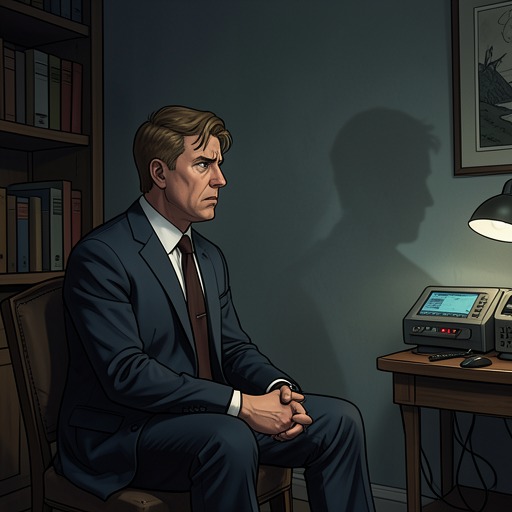
During the short drive to the station, the officer studies him in the rearview mirror. At first William Henry Devereaux, Jr. briefly suspects that the officer may be about to question him about suicidal thoughts, given that he had been sitting alone in the dark rail yard. Instead, the officer recognizes him as the “duck guy.” The recognition recalls his controversial campus persona, but in this encounter it is delivered with a grin rather than as an accusation. The brief exchange gives the arrest an incongruously familiar, almost local quality.
William Henry Devereaux, Jr.’s physical condition adds another kind of pressure to the stop. Earlier that afternoon, he had experienced a dramatic episode of urinary relief that soaked his office chair; by midnight, however, he is again painfully unable to urinate normally. The relief has lasted only briefly, and the return to painful dribbling leaves him angry and apprehensive. He is also waiting to speak with Phil Watson the following day about an examination that raised concern about an asymmetry in his prostate. He does not want the possibility of a tumor to be confirmed, though he recognizes that some part of him might thrill at receiving such news. Fear of illness and an unsettling attraction to life-changing news coexist without resolution as the officer brings him in.
The Drunk Tank and the Reversal
At the station, William Henry Devereaux, Jr. uses his one phone call to try Tony Coniglia. He reasons that Tony is responsible for the night’s predicament, but gets no answer. He considers calling Teddy Barnes, who might welcome a new story about him, but decides against it: Teddy would tell the story badly, and William Henry Devereaux, Jr. has been too cruel to him at dinner to ask for help. The old officer, noticing that his wife is not home, offers him a place in the drunk tank. William Henry Devereaux, Jr. insists that he has other people he could call, including academic deans, unwilling to let the officer read his situation as proof that he has no friends or colleagues.
The cell is nearly empty: on Monday night, its half-dozen cots have only one other occupant. The officer describes the arrangement as unusually comfortable, but William Henry Devereaux, Jr. soon understands the more important fact. Tony Coniglia did not answer because he is not at home. He is in the same cell. William Henry Devereaux, Jr. chooses not to wake him. Letting Tony discover the unexpected cellmate for himself preserves the morning’s comic surprise and gives the situation the shape of a small mystery: the simplest explanation is that Tony could not answer the phone because he was already there.
By morning, the coincidence becomes a shared story. Tony explains that he used his own phone call the previous night to leave a message on William Henry Devereaux, Jr.’s machine, believing that his friend would come and get him. William Henry Devereaux, Jr. grins as he admits that he called Tony too, and gives him aspirin from the Lincoln’s glove compartment. Comparing what happened, they learn that the same young officer detained both of them about half an hour apart and that neither has been charged. Tony says the officer had been prepared to book him until he identified himself as a professor and gave his name; the second encounter must have offered the officer another surprise.
Consequences and Significance
The detention links several strands of the night without settling them. William Henry Devereaux, Jr.’s worsening urinary trouble and anxiety about his prostate accompany his thoughts about death and about the possibility that his wife might leave him. He says he does not want to die, but imagines that receiving terrible news, or the prospect of an urgent new love for his wife, might move him in ways that a quiet future would not. These contradictory wishes do not cause the arrest, but they give his isolation at the rail yard an emotional charge before the police arrive.
The return to childhood memory deepens that charge. Looking at boxcars as if they were the remains of a city buried beneath the snow, William Henry Devereaux, Jr. recalls his mother’s assurance that the family would forget his father’s departure. His recollection turns on the silence of the rented university house after William Henry Devereaux, Sr. left, and on the boy’s retreat into the cellar. The present-day stop thus sits between two forms of uncertainty: the unresolved condition of his body and the old, only partly understood absence within his family.
The night ends, in the evidence available here, not with a charge or a formal resolution but with two friends waiting in the same cell and hoping to get on with the next day. The officer’s identification of William Henry Devereaux, Jr. as the duck figure from campus, the failed phone calls, and the reversal of the two men’s rescue plans turn detention into a compact comedy of mistaken expectations. Yet the joke does not erase the underlying unease: snow has cut the landscape down to a few visible shapes, the body has again become difficult to trust, and the memory of a family’s silence has resurfaced before dawn.