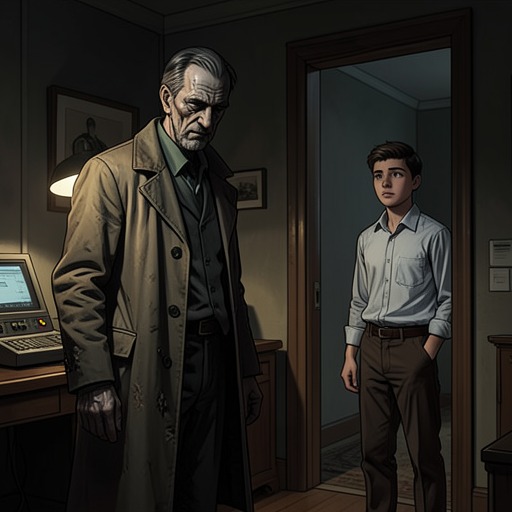
Hank's Mother
Straight ManHank's Mother is a columnist and the long-separated wife of William Henry Devereaux, Sr. In these episodes, she emerges as both a public storyteller and a determined organizer of private family affairs: while readers write to learn more about her husband, she makes plans for his library, living arrangements, and return to teaching. Her efforts do not erase the history of his departure, but they show how resolutely she treats his return as a chance to bring him back into a familiar life.
Public Profile and Family Story
Her presence in the narrative is first framed through the reception of a newspaper story about the family. After the paper publishes an account of the son’s first dog and its burial, the story’s author receives several times the usual volume of mail. Many readers ask about William Henry Devereaux, Sr., who appeared in the account as the father left standing at the newly dug grave after his son had killed the dog shortly after it was brought home. Hank's Mother objects to that portrayal, calling it unfair to her husband. Readers, however, respond sympathetically to him and ask for stories that focus on his life rather than on his son’s. The contrast places her within a family whose private history has become public material, while also showing that her own judgment of the story differs from the audience’s.
The newspaper describes her as already well known to its readers, with columns that attract far more mail than her son’s work. That detail establishes her as a writer with a substantial public following, not merely a subject in her son’s account. It also gives her objection to the dog story a particular weight: she is familiar with the power of a published portrayal to shape how readers understand a person. The son’s decision to continue his father’s story responds to readers’ interest, even as the family’s past remains filtered through his narration.
Marriage, Departure, and Return
The account traces the rupture in her marriage to William Henry Devereaux, Sr.’s departure for a young woman who had been a graduate student in his D. H. Lawrence seminar. Soon after the dog’s burial, he accepts a full professorship at Columbia University; the account presents that appointment and his new relationship as the two attractive offers that draw him to New York. It also situates his departure within a childhood shaped by his distinguished visiting-professor appointments, which had kept the family from settling in one place. The possibility that he wanted a settled life had been suggested by his wife, but he established that life elsewhere.
By the time she discusses his later collapse, she explains his history of relationships through the women’s academic specialties. After the D. H. Lawrence student, she identifies a Brontë scholar and a Joseph Conrad scholar, followed by a woman associated with Virginia Woolf. Her way of naming these relationships makes her husband’s scholarly world the organizing language for a deeply personal history. She believes the last woman contributed to his collapse and says that the woman took the money in his checking and savings accounts before leaving him. These are Hank's Mother's claims about the circumstances, not an independently confirmed account of the woman’s actions. In her telling, William Henry Devereaux, Sr. has been left financially depleted and emotionally unwell.
Plans for His Care and Work
Hank's Mother rejects the idea that the hospital’s assessment means her husband has recovered. She argues that remaining there would not help him and that he needs ordinary routines, familiar surroundings, his books, and conversation about subjects that matter to him. Her account links his condition to practical forms of support: a place he recognizes, access to his library, and intellectual company. She also notes that he cannot resume teaching until the fall, treating that delay as a constraint rather than as a reason to abandon the plan.
She has already begun acting on that plan. Hank learns that she intends to give a substantial part of his and Lily’s garage to William Henry Devereaux, Sr.’s private library, a decision that angers him because she has presumed they would agree. The exchange with Charles Purty reveals another small but telling friction: Hank asks whether his mother thanked Charles, who is helping with the boxes, and Charles says she has not yet done so because the work is unfinished. Her attention is on completing the arrangements; the conversation exposes how that purpose can leave other people’s contributions unacknowledged in the moment.
Her plan extends beyond storage and homecoming. When her son asks where his father might teach, she treats the answer as obvious: at the university, one course each semester. She has arranged to meet with Dickie Pope the following week to discuss it. The proposal gives her attempt to restore normalcy a concrete institutional form. It is not simply a wish that her husband feel better; she is trying to secure a role for him in the academic world that shaped his earlier life.
Determination and Narrative Role
Her meeting with her son on the way to view a house makes the force of her purpose visible without resolving the family’s old estrangement. After forty years of waiting for William Henry Devereaux, Sr. to return, she is looking at a two-story Victorian resembling the houses in which the family lived during his earlier years. The encounter occurs as her son approaches campus by a rear gate, and she appears with a realtor while pursuing the house. He recognizes its resemblance to the family homes of his childhood; she has pointed it out as part of the preparations for her husband’s return. The scene joins past and present through a practical choice of residence rather than through a reconciliation speech.
The son’s narration gives her determination an ambivalent edge. He is furious that she has made decisions involving his household and Lily’s garage, yet he also observes her acting on a hope she has maintained for decades. Her certainty that her husband needs familiar surroundings and her readiness to arrange housing and teaching sit beside the history of his leaving her for someone else. The evidence does not show whether her plans succeed or how their reunion develops. It does show her converting the long-awaited return into a set of immediate tasks, while her son’s resistance and the newspaper readers’ sympathy keep her efforts from becoming a simple story of uncomplicated reconciliation.