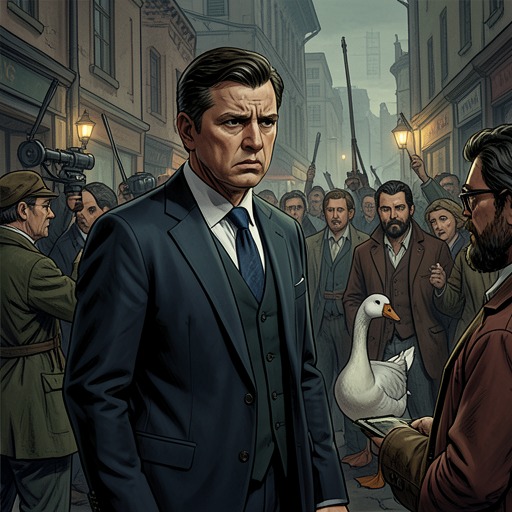
Hank’s televised protest holding Finny the goose
Straight ManWilliam Henry Devereaux, Jr.’s televised protest holding Finny the Goose transforms a budget dispute into a campus-wide public spectacle. Frustrated that his department lacks money for the composition courses it must teach, he seizes a live goose before a television camera and makes an ultimatum about killing a bird each day until the university provides a budget. The performance wins immediate applause, but its broadcast makes the goose’s treatment inseparable from the funding argument, setting up a new confrontation over what the protest means.
The Budget Dispute and the Television Setting
The protest takes shape in late spring, when Devereaux is already preoccupied with the university’s threatened cuts and the effect they could have on his department. He knows that, so far, he has mainly absorbed academic positions left vacant by retirements into his own budget, a practice that colleagues elsewhere regard as standard. But that limited maneuver does not solve the immediate problem: he has no budget for the adjunct instructors needed to cover freshman composition the following fall.
At the Campus Duck Pond, the contrast between university priorities becomes visible. Ducks and geese gather beside the water while a local television crew prepares to film a report connected with the dedication of the proposed Technical Careers Building. The reporter repeats her lead-in several times as the sound technician checks the audio, a routine production process unfolding beside the birds and the new-building project. Devereaux sees the millions committed to construction against the much smaller sum needed to fund the additional composition sections. He calculates that roughly a dozen sections would cost three thousand dollars apiece, yet the department still lacks the money to hire the staff.
The immediate disturbance is not a planned speech. The goose Devereaux has named Finny reacts angrily after the popcorn offered by a station worker runs out. When the camera turns toward Devereaux and his companion, Tony Coniglia, Finny nips Devereaux’s finger and follows his hand toward his jacket pocket. A pair of fake glasses and a nose, given to him by Charles Purty, are in the pocket; the goose pulls them out, and Devereaux has to wrest them back. The commotion draws the crew’s attention and helps turn an ordinary filming setup into an opening for his intervention.
The Protest and Its Ultimatum
Devereaux’s response is driven by a sudden convergence of anger, excitement, and a sense of righteousness. Before he has time to reconsider, he lifts the protesting goose and faces the camera. Wearing the fake nose and glasses, he presents himself as a department chair who wants to remain anonymous, then explains the mismatch between the university’s commitment to a multimillion-dollar building and its failure to fund the composition teaching required for the next term. He keeps the appeal concise for television, while the crowd grows and applauds.
He then makes the budget dispute an ultimatum: beginning Monday, he will kill one duck a day until he receives the money. He demands that the funds be delivered to his desk by Monday morning and threatens to serve the goose if they are not. The audience’s applause and Finny’s distress compete for the camera’s attention, while Devereaux’s disguise turns the chair into an apparently anonymous figure making a deliberately theatrical demand.
Among the people arriving from a limousine are campus executive officer Dickie Pope and state representative Jack Proctor, who is on crutches and has come to claim credit for the building project. Their presence brings university and political authority into the scene, but the assembled crowd is focused on Devereaux rather than the scheduled dedication. The television crew and spectators cheer him; the officials’ presence does not redirect the event or restore the ceremony’s intended focus.
Broadcast and Public Reaction
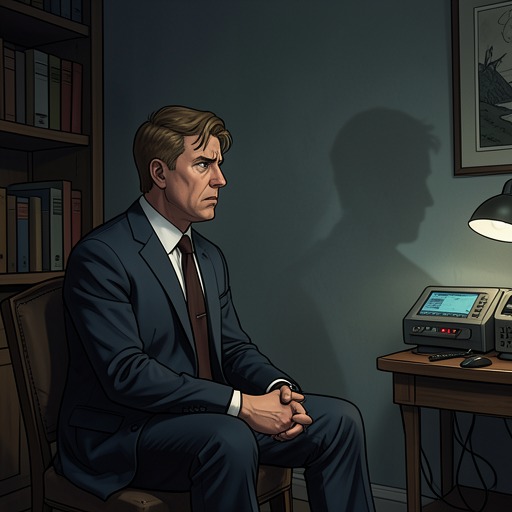
The station later airs the footage as part of its news coverage. At The Tracks, Devereaux sees a brief promotional glimpse of himself holding Finny before the full report begins. The editor has left much of his improvised speech in the broadcast, including the funding argument and the threat. In close-up, the fake nose and glasses do not read as an obvious comic disguise: the glasses look plausible, and the nose appears simply large. Devereaux realizes that viewers may not understand how deliberately he altered his appearance.
The televised image changes the balance between his intended message and the spectacle carrying it. On screen, a middle-aged English professor holds a frightened goose; the bird’s bulging eyes and flapping convey menace more immediately than a departmental budget does. In the bar, however, the audience treats the clip as a comic triumph, applauding and making Devereaux stand for a bow. When Pope and Proctor appear, the crowd boos over their remarks, and the station cuts away to its studio presenters. For the moment, Devereaux is celebrated as a hero by the people watching with him.
Aftermath and Significance
The favorable reception is short-lived. The next day, a large group of protesters has gathered at the place where Devereaux faced the cameras. Placards, chanting, ducks, and geese combine into a noisy demonstration; the television crew has returned, and Missy Blaylock is with it. A crew member warns Devereaux that the animal-rights protesters are serious. The protest has therefore widened beyond whether the university will fund composition courses: the birds placed at the center of his televised threat now make their welfare a public issue.
The episode’s reversal depends on the same media exposure that first appears to validate Devereaux. His sharp contrast between the costly building and the unfunded classes reaches an audience, and the crowd’s response briefly turns him into a campus celebrity. Yet the camera also preserves the image of his hand around a goose and gives the threatened animal a visible presence that the budget figures cannot compete with. The stunt makes institutional neglect legible through a comic, startling performance, but it also lets the spectacle overtake the argument. Its immediate consequence is not a demonstrated budget settlement; it is a new round of public scrutiny and protest directed at Devereaux’s treatment of the birds.